
 pls help
Please log in to comment and participate in discussions.
Comments (11)
okay mujhe acche se yaad nahi(i havent done lr in like a month) but we were taught that there's a specific way to approach ques like these. you should check out yt vids on this cuz it has formulae and patterns you need to apply here
can you share 1-2 videos? can't find anything similar to these ;-;
im sorry i couldnt find any TT i actually did it in my coaching last yr. mb i thought yt would also have vids on this
Coin / Match-stick Games : Important Questions | LRDI | CAT 2026 Preparation
Games and Tournaments: The Coin Game | LRDI Basics to Advanced | CAT 2027 | Ravi Sir
take a look at these tho they seem kinda similar
Academic discussion and doubt solving for: Tournaments, Arrangements, Puzzles, Bar Graphs, Tabular Data
Members can post and comment here, and get these posts in their Latest feed.
Moderators
Join AfterBoards
Create an account to join our community and participate in discussions.
- • Connect with peers
- • Resolve doubts
- • Learn more about admissions
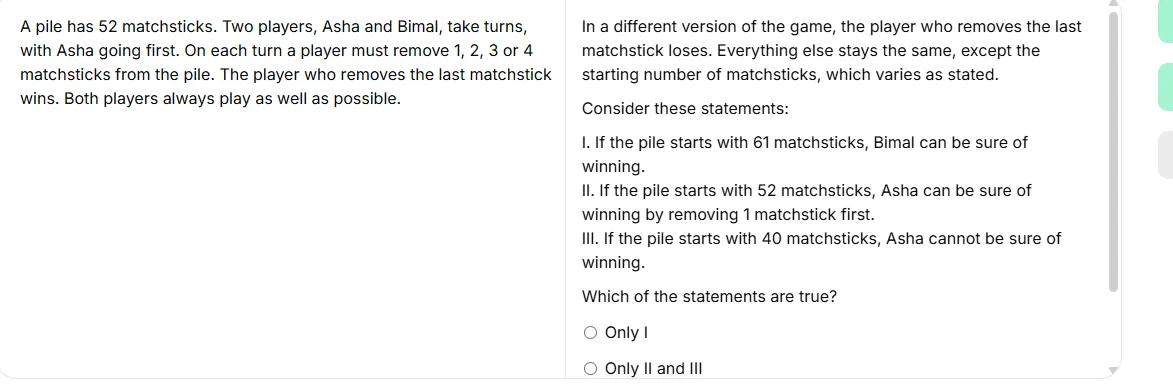
In this game you want to force your opponent to take the very last matchstick.
On each turn, players can take 1 to 4 matchsticks.
Because 1 + 4 = 5, you can always control the game in groups of 5 (whatever your opponent picks, you pick enough to make the round add up to 5).
For eg, start with small piles:
1 matchstick: the player whose turn it is must take it and lose.
2–5 matchsticks: the player can leave 1 for the opponent and win.
Now, to leave 1 final matchstick for your opponent at the end, you want to always leave them with a number that ends in 1 or 6 (which is just 1 more than a multiple of 5: 1, 6, 11, 16, 21 ... 51, 61).
If your opponent starts their turn on a number ending in 1 or 6, they are trapped and will lose.
Now try solving it :))
What if the question instead changed the specific number we can pick, for eg 1, 2 or 4
Let's say we have number 5 to 10 instead of 1 to 4, so you can make each pair of turns total 15:
If taking the last matchstick wins, you can therefore guarantee a win by leaving your opponent a multiple of 15.
For the original pile of 52:
Remove 7 first → leave 45.
Then respond using the table. After each pair of turns, the pile becomes:
45 → 30 → 15 → 0
You take the last matchsticks and win.
The pairing number is smallest allowed move + largest allowed move = 5 + 10 = 15.
how do u find that number like 5 in first case 15 in the second, also what if they are non consecutive such as 1,2 and 4, like the one in mock Beta.
5 and 15, are smallest + largest, (1 to 4 so 1+4 = 5 in first one and 5 to 10 so 5 + 10 = 15 in second) use it in this type of question (where you have consecutive integers)
In non consecutive like the one you gave 1,2 and 4, you need to discover a pattern, by using smaller piles
If taking the last matchstick wins:
The losing positions are 0, 3, 6, 9, 12, …, the multiples of 3.
Also look why that pattern continues:
From a multiple of 3, removing 1, 2 or 4 always leaves a number that is not a multiple of 3.
From any non-multiple of 3, you can remove 1 or 2 to leave a multiple of 3.
So, with 52 matchsticks, Asha removes 1, leaving 51, and keeps returning the pile to a multiple of 3.
If taking the last matchstick loses, the pattern shifts: the losing positions become 1, 4, 7, 10, …. In that version, 52 is a losing position for Asha.
Thank you cause same type of que came in ugat
So glad to hear, while making it I knew one of this or josephus would definitely be there :))