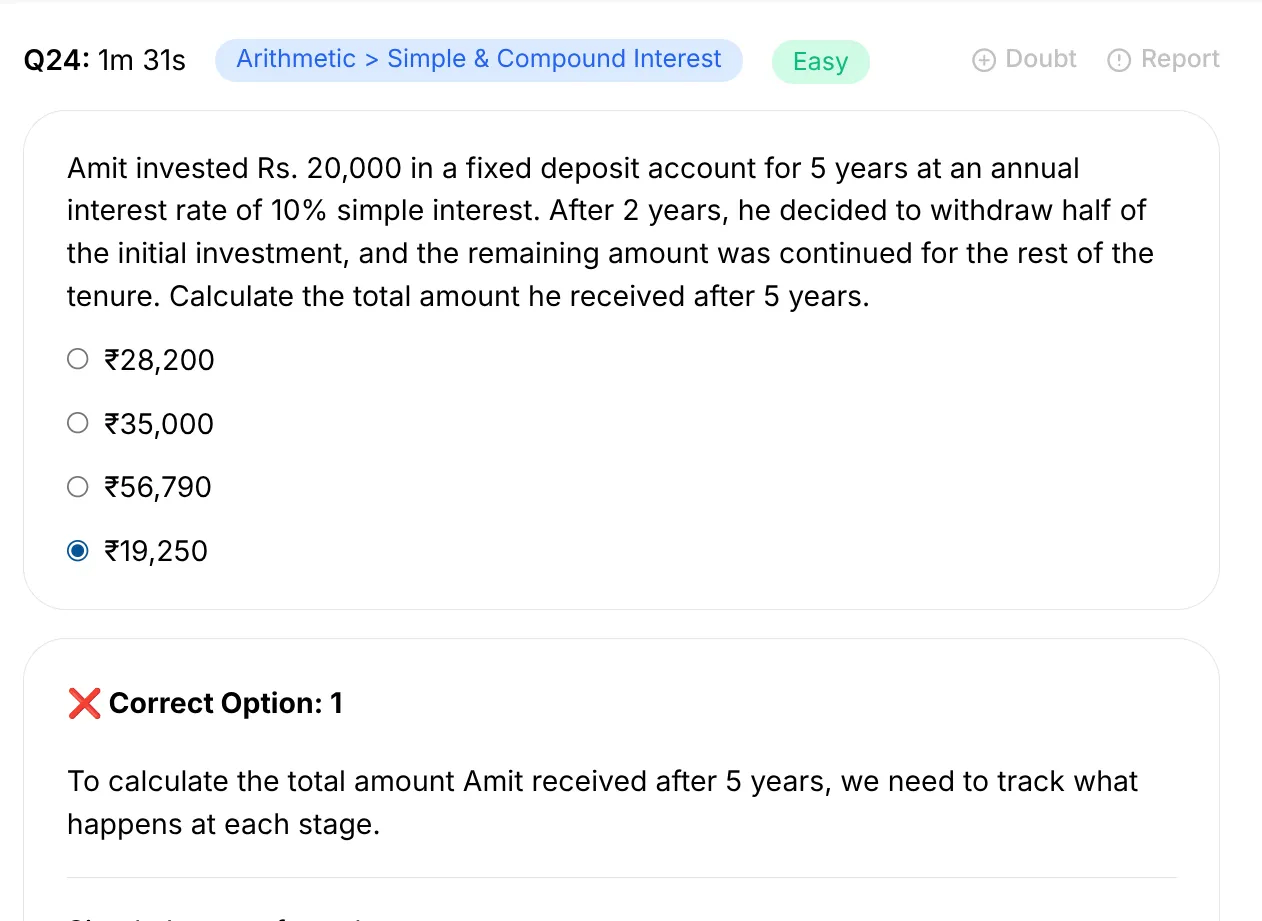
 the question asked for the total amount he received after 5 years , shouldn't the amount be 18200?? Because he already withdrew 10000 at the end of 2 years ??
Please log in to comment and participate in discussions.
Academic discussion and doubt solving for: Percentages, Ratios, Time & Work, Averages, Time/Speed/Distance, Mixture/Alligation, Profit/Loss, Simple/Compound Interest.
Create an account to join our community and participate in discussions.

The initial investment itself it 20000. How can the final amount be less than that.
For the first two years, interest was 10% of 20000 for two years. So interest accumulated was 4000.
He withdrew 50% of initial capital so 10000 + 4000 interest on initial capital. This is the new capital. So, 10% of 14000 for three years will be 4200.
Total amount will be = 20000 + 4000 + 4200 = 28200
I'm assuming you're thinking that by "withdrawing" they are literally taking it out and using it or whatever. That's not what the question means. It simply means that they took it out of the fixed deposit, thus no interest will be given on it. Amount mei to add hoga na wo.
Yes that's what I was thinking , by 'withdrawing' ,I thought it meant he literally took it out , but if he just took it out of the FD and didn't actually take it , then the amount should be 28200, but how do we know he only took it out of the FD and not actually take it , I mean the question is a bit ambiguous right?
From the way it is written, that can be inferred so yes, it is ambiguous and I don't blame you. But once again, if this would have been the case the question would usually mention it clearly. To be on the safer side, just calculate for both cases if you'reunsure, but 99% of the times, you shouldn't assume as the question simply doesn't mean that.
Yeah , got that , thank you