Please log in to comment and participate in discussions.
Academic discussion and doubt solving for: Percentages, Ratios, Time & Work, Averages, Time/Speed/Distance, Mixture/Alligation, Profit/Loss, Simple/Compound Interest.
Create an account to join our community and participate in discussions.

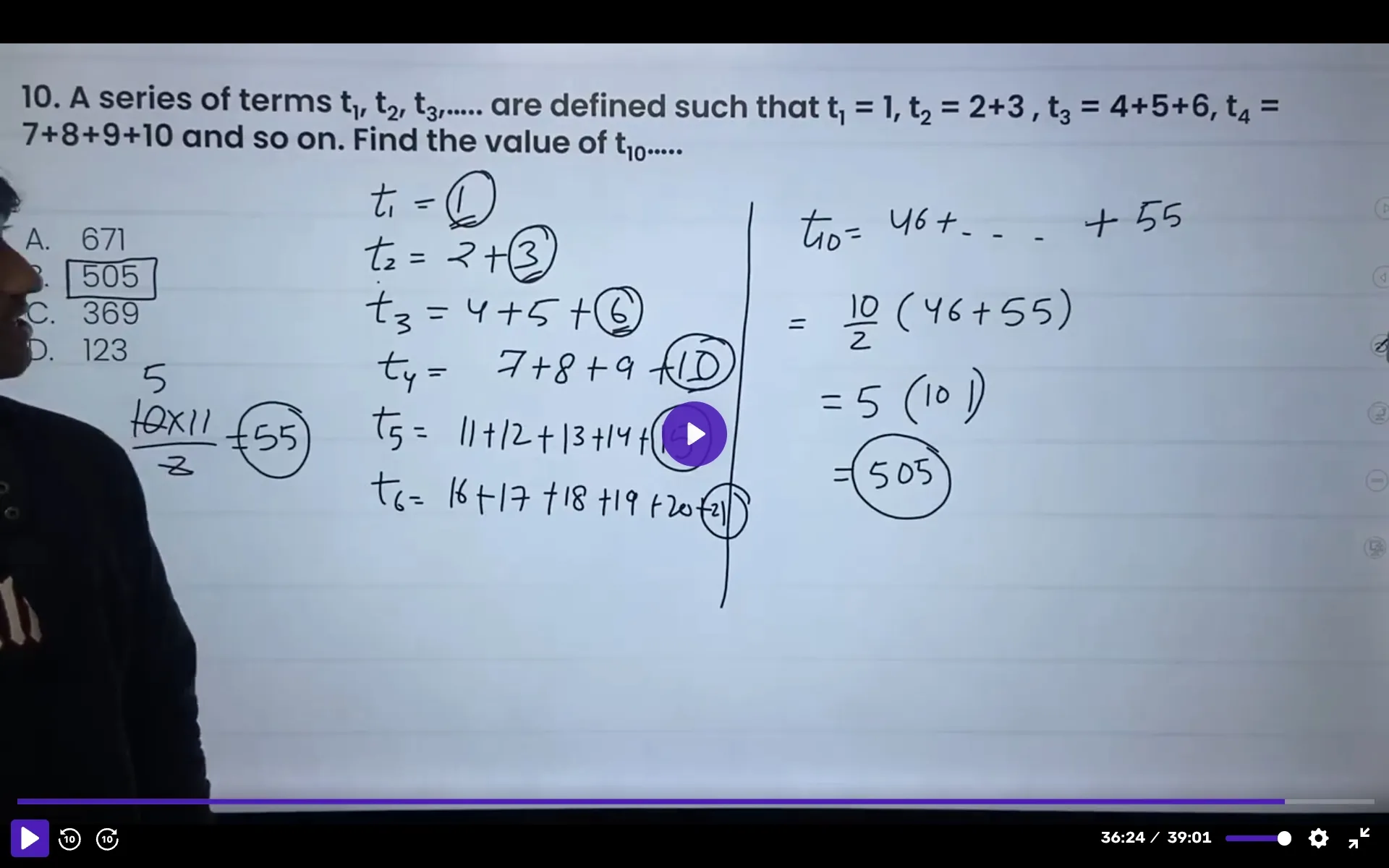 Didn't get the solution at all any method or newer approach?
Hey! I totally get why this series problem feels confusing at first glance. Sadly there is no fast way to do questions like these, they usually rely on finding the patterns. Here's the solution, let me know if you feel stuck in a particular part (also this question is from Algebra, please post it in the correct farmhouse next time, you're in Arithmetic currently!) Looking at the given terms:
Each term is the sum of consecutive integers, and the number of integers being added increases by 1 each time.
Notice how the starting numbers are: 1, 2, 4, 7... The differences between consecutive starting numbers are: 1, 2, 3... (increasing by 1 each time)
For t10, we need the sum of 10 consecutive integers. But where do we start? Following the pattern:
So t10 = sum of 10 consecutive integers starting from 46 t10=46+47+48+49+50+51+52+53+54+55 Instead of adding these one by one, use the formula for sum of consecutive integers: Sum = 2n×(first term+last term) Where n = 10, first term = 46, last term = 55 t10=210×(46+55)=5×101=505Answer: 505 (Option B)
Gotcha!!but what if it was t30 or somewhat like that so we have to find till t29 or any other way out
Yaa...mb posted in wrong farmhouse
If you want to find the starting point of the 30th group, you need to find the total numbers used until the 29th group.
Group 1: (1) → 1 number
Group 2: (2, 3) → 2 numbers
Group 3: (4,5,6) → 3 numbers
Each group contains consecutive natural numbers
So the nth group contains n numbers.
Using our pattern: 29th group has 29 numbers
Count all numbers from groups 1 through 29.
Total numbers used = 1+2+3+4+...
This is the sum of the first 29 numbers.
Sum of first n numbers = n(n+1)/2
Therefore: Numbers used in first 29 groups = 29(30)/2=435
Since 435 natural numbers have been used in the first 29 groups, the 30th group starts with the 436th natural number.
You can verify this with t10
For t10, you need numbers until the 9th group $$= 9(10)/2 = 45$
This matches our result.
Hope it made sense.