Please log in to comment and participate in discussions.
a
Academic discussion and doubt solving for: Percentages, Ratios, Time & Work, Averages, Time/Speed/Distance, Mixture/Alligation, Profit/Loss, Simple/Compound Interest.
Create an account to join our community and participate in discussions.

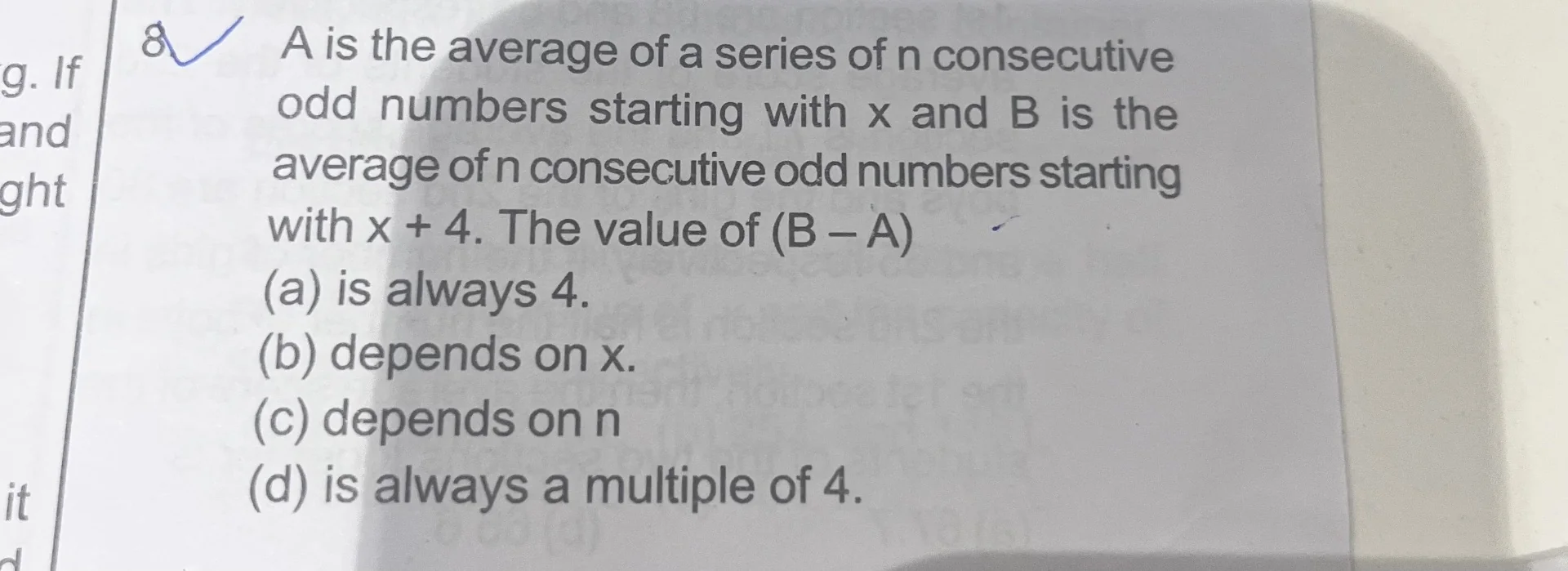
Setting up A: The n consecutive odd numbers starting with x are: x, x+2, x+4, ..., x+2(n-1)
For an arithmetic sequence, the average equals the middle term (or average of first and last terms):
Setting up B: The n consecutive odd numbers starting with x+4 are: x+4, x+6, x+8, ..., (x+4)+2(n-1)
Using the same logic:
Finding B - A: B - A = (x + n + 3) - (x + n - 1) = 4
Verification (and you'll cry once you know that you could have just assumed lol): Let's check with x = 1, n = 3:
The answer is (a) is always 4.
This makes intuitive sense: when you shift an arithmetic sequence by a constant amount (here by 4), the average shifts by that same amount, regardless of x or n.
could have just assumed. cry