
Please log in to comment and participate in discussions.
Comments (5)
IPMAT/Algebra
Academic discussion and doubt solving for: Progression & Series, Inequalities, Linear Equation, Functions, Modulus, Minima & Maxima, Polynomials, Identities, Indices
1693Members
73
Online
Members can post and comment here, and get these posts in their Latest feed.
Moderators
Join AfterBoards
Create an account to join our community and participate in discussions.
- • Connect with peers
- • Resolve doubts
- • Learn more about admissions
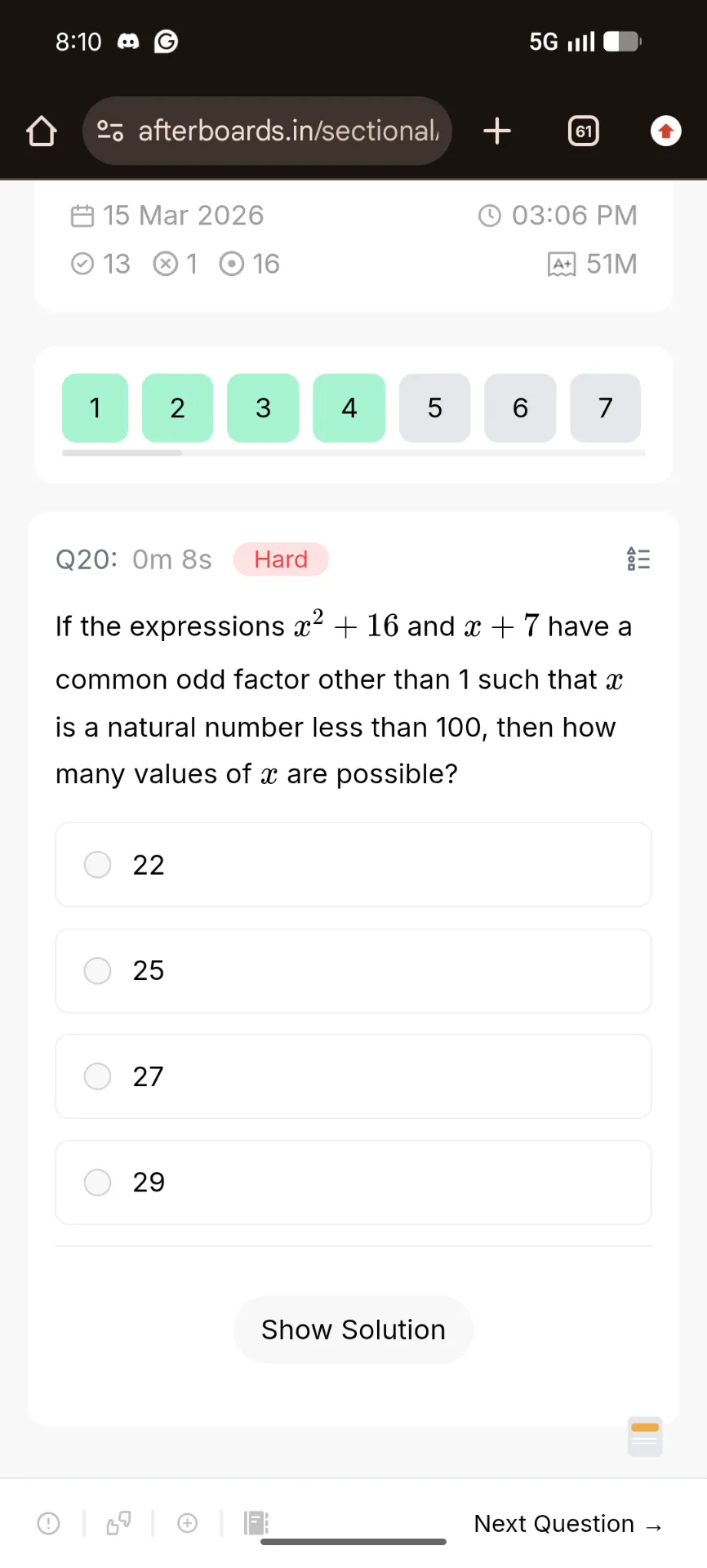
Let the common odd factor be k. Since k divides x + 7, it must also divide any multiple of it, such as (x + 7)(x - 7) = x^2 - 49.
If k is a factor of both x^2 + 16 and x^2 - 49, it is mathematically required to also divide their difference:
(x^2 + 16) - (x^2 - 49) = 65
The prime factorization of 65 is 5 times 13. The odd factors (excluding 1) are 5, 13, and 65. Therefore, the original expression x + 7 must be a multiple of 5 or 13.
For natural numbers x < 100 (values from 1 to 99), we just count the possibilities:
Multiples of 5: x must end in 3 or 8 (3, 8, 13,...., 98). This gives 20 values.
Total unique values = 20 + 8 - 1 = 27.
Ohhh, didn't think this that way ... Btw thanks, Swayam bhai
how tf dyk ma name lmfao
Ahh, you don't know me, but I know you very well..
bro-