
Please log in to comment and participate in discussions.
Comments (10)
You can refer to the playlist below to get a better understanding of such qns.
https://www.youtube.com/watch?v=oFDNfUNc8l0&list=PLVVVfitxrCHxItC3h6N5wF9R6XVJT-21b
Thank you 😊
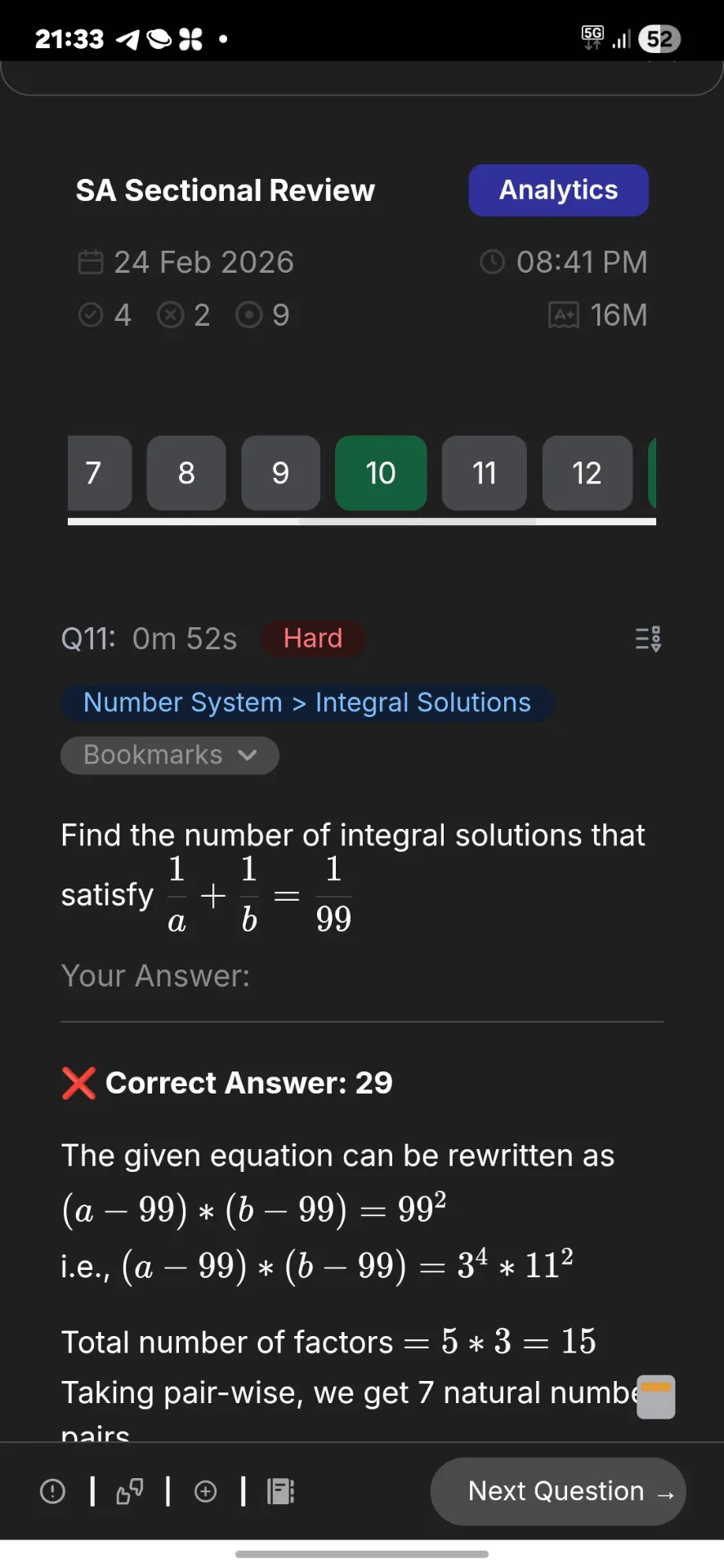
the equation is
1/a + 1/b = 1/99
first combine the fractions
(a + b) / ab = 1 / 99
now cross multiply
99(a + b) = ab
rearrange
ab - 99a - 99b = 0
now use a small algebra trick - add 99^2 to both sides so it factors nicely
ab - 99a - 99b + 99^2 = 99^2
this becomes
(a - 99)(b - 99) = 99^2
and
99^2 = 9801
so now the question becomes - how many integer pairs multiply to 9801?
prime factorize 99
99 = 3^2 x 11
so
99^2 = 3^4 x 11^2
number of positive factors = (4 + 1)(2 + 1) = 5 x 3 = 15
each factor pairs with another factor - so 15 positive pairs
since negative x negative = positive, we also get 15 negative pairs
total = 30
but one case gives a = 99 and b = 99, which does not work in the original setup
so final answer = 29
Ok i understand it except the last point
Why 99 99 wala case is not considered
The 99,99 case would mean a = 99 and b = 99 in the original equation. But that gives 1/99 + 1/99 = 2/99, which is not 1/99. So a = b = 99 is simply not a solution, that’s why it’s not counted.
Academic discussion and doubt solving for: Progression & Series, Inequalities, Linear Equation, Functions, Modulus, Minima & Maxima, Polynomials, Identities, Indices
Members can post and comment here, and get these posts in their Latest feed.
Moderators
Join AfterBoards
Create an account to join our community and participate in discussions.
- • Connect with peers
- • Resolve doubts
- • Learn more about admissions
https://youtube.com/shorts/RWWLp6zpmHI?si=hru5AImqfciy_8A0 use this trick i got 15 and taking as pair will be 15 plus 15 as 30 subtract 1 get 29..
Thankyou
Why did you take the pair and then subtract it by 1?