
Please log in to comment and participate in discussions.
Comments (1)
IPMAT/Algebra
Academic discussion and doubt solving for: Progression & Series, Inequalities, Linear Equation, Functions, Modulus, Minima & Maxima, Polynomials, Identities, Indices
1693Members
103
Online
Members can post and comment here, and get these posts in their Latest feed.
Moderators
Join AfterBoards
Create an account to join our community and participate in discussions.
- • Connect with peers
- • Resolve doubts
- • Learn more about admissions
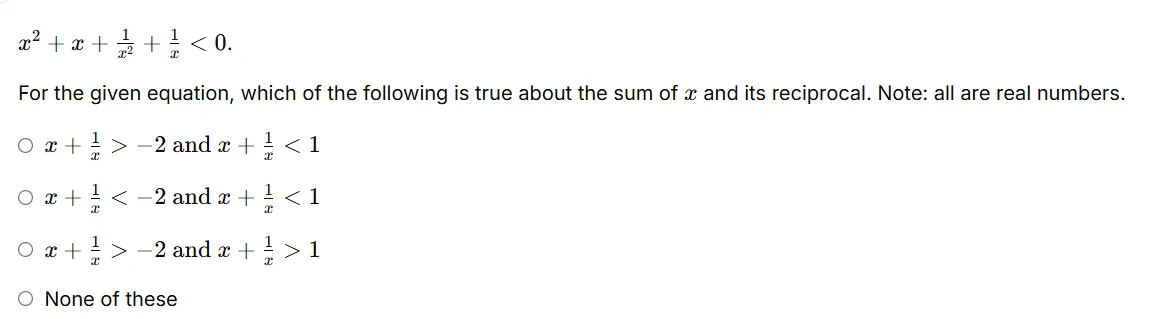
The main thing to notice here is that (x^2+(1/x)^2)= ((x+(1/x))^2)-2. Now we can take (x+(1/x)) as 'a'. This will let us handle the sum more easily.
(x^2)+(x)+(1/x^2)+(1/x)<0
((a^2)-2)+a<0.... assuming (x+(1/x)) as 'a' and using the above mentioned identity. Now this becomes a simple inequality involving a quadratic.
a^2+a-2<0
(a+2)(a-1)<0
This implies that a is between -2 and 1.
Now, what was 'a'? This was the sum of x and its reciprocal. That means that the sum of x and its reciprocal is between -2 and 1. Hence, the correct answer must be option A. Is that right?