
aloo_samosa
SSCBS
How did the solution assume this?
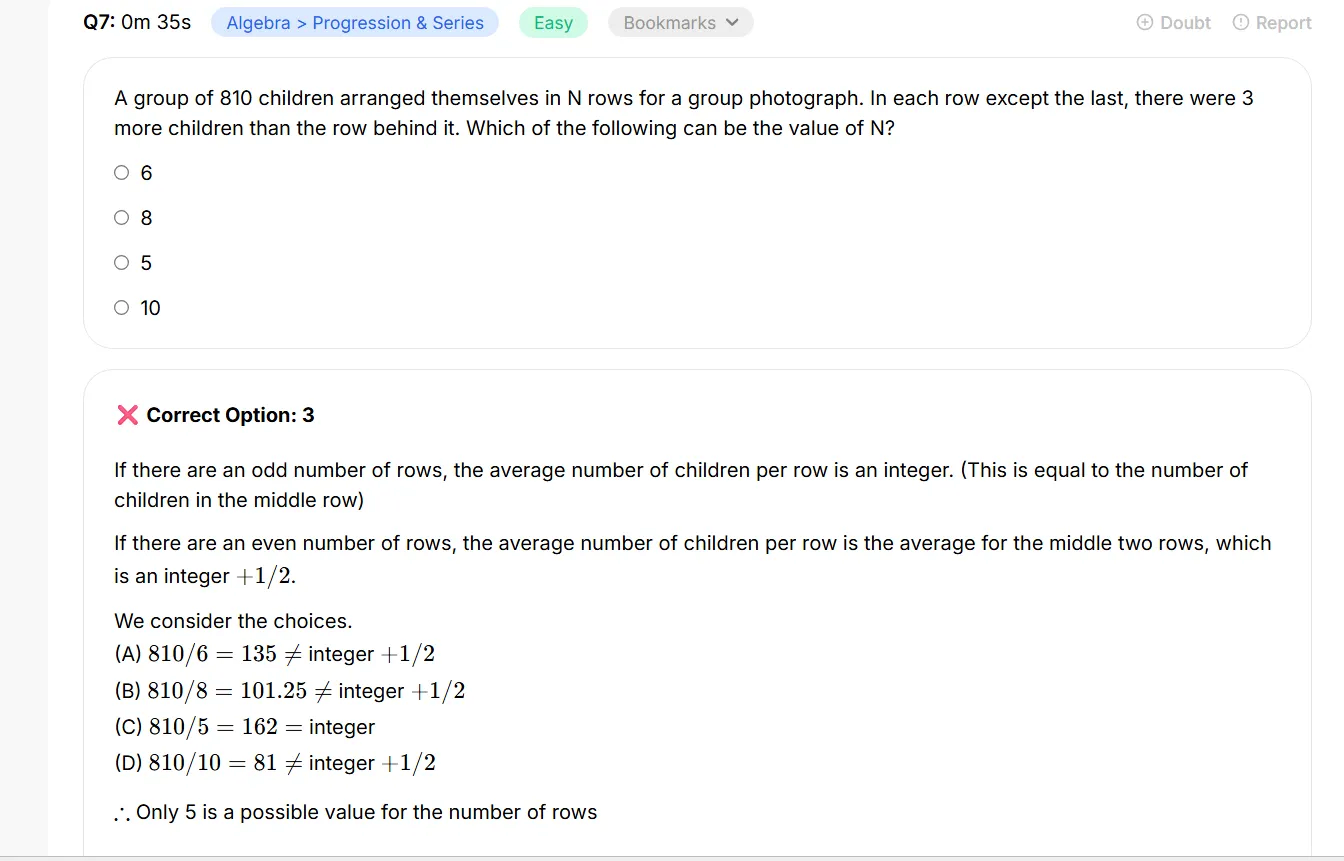 How come the solution is starting with these statements? What about the exception of one row I did not understand this sol
1
Please log in to comment and participate in discussions.
Comments (2)
IPMAT/Algebra
Academic discussion and doubt solving for: Progression & Series, Inequalities, Linear Equation, Functions, Modulus, Minima & Maxima, Polynomials, Identities, Indices
1719Members
58
Online
Members can post and comment here, and get these posts in their Latest feed.
Moderators
Join AfterBoards
Create an account to join our community and participate in discussions.
- • Connect with peers
- • Resolve doubts
- • Learn more about admissions
The formula for the sum of an AP is:
Sn=2n[2a+(n−1)d]
810=2N[2a+(N−1)3]
1620=N[2a+3(N−1)]
2a+3(N−1)=N1620
2a=N1620−3(N−1)
Test the Options:
For a solution to be valid, a must be a positive integer. This means 2a must be an even integer.
Test N=6:
2a=61620−3(5)=270−15=255
Since 255 is odd, a would be 127.5 (Not an integer). Invalid.
Test N=8:
2a=81620−3(7)=202.5−21=181.5
Not an integer. Invalid.
Test N=10:
2a=101620−3(9)=162−27=135
Since 135 is odd, a would be 67.5. Invalid.
Test N=5:
2a=51620−3(4)=324−12=312
a=2312=156
Since 156 is a whole number, this works! Correct.
Conclusion: Only N=5 allows for a whole number of children in each row.
The phrase "except the last row" is just technical wording.
In any sequence where numbers change by a constant amount (like 3), the Average of all the numbers has a specific behavior:
We check the total (810) divided by each option (N):
Option (B) N=8 (Even): 810÷8=101.25.
Option (C) N=5 (Odd): 810÷5=162.
Option (D) N=10 (Even): 810÷10=81.