
aloo_samosa
SSCBS
I did not understand the solution provided by AB
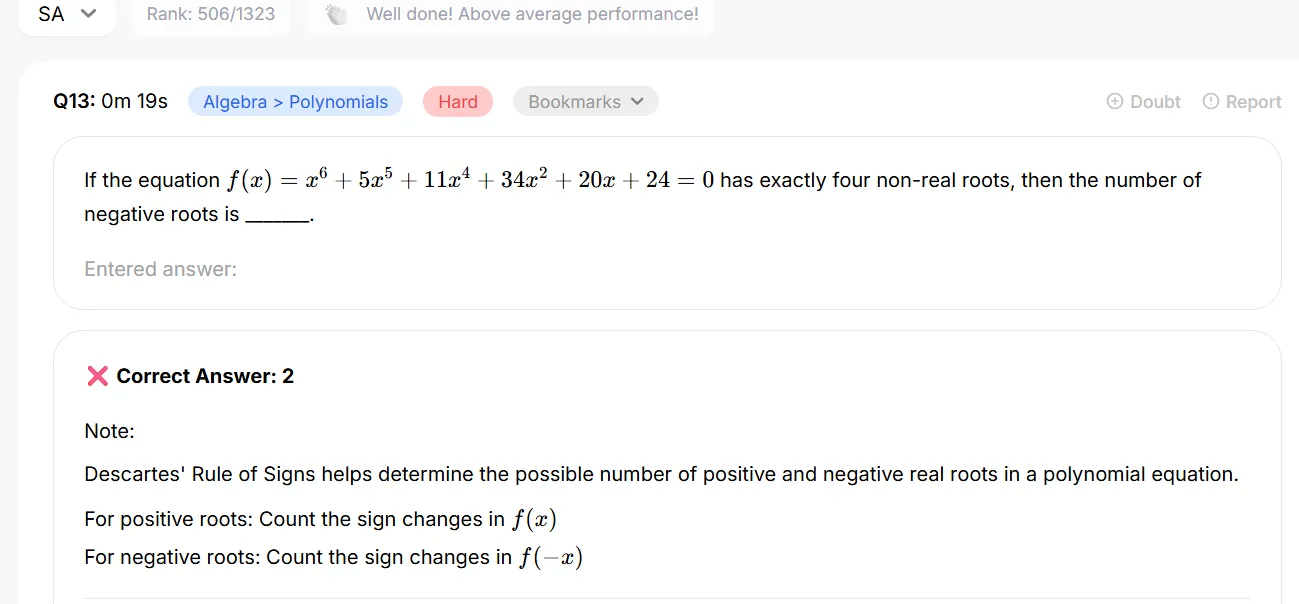 Is there any other way to understand this question? I did not get the one provided by them
1
Please log in to comment and participate in discussions.
Comments (1)
IPMAT/Algebra
Academic discussion and doubt solving for: Progression & Series, Inequalities, Linear Equation, Functions, Modulus, Minima & Maxima, Polynomials, Identities, Indices
1723Members
124
Online
Members can post and comment here, and get these posts in their Latest feed.
Moderators
Join AfterBoards
Create an account to join our community and participate in discussions.
- • Connect with peers
- • Resolve doubts
- • Learn more about admissions
According to the Fundamental Theorem of Algebra, a polynomial of degree n has exactly n roots (including real and non-real/complex roots).
We now know there are exactly 2 real roots. These 2 roots must be either positive, negative, or zero.
Testing for Positive Roots (x>0)
Look at the polynomial:
f(x)=x6+5x5+11x4+34x2+20x+24
Notice the coefficients: 1, 5, 11, 34, 20, and 24.
Testing for Zero (x=0)
If we plug in x=0:
f(0)=0+0+0+0+0+24=24
Since f(0)=0, zero is not a root.
Solving the Mystery
We can now summarize the types of roots in a simple table: