
Please log in to comment and participate in discussions.
Comments (6)
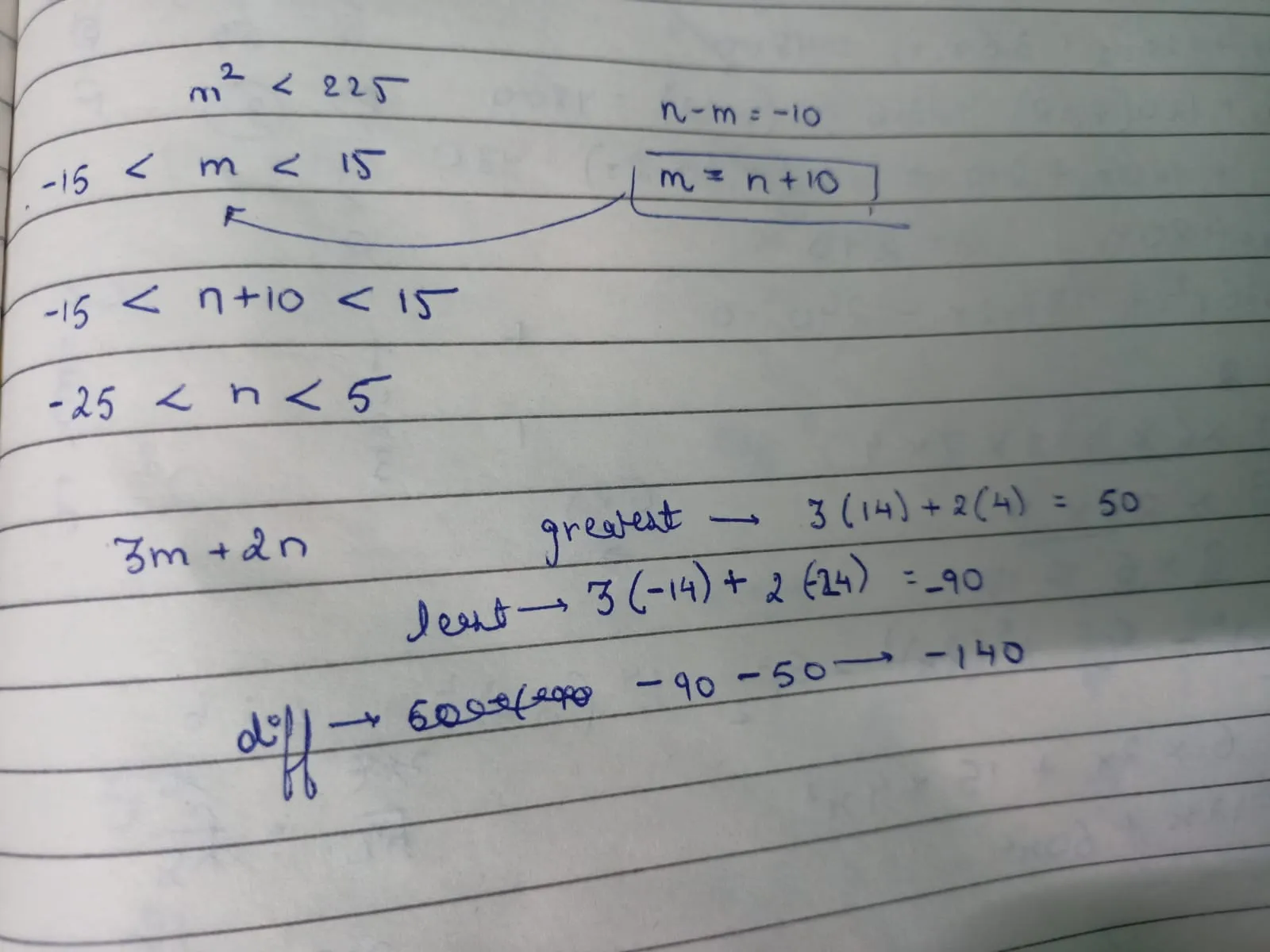
i think the mistake is using extreme values of m (−14, 14) whereas m can’t actually take boundary values
but the actual extremes are (-15,15), I've taken the closest integer within the range.
ah that's where you went wrong, use the corner(boundary), you will get -95 and -55. you musn't take the boundary values. Take -94 and -54. By taking the closest integer, you are missing out on values that are in between.
Oh! now I get it. I understood where I fumbled. Thanks a lot.
Academic discussion and doubt solving for: Progression & Series, Inequalities, Linear Equation, Functions, Modulus, Minima & Maxima, Polynomials, Identities, Indices
Members can post and comment here, and get these posts in their Latest feed.
Moderators
Join AfterBoards
Create an account to join our community and participate in discussions.
- • Connect with peers
- • Resolve doubts
- • Learn more about admissions
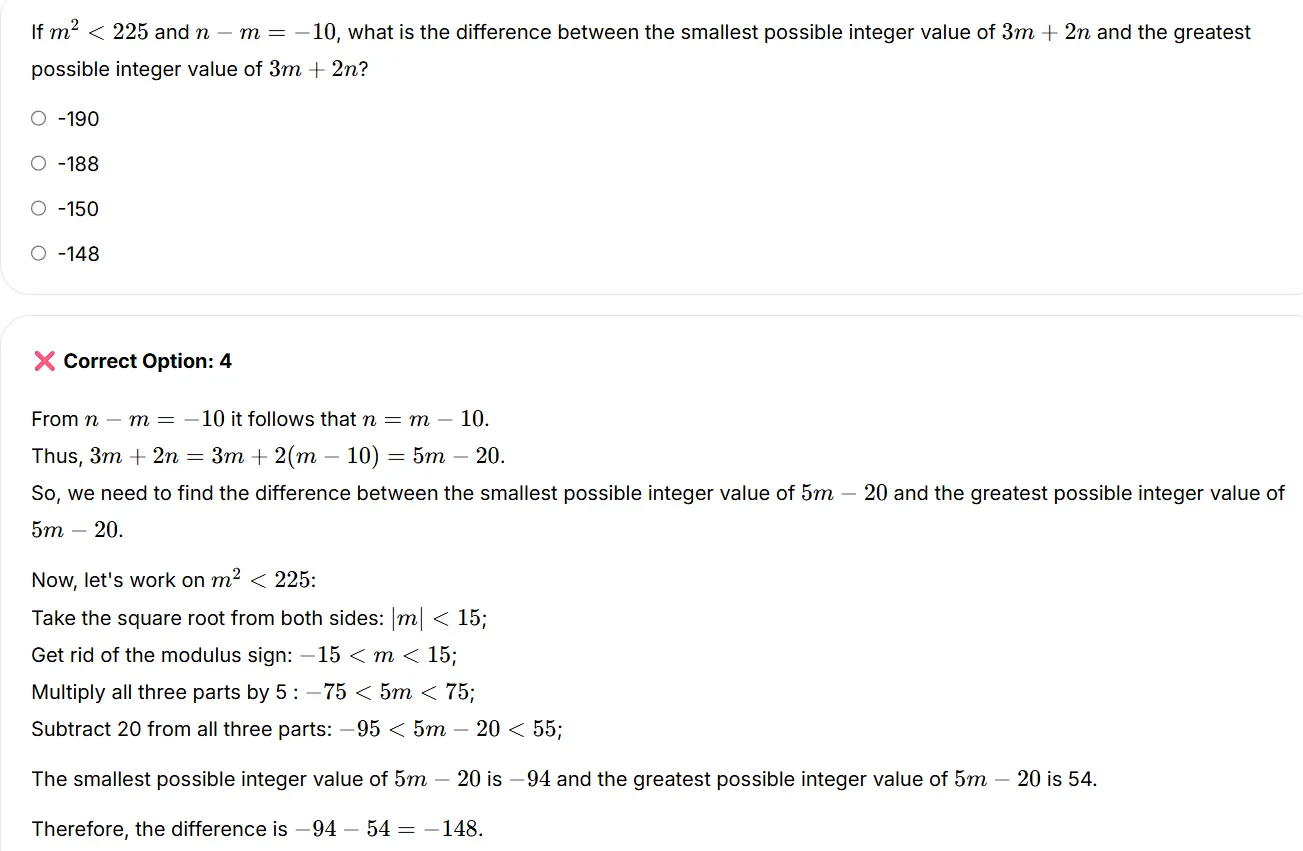
The mistake is in how you’re picking extreme values.
From n − m = −10, you correctly get n = m − 10, so
3m + 2n = 5m − 20
Now the key point is that m² < 225 gives −15 < m < 15, but m has to be an integer, so m ranges from −14 to 14.
Since 5m − 20 is increasing in m,
maximum will be at m = 14 → 5(14) − 20 = 50
minimum will be at m = −14 → 5(−14) − 20 = −90
Difference = −90 − 50 = −140, but this is not the answer because the question asks for smallest and greatest possible integer values of the expression, not just plugging extreme m directly without checking the full valid range impact on the expression.
Correct way is to directly apply bounds:
−15 < m < 15
→ −75 < 5m < 75
→ −95 < 5m − 20 < 55
So smallest integer = −94, greatest = 54
Difference = −94 − 54 = −148
So you mean the greatest and the least values are not at the extreme ends?