
Please log in to comment and participate in discussions.
Comments (1)
IPMAT/Algebra
Academic discussion and doubt solving for: Progression & Series, Inequalities, Linear Equation, Functions, Modulus, Minima & Maxima, Polynomials, Identities, Indices
1693Members
153
Online
Members can post and comment here, and get these posts in their Latest feed.
Moderators
Join AfterBoards
Create an account to join our community and participate in discussions.
- • Connect with peers
- • Resolve doubts
- • Learn more about admissions
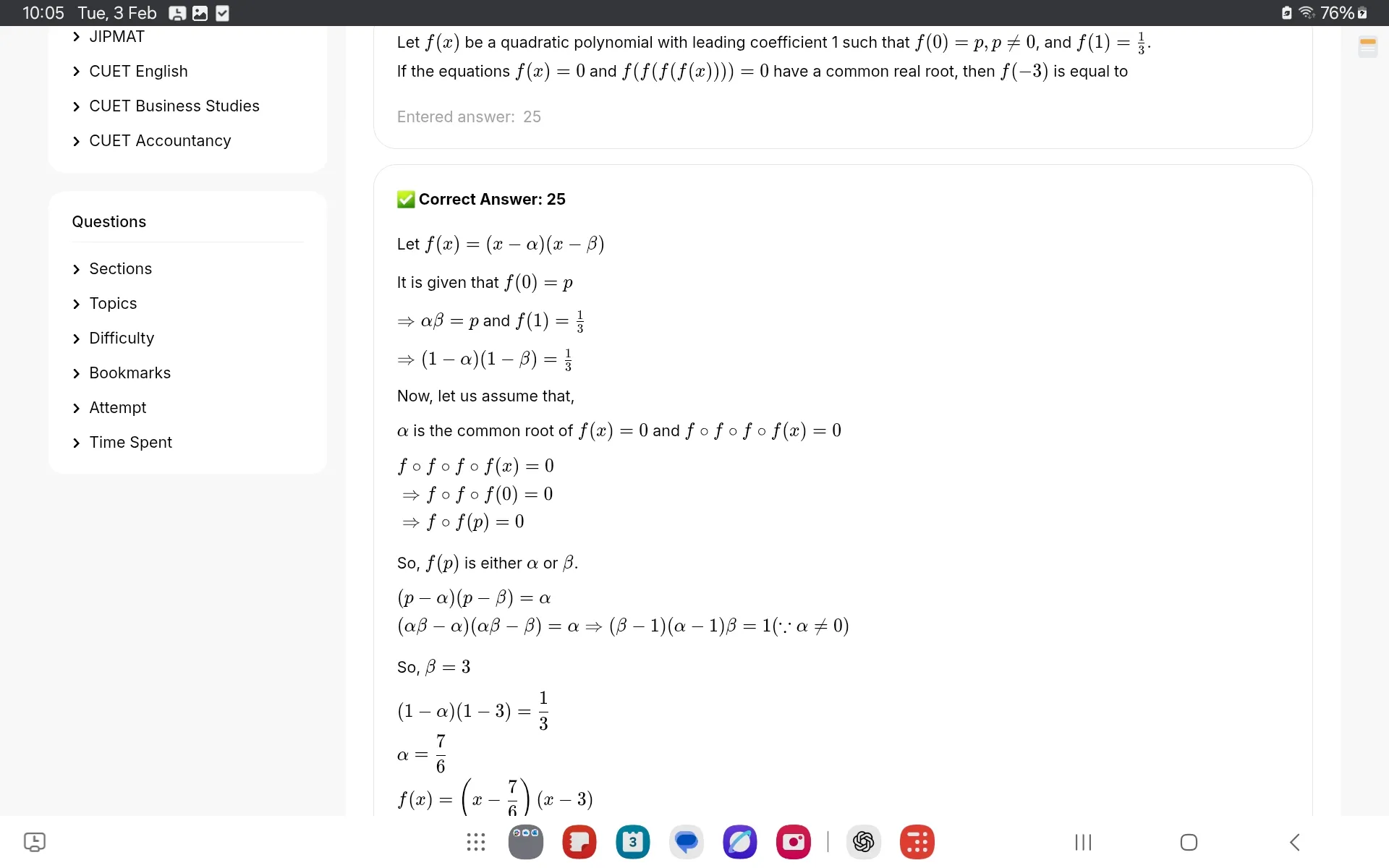
A quadratic polynomial with a leading coefficient of 1 looks like this:
f(x) = (x - a)(x - b) To make this even easier to read, let’s replace those Greek letters with a and b.
We use the clues given in the problem to find the actual numbers for a and b:
From f(0)=p: We find that a×b=p.From f(1)=1/3:
We get the equation (1−a)(1−b)=1/3
The problem says f(x)=0 and f(f(f(f(x))))=0* *share a root.
If we call that root a, then f(a)=0.
Plugging this into the chain:
f(f(f(f(a))))=f(f(f(0)))=f(f(p))=0*.*
For f(f(p)) to be 0, the result of f(p) must be one of our roots (a or b).
By solving (p - a)(p - b) = a along with our other equations, we find:
f(x) = (x - 7/6)(x - 3)
o find f(−3), we just plug in -3 for x:
f(-3) = (-3 - 7/6)(-3 - 3)
f(-3) = (-25/6)(-6)
f(-3) = 25