
Please log in to comment and participate in discussions.
Comments (4)
M
manthanagar
•1yr
B)20
1
N
nahi_batunga
OP•1yr
Nope
1
IPMAT/Algebra
Academic discussion and doubt solving for: Progression & Series, Inequalities, Linear Equation, Functions, Modulus, Minima & Maxima, Polynomials, Identities, Indices
1778Members
255Posts
Members can post and comment here, and get these posts in their Latest feed.
Moderators
Join AfterBoards
Create an account to join our community and participate in discussions.
- • Connect with peers
- • Resolve doubts
- • Learn more about admissions
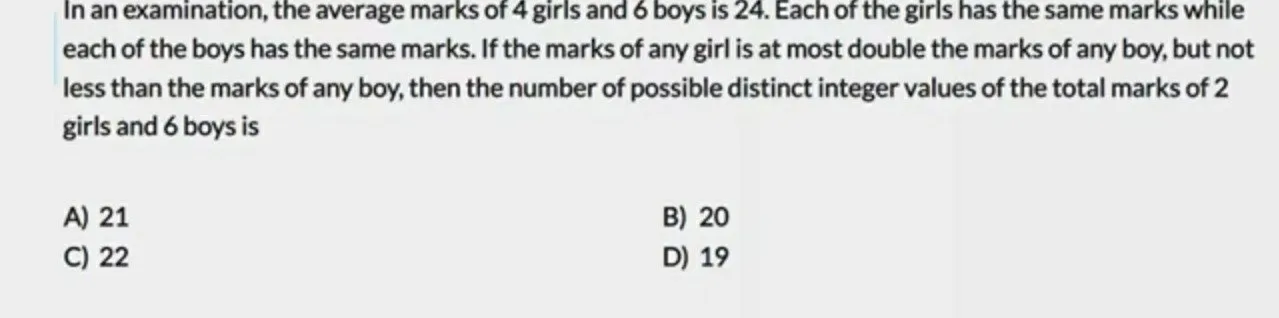
Given information:
Setting up equations:
Total marks = 10×24=240
So: 4G+6B=240
Dividing by 2: 2G+3B=120
Therefore: G=60−23B
Applying constraints:
From B≤G: B≤60−23B 2B≤120−3B 5B≤120 B≤24
From G≤2B: 60−23B≤2B 60≤2B+23B 60≤27B 120≤7B B≥7120≈17.14
Finding possible values:
We need: 7120≤B≤24
We want integer values of 2G+6B.
Substituting G=60−23B: 2G+6B=2(60−23B)+6B=120−3B+6B=120+3B
For 120+3B to be an integer, 3B must be an integer.
So we need 3B to be an integer where 3B≥3×7120=7360≈51.43
Since 3B must be an integer: 3B≥52
And 3B≤3×24=72
Therefore: 3B∈52,53,54,...,72
This gives us: 120+3B∈172,173,174,...,192
Counting the values:
From 172 to 192: 192−172+1=21 distinct integer values.
Wowwwwwwwwwwwww,
Thank you bhavesh bhaiya 🙌🙌