

Please log in to comment and participate in discussions.
Comments (6)
S
solulu
OP•7mos
Yes, but the answer is 9
1
B
bheem0001
•7mos
?you are getting 10 as answer?
1
IPMAT/Algebra
Academic discussion and doubt solving for: Progression & Series, Inequalities, Linear Equation, Functions, Modulus, Minima & Maxima, Polynomials, Identities, Indices
1693Members
160
Online
Members can post and comment here, and get these posts in their Latest feed.
Moderators
Join AfterBoards
Create an account to join our community and participate in discussions.
- • Connect with peers
- • Resolve doubts
- • Learn more about admissions
Yeah your approach broke because you split it incorrectly.
We need
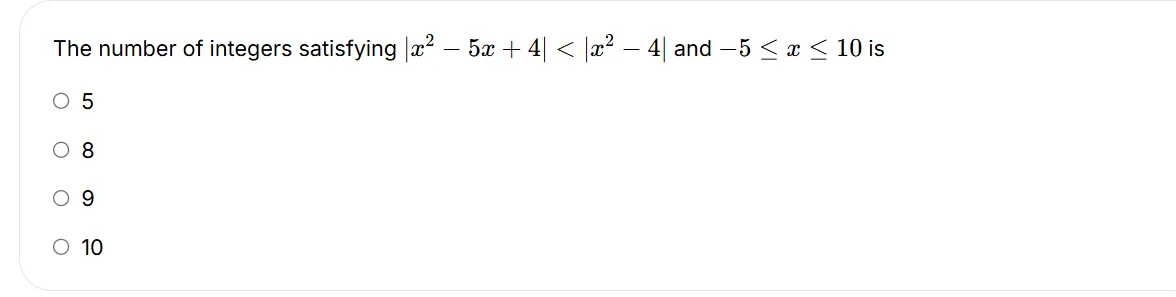
|x² − 5x + 4| < |x² − 4|
Factor:
x² − 5x + 4 = (x − 1)(x − 4)
x² − 4 = (x − 2)(x + 2)
So inequality becomes
|(x − 1)(x − 4)| < |(x − 2)(x + 2)|
Now square both sides:
(x − 1)²(x − 4)² < (x − 2)²(x + 2)²
Cancel common structure by bringing everything one side and simplifying, you’ll get:
(x − 2)²(x + 2)² − (x − 1)²(x − 4)² > 0
This simplifies to:
(3x − 4)(x − 2)(x − 1) > 0
Now solve sign-wise:
Critical points: x = 1, 4/3, 2
Check intervals → solution comes out as:
x < 1 OR 4/3 < x < 2 OR x > 2
Now restrict to integers in −5 ≤ x ≤ 10:
Valid integers:
−5, −4, −3, −2, −1, 0, 2, 3, 4
Total = 9
I understood this method but why do we have to sqaure the terms?
Is my method wrong?
Oh wait I got it. 2 is violating the condition on the left. It will become 0 which isn't allowed.
Thank you!