
Modulus and graphs !!
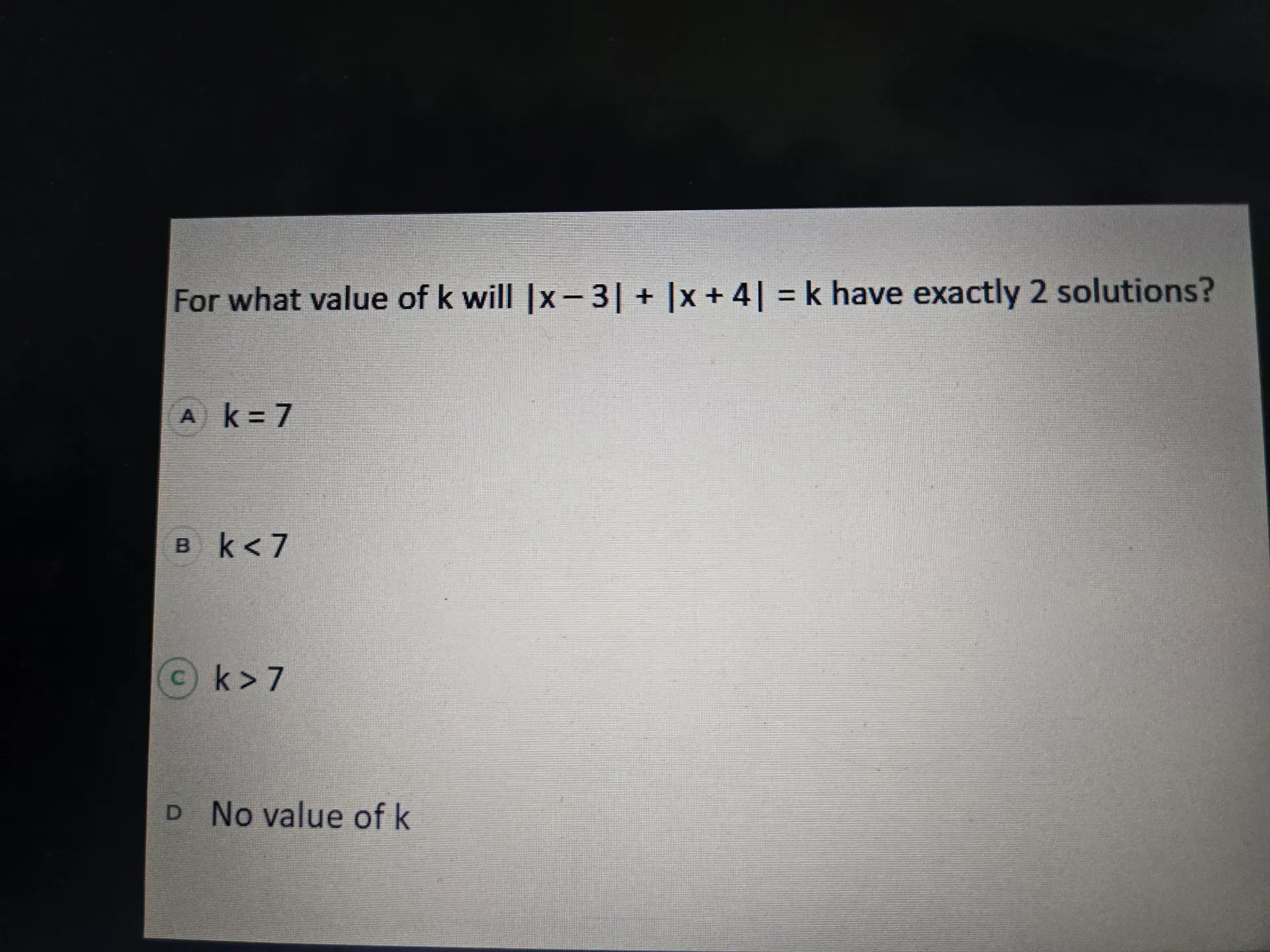
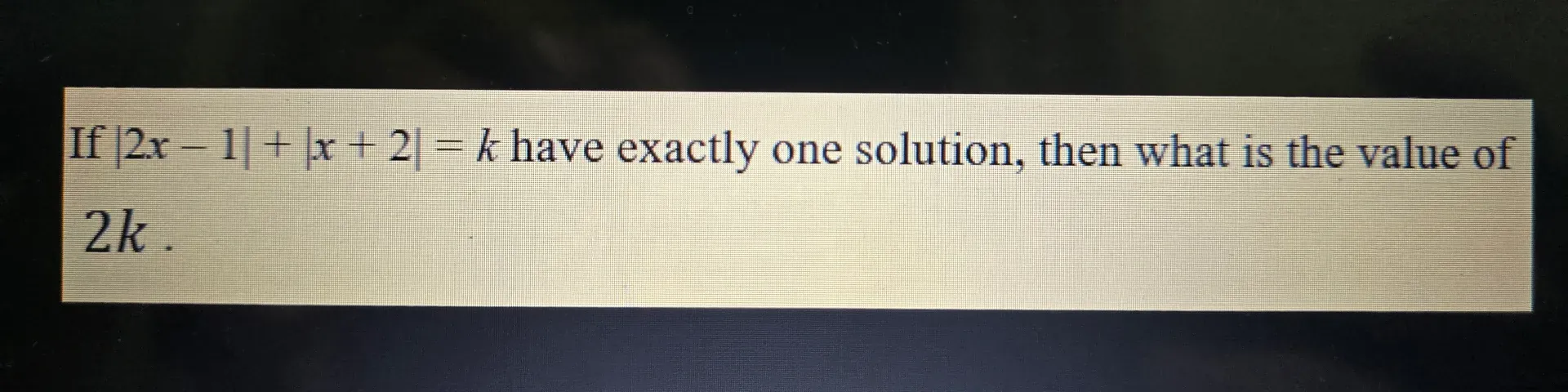

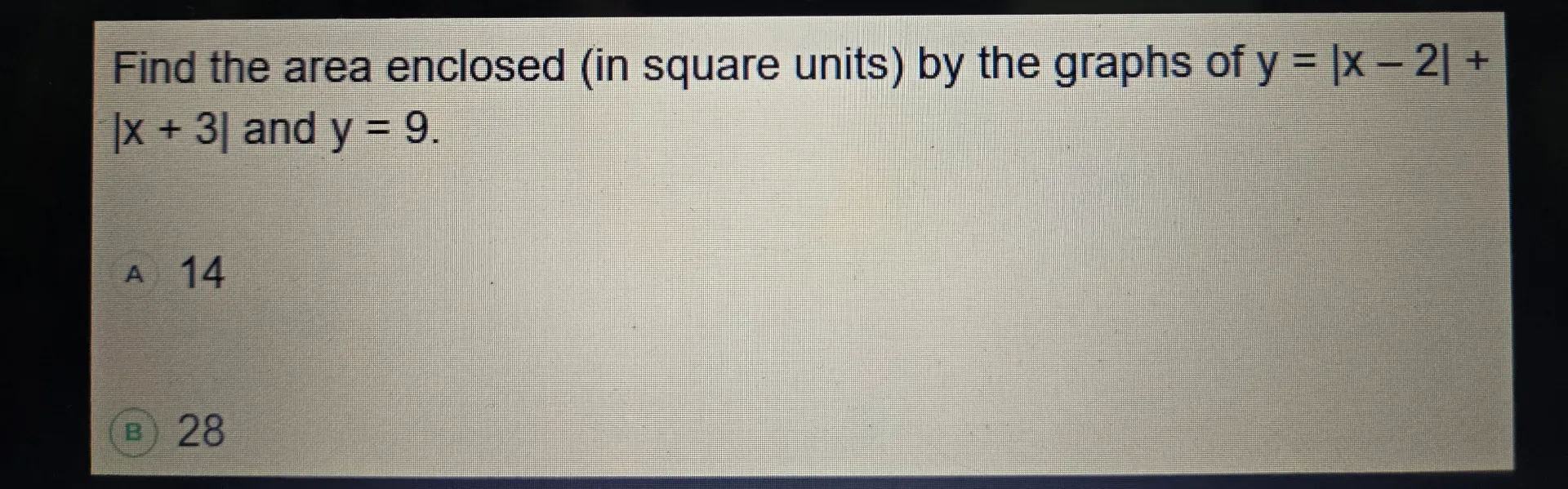
 Facing difficulty understanding these questions. Koi mai ka lal please help me 😭
3
Please log in to comment and participate in discussions.
Comments (3)
S
solulu
•6mos
+1 bhai and could you post the answers of the rest of the questions too
2
IPMAT/Algebra
Academic discussion and doubt solving for: Progression & Series, Inequalities, Linear Equation, Functions, Modulus, Minima & Maxima, Polynomials, Identities, Indices
1719Members
130
Online
Members can post and comment here, and get these posts in their Latest feed.
Moderators
Join AfterBoards
Create an account to join our community and participate in discussions.
- • Connect with peers
- • Resolve doubts
- • Learn more about admissions
I too am not very adept at this concept, but I will try to explain the method I use for these sums.
I always use the number lines for modulus sums. Any kind of modulus |x-a|=k talks about the absolute distance between x and the fixed point 'a'. If the question is |x-2|=3, it basically asks the for the values of 'x' for which the distance between 'x' and 2 is equal to 3. This means the values of 'x' will be three units right of 2 and three units to the left of 2 (5 and -1, respectively).
Similarly, when the question is in the format |x-a|+|x-b|=k, it is asking for which value/s of 'x' for which the sum of the distance between 'x' and 'a' and 'x' and 'b' is equal to k. If the question is |x-1|+|x-4|=7, it is asking for the values of 'x' for which the sum of the distances between 'x' and 1 and 'x' and 4 is equal to 7. We can solve this by the following method:
We know that if 'x' is between 1 and 4, the sum of the distance cannot be more than 3. In fact, the minimum value of the function is 3. So, 'x' has to be outside the range of [1,4]. Since the distance between 1 and 4 is 3, what is left is 4 (7-3=4). Now 4 has to be divided between the two modules (one from 1 and another from 4), which comes out to 2. So the values of 'x' is 2 units to the right of 4 and two units to the left of 1 (6 and -1).
The graphs of these kinds of functions can be best understood by experimenting on Desmos! But I can still give a basic explanation:
Lets take the same function |x-1|+|x-4|. Since, the minimum value of the function is 3, and this is attained in all the values from 1 and 4 (inclusive), the graph is flat between these two critical points. Now, we can take some values beyond -1 and 4 and see how the function is behaving (how the output is changing with respect to change in x) to find the slopes of lines beyond the minimum value.
thank u very much for giving your time. but still how can i use this to solve those questions of "values of k for which it has n solutions." and also the "area enclosed" one