Please log in to comment and participate in discussions.
Academic discussion and doubt solving for: Progression & Series, Inequalities, Linear Equation, Functions, Modulus, Minima & Maxima, Polynomials, Identities, Indices
Create an account to join our community and participate in discussions.

Understanding the Expression
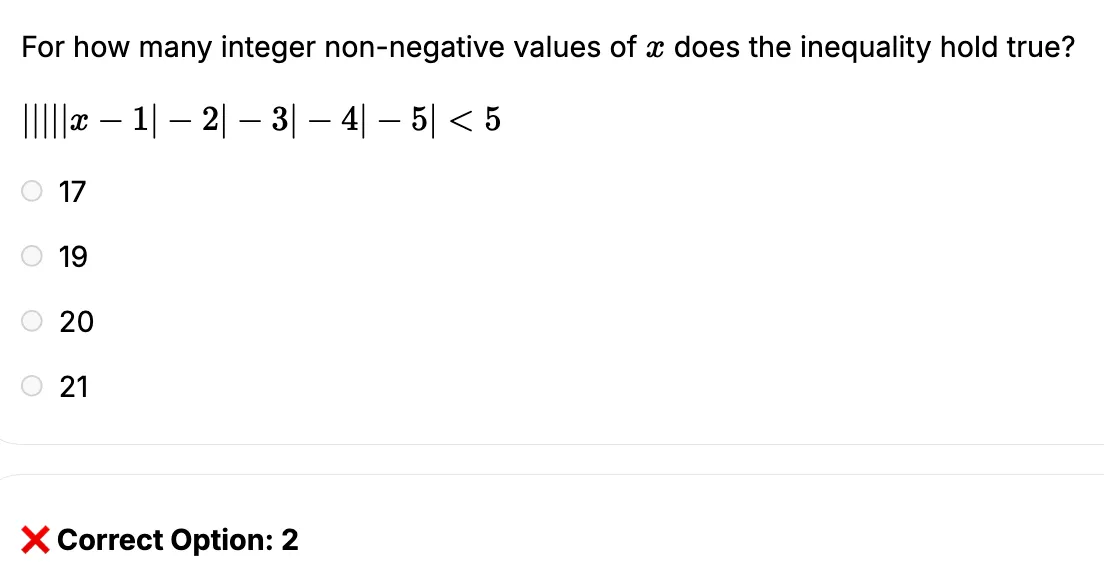
The inequality is: ∣∣∣x−1∣−2∣−3∣−4∣−5∣<5
This looks scary because of all those nested absolute values, but there's a smart way to handle this. We'll work from the inside out, like peeling an onion.
Each absolute value creates "kinks" or turning points in the graph, and we need to find where the final expression is less than 5.
The fastest approach is to recognize that we need: ∣∣∣x−1∣−2∣−3∣−4∣−5∣<5
This means: −5<∣∣∣x−1∣−2∣−3∣−4∣−5<5
Since we're dealing with nested absolute values, the expression ∣∣∣x−1∣−2∣−3∣−4∣−5 can never be less than −5 (absolute values make things non-negative after enough nesting).
So we really just need: ∣∣∣x−1∣−2∣−3∣−4∣−5<5
Using the understanding above, we can open all the internal mods until we have this:
∣x−1∣<19
−18<x<20
Since we are looking at non-negative integers, we have [0 to 19]. BUT notice something (this is what makes the question hard.
x=10 actually results lhs = 5 which doesn't pass our inequality test.
Algebraic manipulation of nested absolute values gives you the outer envelope, but the piecewise nature creates interior exceptions that must be checked separately.
This is why x=10 "hides" - it passes the range test but fails the actual inequality test.
The answer is 19, not 20, because we exclude the interior point wheref(x)=5 exactly.
Since we are only looking for positive solutions, you can open mod as ∣x−15∣<5 and here it is more clear that x=10 does not pass as a solution.
Don't let this loose your confidence in the topic, but it's something to keep in the back of your mind.
got it, thanksss