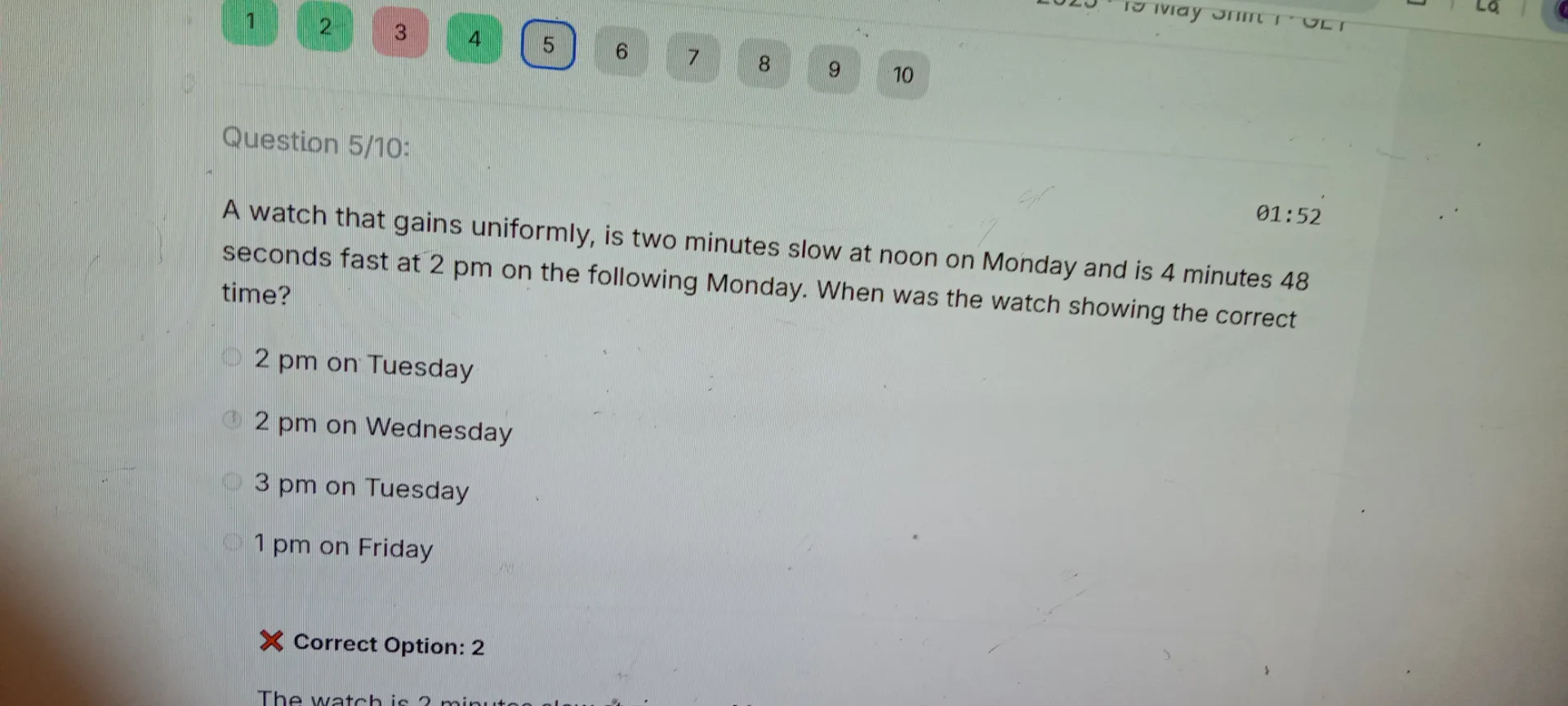
 In this type of questions mai bahut difficulty ho rhi hai . What should be the thought process ?
Please log in to comment and participate in discussions.
Function like a topper, integrate your efforts, and multiply your scores. Whether it's limits or logic, this subject is your π-rate ship to conquer the CUET.
Create an account to join our community and participate in discussions.

Honestly, the biggest issue in clock gain/loss questions is that people try to memorize formulas instead of understanding the “movement of error.”
The thought process should always be:
“How much total error changed?”
and
“In how much real time did that happen?”
Here:
So first think:
to go from 2 min slow to 4 min 48 sec fast, the watch had to “cover”:
2 min + 4 min 48 sec
= 6 min 48 sec
= 408 seconds
Now calculate total real time passed.
From Monday noon to next Monday 2 pm:
= 7 days + 2 hours
= 170 hours
So:
A 408 sec gain takes 170 hours.
Now ask:
“When will the watch become correct?”
Initially, it is 2 min slow.
So it needs to gain:
120 seconds
Use direct proportion:
408 sec gain → 170 hours
120 sec gain → x hours
x=(120×170)/408x =50 hours
50 hours after Monday noon:
So the watch shows the correct time at:
2 pm on Wednesday.
The key mindset in these questions:
That alone simplifies almost every gain/loss clock question.