
Doubt
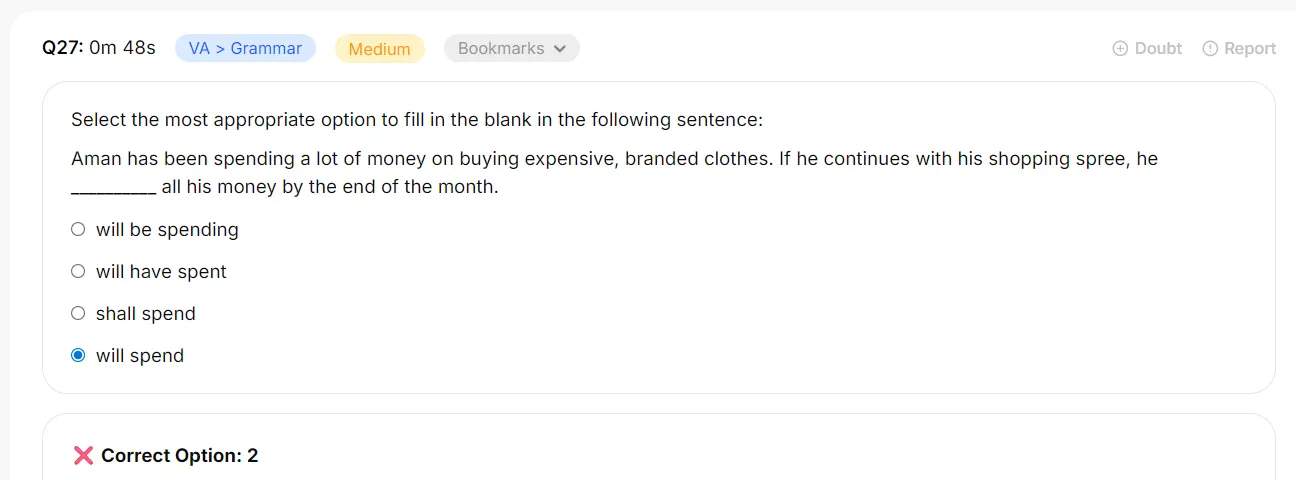 Ik "will have spent" is right but as per the 1st conditional (after "if", it simple present is being used, then it is followed by simple future tense), shouldn't it be "will spend"??
1
Please log in to comment and participate in discussions.
Comments (2)
A
aaryan_2681
•5mos
if here represents a possiblity and a possiblity cant be represented in the same tense as before.
WIll have spent represents a deadline by which this is about to happen which is by the end of the month
1
CUET/English
Polish your prose, flex your grammar, and decode passages. In CUET English, comprehension & vocabulary is power, and every word counts.
1108Members
35
Online
Members can post and comment here, and get these posts in their Latest feed.
Join AfterBoards
Create an account to join our community and participate in discussions.
- • Connect with peers
- • Resolve doubts
- • Learn more about admissions
Your doubt is actually very good. Grammatically, based purely on the standard first conditional structure, you are absolutely right that “will spend” sounds natural.
The usual rule is:
“If + present simple, then will + base verb.”
So according to that pattern, “If he continues with his shopping spree, he will spend all his money” is completely logical.
The reason the answer key prefers “will have spent” is because of the phrase “by the end of the month.”
That phrase creates a future completion point. Future perfect tense is commonly used when an action will be completed before a specific future time.
So the sentence:
“If he continues with his shopping spree, he will have spent all his money by the end of the month”
means that by that future point, the action of spending will already be complete.