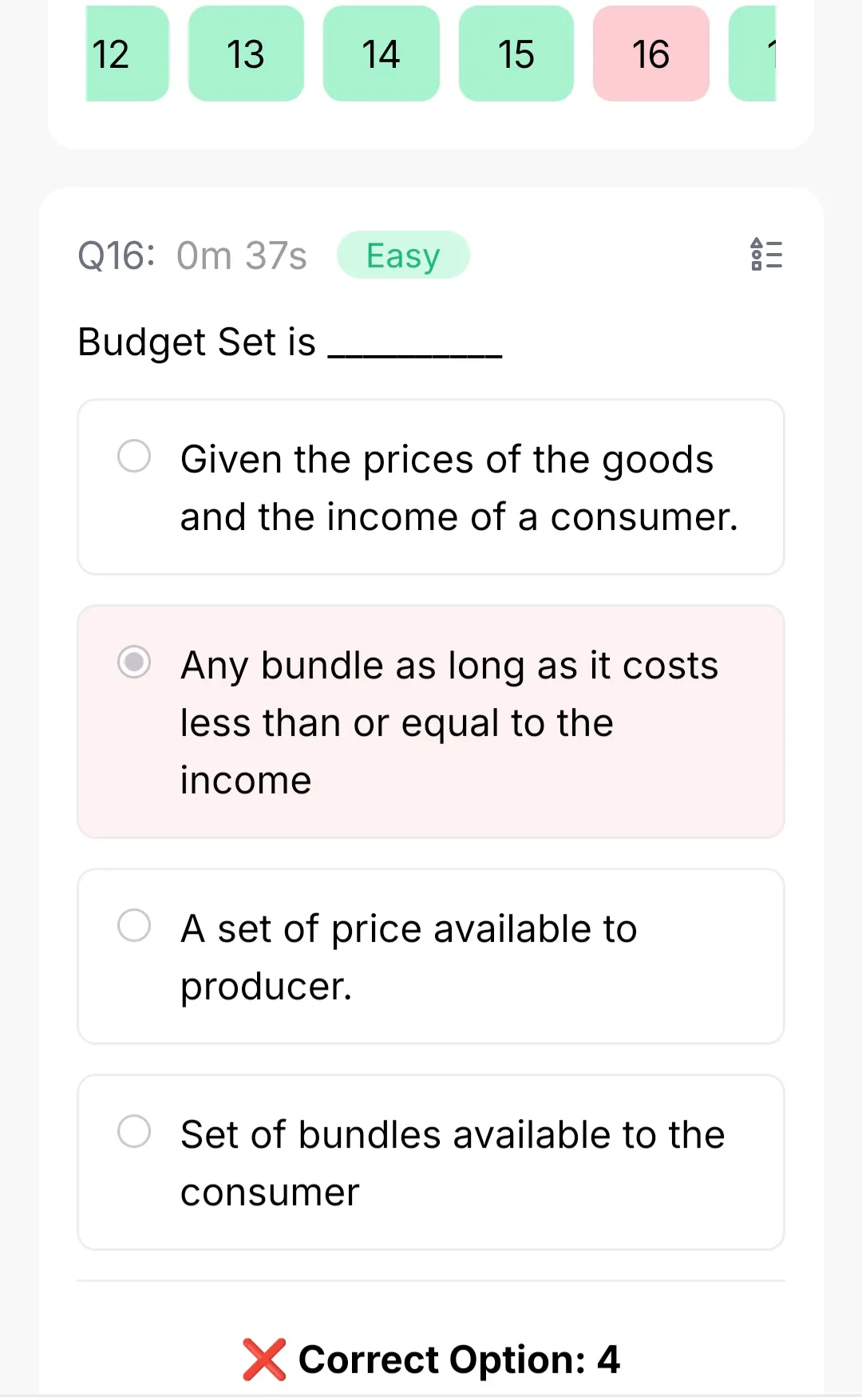
 Doesn't budget set refer to all the possible combination of goods a consumer can buy within his income? Set of bundles available to consumer, does that not include those sets that cost more than the income?
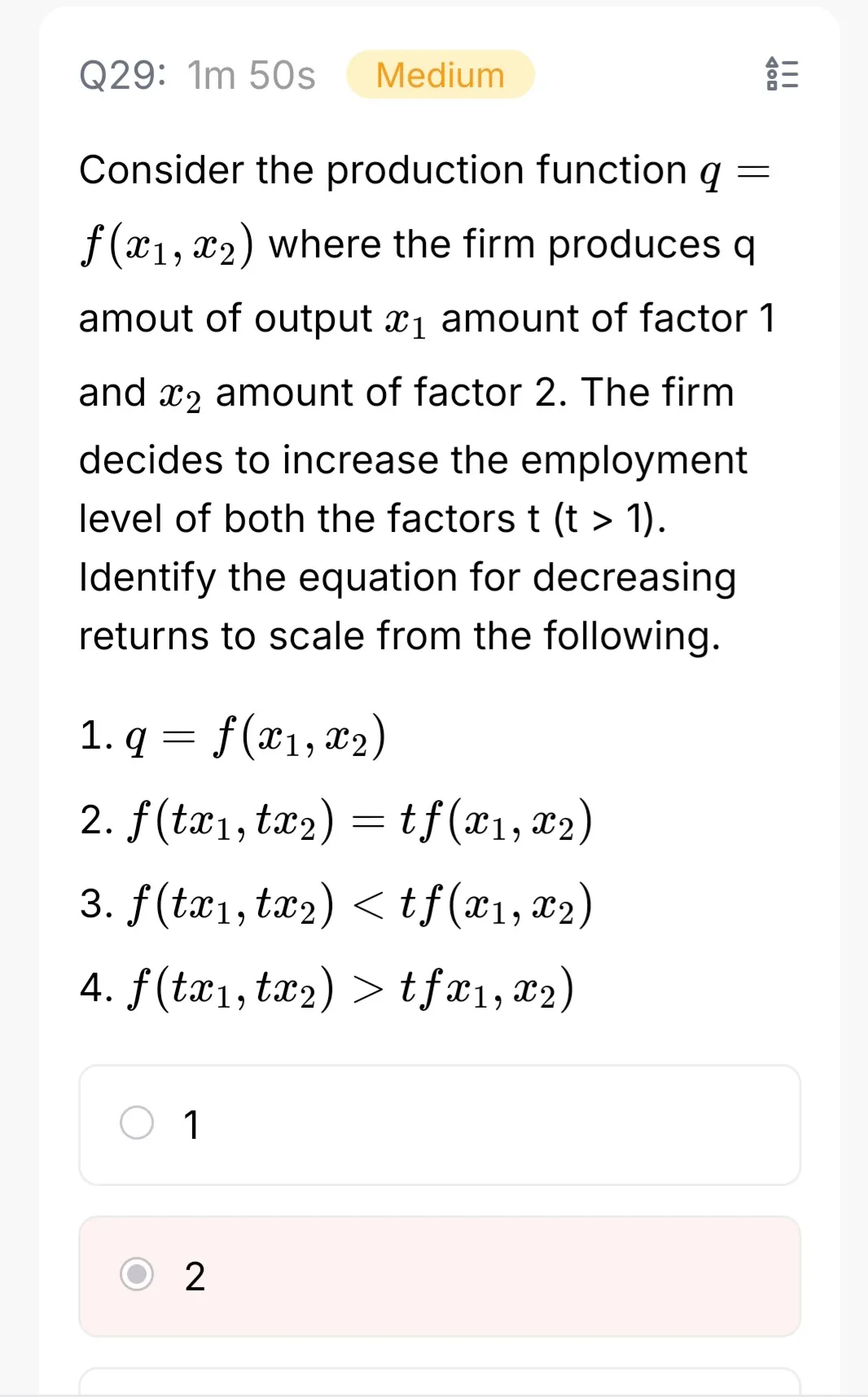 And for this question, what is it even asking? 🙏
Please log in to comment and participate in discussions.
Turn demand for marks into a supply of answers. Ride the invisible hand of preparation, balance your utilities, and prove that your marginal effort equals maximum success.
Create an account to join our community and participate in discussions.

Doesn't budget set refer to all the possible combination of goods a consumer can buy within his income?
No, thats the budget line not the budget set. (its used for the indifference curve analysis)
A budget set is specifically defined as the collection of all combinationsof goods that a consumer can buy given their fixed income and the market prices.
Doubt 2
In microeconomics, Returns to Scale refers to how much output (q) changes when you increase all inputs (factors of production like x1 and x2) by the same proportion (t).
the question asks us to identify the mathematical condition for Decreasing Returns to Scale (DRS).
Imagine you double every single input in a factory (meaning t = 2).
If your output exactly doubles, you have Constant Returns to Scale.
If your output more than doubles, you have Increasing Returns to Scale.
If your output less than doubles, you have Decreasing Returns to Scale.
option one is just the standard definition of a production function; it doesn't describe a change in scale.
option 2 is Constant Returns to Scale (CRS). The output increases by exactly the same proportion as the inputs.
option 3 is Decreasing Returns to Scale (DRS). When you increase inputs by t, the resulting output is less than t times the original output.
option 4 is Increasing Returns to Scale (IRS). The output grows faster than the inputs.
Hence, option 3 must be the answer, or is it?
Yes option 3 is the answer. Thanks for the clear explanation!
but for Q1 i don't think option 2 is wrong bcz it says costs less than or equal?
You right on that Option 2 is economically correct in its description. In many economics contexts, both Option 2 and Option 4 are used to describe the budget set.
However, in the context of a mcq, there is a subtle distinction in "completeness" and "definition" that usually makes option 4 the technically preferred answer.
Option 2 describes the condition: It tells you how to determine if a bundle is in the set (the cost must be less than equal to incomme).Option 4 describes the object itself: It tells you what the budget set is a set of bundles available to the consumer.
okayy. thank you