
The figure below shows an equiconvex lens (n = 1.5) placed in contact with a thin liquid layer resting on a plane mirror. A small needle, with its tip positioned on the principal axis of the lens, is moved along the axis until its inverted image coincides with the needle tip itself.
When the liquid is present, the distance between the needle and the lens is found to be 50 cm. The experiment is then repeated after removing the liquid, and the distance is observed to be 35 cm. The refractive index of the liquid is-
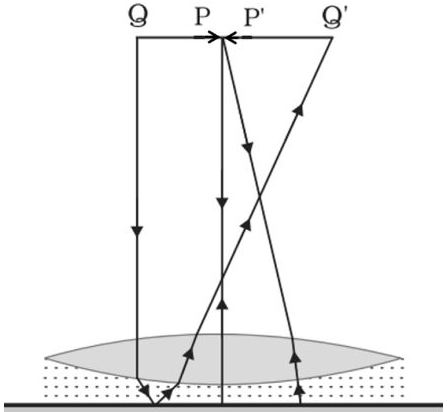
The figure below shows an equiconvex lens (n = 1.5) placed in contact with a thin liquid layer resting on a plane mirror. A small needle, with its tip positioned on the principal axis of the lens, is moved along the axis until its inverted image coincides with the needle tip itself.
When the liquid is present, the distance between the needle and the lens is found to be 50 cm. The experiment is then repeated after removing the liquid, and the distance is observed to be 35 cm. The refractive index of the liquid is-
Solution
When the image forms on the needle itself, rays must strike the mirror normally. So the needle sits at the focus of the lens (or lens plus liquid combination), and the needle-lens distance equals the focal length.
Without liquid, cm. For an equiconvex lens with :
So cm.
With liquid, the liquid forms a plano-concave lens with one curved surface of radius , so its focal length is given by . The combination has cm:
Related questions:
2026: 18 May Shift 1
2025: 21 May Shift 1