As shown in the figure, P and Q are two coaxial conducting loops separated by some distance. when the switch S is closed, a clockwise current flows in P (as seen by E) and an induced current flows in Q. The switch remains closed for a long time. When S is opened, a current flows in Q. Then, the directions of , and (as seen by E) are
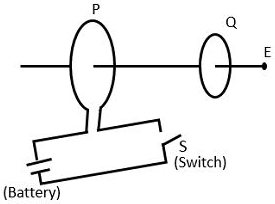
As shown in the figure, P and Q are two coaxial conducting loops separated by some distance. when the switch S is closed, a clockwise current flows in P (as seen by E) and an induced current flows in Q. The switch remains closed for a long time. When S is opened, a current flows in Q. Then, the directions of , and (as seen by E) are
Solution
When S is closed, rises from zero and is clockwise as seen by E, so its flux through Q points away from E and grows. By Lenz's law, Q opposes this increase by producing flux towards E, so is anticlockwise.
After a long time the current in P is steady, so there is no induced current in Q. When S is opened, falls to zero and the flux through Q decreases. Q now opposes the decrease by producing flux in the original direction, away from E, so is clockwise.
Option 1: reverses both directions; a student gets this by applying Lenz's law as if the induced current should copy the changing flux rather than oppose the change.
Option 2 and Option 3: the two induced currents cannot have the same direction, because the flux through Q first increases and then decreases.
Memory trick: the induced current opposes the change, so it is opposite to when grows and in the same sense as when falls.
Related questions:
2025: 21 May Shift 2
2026: 7 June Shift 2