
A p-n junction diode (D) shown in figure below can act as a rectifier. An alternating current source (V) is connected in the circuit. The current (I) in the resistor (R) can be shown by which graph?
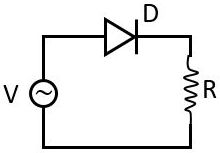
A p-n junction diode (D) shown in figure below can act as a rectifier. An alternating current source (V) is connected in the circuit. The current (I) in the resistor (R) can be shown by which graph?
Solution
The diode conducts only when the source makes its anode positive, which is the positive half-cycle. In the negative half-cycle it is reverse biased and no current flows through R. The current is therefore a series of positive half-cycles separated by equal gaps of zero current, which is half-wave rectification. This is the graph in Option 2.
Option 1: this is full-wave rectified output, which needs two diodes (centre-tapped) or a bridge of four diodes.
Option 3: a steady DC current needs a filter (capacitor) after rectification, which this circuit does not have.
Option 4: this is the unrectified AC waveform, with a negative half-cycle that a diode would block.
Related questions:
2026: 21 May Shift 1
2025: 15 May Shift 1
2026: 26 May Shift 1