
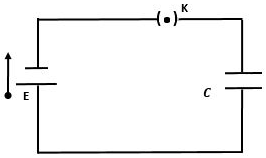
A parallel plate capacitor (C) is connected to a battery as shown in figure. Consider two cases:
Case-I: key 'k' is kept closed and plates of capacitors are moved apart using insulating handle.
Case-II: Initially key 'k' is closed for a long time and then opened. Now,the plates of capacitors are moved apart using insulating handle. Then, identify the correct statements among the following.
(A) In case-I: Q remains same but C changes.
(B) In case-II : V remains same but C changes.
(C) In case-I : V remains same and hence Q changes.
(D) In case-II: Q remains same and hence V changes.
A parallel plate capacitor (C) is connected to a battery as shown in figure. Consider two cases:
Case-I: key 'k' is kept closed and plates of capacitors are moved apart using insulating handle.
Case-II: Initially key 'k' is closed for a long time and then opened. Now,the plates of capacitors are moved apart using insulating handle. Then, identify the correct statements among the following.
(A) In case-I: Q remains same but C changes.
(B) In case-II : V remains same but C changes.
(C) In case-I : V remains same and hence Q changes.
(D) In case-II: Q remains same and hence V changes.
Solution
In Case-I the key stays closed, so the battery holds the potential difference constant. Moving the plates apart reduces , so decreases. Statement (C) is correct.
In Case-II the key is opened after charging, so the capacitor is isolated and stays constant. Moving the plates apart reduces , so increases. Statement (D) is correct.
(A): in Case-I the battery stays connected, so changes and does not stay the same.
(B): in Case-II the charge is fixed, so changes and does not stay the same.
Remember: battery connected means is fixed; battery disconnected means is fixed.
Related questions:
2025: 29 May Shift 2
2026: 19 May Shift 1
2026: 18 May Shift 2