
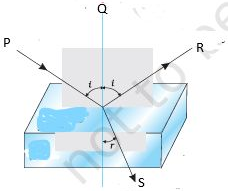
In the above figure, P, Q, R and S are, respectively:
(A) Normal
(B) Refracted ray
(C) Incident Ray
(D) Reflected Ray
In the above figure, P, Q, R and S are, respectively:
(A) Normal
(B) Refracted ray
(C) Incident Ray
(D) Reflected Ray
Solution
P is the ray travelling towards the surface, so it is the incident ray (C). Q is the line perpendicular to the surface at the point of incidence, so it is the normal (A). R leaves the surface at angle on the same side as P, so it is the reflected ray (D). S bends into the second medium at angle , so it is the refracted ray (B).
So P, Q, R, S are (C), (A), (D), (B).
Options 1 and 2: these name P as the normal, but P is the incoming ray. The normal is the vertical line Q, from which both angles are measured.
Option 3: this calls P the refracted ray, but a refracted ray goes into the second medium, as S does.
Remember that the reflected ray stays in the same medium as the incident ray, and the angle of reflection equals the angle of incidence, .
Related questions:
2026: 30 May Shift 2
2025: 27 May Shift 2