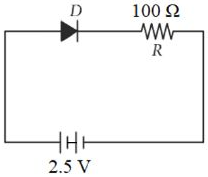
When a forward bias is applied to a p-n junction diode, then,
(A) majority carrier current becomes zero.
(B) potential barrier is raised.
(C) width of the depletion layer reduces.
(D) junction resistance increases.
When a forward bias is applied to a p-n junction diode, then,
(A) majority carrier current becomes zero.
(B) potential barrier is raised.
(C) width of the depletion layer reduces.
(D) junction resistance increases.
Solution
✅ Correct Option: 2
Under forward bias, the applied voltage opposes the built-in potential. This lowers the potential barrier, so the depletion layer becomes narrower. Only statement (C) is correct.
(A): Majority carriers cross the junction easily under forward bias, so the majority carrier current is large. It is not zero.
(B): The barrier is lowered, not raised. The raised barrier is for reverse bias.
(D): The narrow depletion layer lowers the junction resistance, so it decreases.
Related questions:
2026: 19 May Shift 2