CUET Physics: PhysicsRay Optics & Optical Instruments. Free, no login required.

Q1:

2026: 7 June Shift 2

Ray Optics & Optical Instruments

Medium

The focal length of the combination of a convex lens (focal length f1f_1) and a concave lens (focal length f2f_2) is f. For this combination to behave like a diverging lens

Answer options
Option 2
Correct Answer
Explanation for 2026: 7 June Shift 2 PHY question 1

Q2:

2026: 7 June Shift 2

Ray Optics & Optical Instruments

Medium

A double convex lens made of glass (μ\mu = 1.5) has equal radii of curvature and a focal length of 24 cm in air. When the lens is immersed in a liquid of refractive index 1.25, its new focal length is

Answer options
Option 3
Correct Answer
Explanation for 2026: 7 June Shift 2 PHY question 2

Q3:

2026: 7 June Shift 2

Ray Optics & Optical Instruments

Medium

Arrange the following lenses in increasing order of their typical focal lengths:

(A) Objective lens of a compound microscope

(B) Objective lens of an astronomical telescope

(C) Eyepiece of a compound microscope

(D) Eyepiece of an astronomical telescope

Answer options
Option 3
Correct Answer
Explanation for 2026: 7 June Shift 2 PHY question 3

Q4:

2026: 7 June Shift 2

Ray Optics & Optical Instruments

Easy

Match List-I with List-II

List-IList-II
(Demonstration)(Phenomena)
(A) Wave nature of light(I) Dispersion of light
(B) Particle nature of light(II) Total internal reflection
(C) Brilliance of diamond(III) Diffraction
(D) Rainbow(IV) Photoelectric effect
Answer options
Option 4
Correct Answer
Explanation for 2026: 7 June Shift 2 PHY question 4

Q5:

2026: 6 June Shift 1

Ray Optics & Optical Instruments

Medium

A ray of light passes through an equilateral prism in minimum deviation position. If the angle of emergence is 34\frac{3}{4} times of angle of prism, then the refractive index of material of prism is-

Answer options
Option 1
Correct Answer
Explanation for 2026: 6 June Shift 1 PHY question 5

Q6:

2026: 6 June Shift 1

Ray Optics & Optical Instruments

Easy

If FoF_o and FeF_e are the focal lengths of the objective and eyepiece of a telescope, respectively, then its magnifying power in normal adjustment will be

Answer options
Option 3
Correct Answer
Explanation for 2026: 6 June Shift 1 PHY question 6

Q7:

2026: 6 June Shift 1

Ray Optics & Optical Instruments

Medium

The wavelengths of a light in two adjacent media are 3500 A˚3500\ \mathring{A} and 7000 A˚7000\ \mathring{A}, respectively. Then the critical angle for total internal reflection from their interface will be:

Answer options
Option 3
Correct Answer
Explanation for 2026: 6 June Shift 1 PHY question 7

Q8:

2026: 6 June Shift 1

Ray Optics & Optical Instruments

Medium

A parallel beam of light falls on a concave mirror of focal length 12 cm. To determine the nature and the position of the image, a student executes the following steps. Arrange them in the correct order.

(A) Uses the mirror formula 1f=1v+1u\frac{1}{f}=\frac{1}{v}+\frac{1}{u} with u=−∞u=-\infty

(B) Concludes whether the image is real or virtual from the sign of image distance v.

(C) Draws the ray diagram showing rays parallel to the principal axis passing through focus after reflection.

(D) Determines the image distance v.

Answer options
Option 1
Correct Answer
Explanation for 2026: 6 June Shift 1 PHY question 8

Q9:

2026: 6 June Shift 1

Ray Optics & Optical Instruments

Medium

Two thin lenses of powers +15 D and -5 D are placed in contact with each other. An object is placed at 30 cm from this combination. The distance of the final image from the combination is-

Answer options
Option 2
Correct Answer
Explanation for 2026: 6 June Shift 1 PHY question 9

Q10:

2026: 31 May Shift 2

Ray Optics & Optical Instruments

Easy

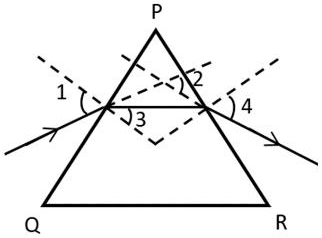
In the given figure, ∠1,∠2,∠3\angle 1, \angle 2, \angle 3 and ∠4\angle 4, respectively are-

Figure

A. angle of emergence

B. angle of incidence

C. angle of refraction

D. angle of deviation

Answer options

Q11:

2026: 31 May Shift 2

Ray Optics & Optical Instruments

Easy

A man makes a glass lens with refractive index (n) = 1.47, disappear in a pool of liquid. The refractive index (n1n_1) of the liquid is

Answer options

Q12:

2026: 31 May Shift 2

Ray Optics & Optical Instruments

Medium

Arrange the following media in the decreasing order of their respective critical angle with respect to air.

A. Water

B. Diamond

C. Crown glass

D. Dense flint glass

Answer options

Q13:

2026: 31 May Shift 2

Ray Optics & Optical Instruments

Hard

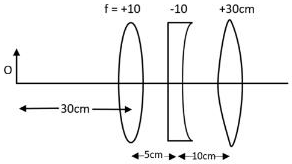
What would be the position of the image formed by the lens combination in the given figure-

Figure

Answer options

Q14:

2026: 30 May Shift 2

Ray Optics & Optical Instruments

Easy

Arrange the following media according to the values of their refractive indices in increasing order.

(A) Water

(B) Diamond

(C) Dense flint glass

(D) Air

Answer options

Q15:

2026: 30 May Shift 2

Ray Optics & Optical Instruments

Hard

Two thin convex lenses, when in contact, produce a combination of power + 10 D. When they are 0.25 m apart, the power reduces to + 6 D. The ratio of their focal lengths is

Answer options

Q16:

2026: 30 May Shift 2

Ray Optics & Optical Instruments

Easy

A biconvex lens has a focal length 23\frac{2}{3} times the radius of curvature of either surface. The refractive index of the lens material is

Answer options

Q17:

2026: 30 May Shift 2

Ray Optics & Optical Instruments

Easy

Arrange the following media in the increasing order of velocity of light (λ\lambda = 500 nm) in them.

(A) Water

(B) Glass

(C) Air

(D) Diamond

Answer options

Q18:

2026: 30 May Shift 1

Ray Optics & Optical Instruments

Easy

Identify the correct statements among the following in the context of the phenomenon of refraction of light.

A. Light rays do not deviate from their path while travelling from one medium to another when they are incident normally at the interface between the two media.

B. If light ray bends away from normal after refraction then second medium is optically denser. If the light ray bends towards normal, then second medium is optically rarer.

C. The ratio of sine of angle of incidence to the sine of angle of refraction is a constant for a given pair of media.

D. The velocity and frequency of the incident ray change when it travels from one medium to another after refraction.

E. The incident ray, the refracted ray and the normal to the interface of two transparent media, at the point of incidence, all lie in the same plane.

Answer options

Q19:

2026: 30 May Shift 1

Ray Optics & Optical Instruments

Medium

If a man's face is 30 cm in front of a concave shaving mirror creating an upright image 1.5 times as large as the object, then the mirror's focal length is

Answer options

Q20:

2026: 30 May Shift 1

Ray Optics & Optical Instruments

Easy

In a compound microscope, the intermediate image is:

Answer options

Q21:

2026: 30 May Shift 1

Ray Optics & Optical Instruments

Easy

Match the LIST-I with LIST-II

LIST-I (Observation)LIST-II (Phenomenon)
A.Blue colour of the skyI.Total internal reflection of light
B.Shining of diamondII.Refraction of light
C.Colours in soap bubbleIII.Scattering of light
D.Twinkling of starsIV.Interference of light
Answer options

Q22:

2026: 29 May Shift 2

Ray Optics & Optical Instruments

Easy

In the refraction through a triangular prism, which is not true in case of the minimum deviation of light ?

Answer options

Q23:

2026: 29 May Shift 2

Ray Optics & Optical Instruments

Easy

A compound microscope has a magnification of 30. The focal length of its eyepiece is 5 cm. Assuming the final image to be formed at the least distance of distinct vision (25 cm), the magnification produced by the objective is

Answer options

Q24:

2026: 29 May Shift 2

Ray Optics & Optical Instruments

Easy

A convex lens of focal length 25 cm is placed coaxially in contact with a concave lens of focal length 20 cm. The power of the combination is:

Answer options

Q25:

2026: 29 May Shift 2

Ray Optics & Optical Instruments

Medium

The image formed by a convex lens is erect and its size is four times the size of the object. If the focal length of the lens is 20 cm, the object and image distances are:

Answer options

Q26:

2026: 29 May Shift 1

Ray Optics & Optical Instruments

Medium

A 20 D lens is used as a magnifier. Where should the object be placed to obtain maximum angular magnification for a normal eye (near point = 25 cm)?

Answer options

Q27:

2026: 29 May Shift 1

Ray Optics & Optical Instruments

Easy

A combination of thin lenses in contact

(A) helps to obtain diverging or converging lenses of desired magnification.

(B) has the net power equal to the algebraic sum of their individual powers

(C) is used in designing lenses for many optical instruments.

(D) enhances sharpness of the image.

Answer options

Q28:

2026: 29 May Shift 1

Ray Optics & Optical Instruments

Easy

The image formed by a concave lens is

Answer options

Q29:

2026: 29 May Shift 1

Ray Optics & Optical Instruments

Medium

A beaker contains water (refractive index μw\mu_w) up to a height h and kerosene oil ( refractive index μo\mu_o) above water up to another height H. What will be the apparent shift in the position of an ink dot marked on the bottom of the beaker when viewed from above?

Answer options

Q30:

2026: 26 May Shift 2

Ray Optics & Optical Instruments

Medium

An image of maginification m = +1 will be produced by :

Answer options