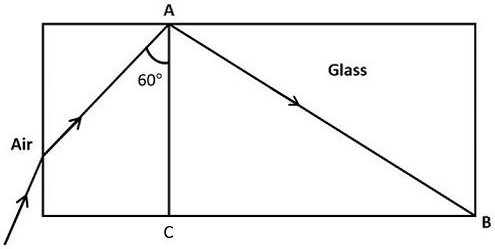
The lateral shift produced by a glass slab during refraction through it, increases with -
(A) the increase in the thickness of the glass slab
(B) the increase in the value of the angle of incidence
(C) the increase in the value of the refractive index of the slab
(D) the increase in the length of the glass slab
Solution
The lateral shift of a ray through a glass slab of thickness is
Here is directly proportional to the thickness , so (A) is correct.
As the angle of incidence increases, increases, so increases. Hence (B) is correct.
A higher refractive index makes smaller (since ), which increases and therefore . Hence (C) is correct.
(D): the length of the slab (its extent along the face) does not appear in the formula. Only the thickness, the distance between the two parallel faces, matters.
Related questions:
2025: 22 May Shift 1