
In the circuit shown below, , and battery B = 40 V. Initially, switch is opened and the switch is closed. Now switch is opened and is closed. The charge on will be
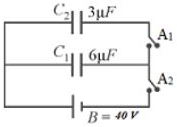
In the circuit shown below, , and battery B = 40 V. Initially, switch is opened and the switch is closed. Now switch is opened and is closed. The charge on will be
Solution
Initially is open and is closed, so only is connected to the battery and charges to the full 40 V:
After is opened and is closed, the battery is disconnected. is now connected in parallel with the uncharged , and the total charge of is conserved. The charge redistributes until both have the same potential:
The charge on is then:
Option 2: is not a result of the charge-sharing calculation. It would only follow from wrongly assuming the charge on is .
Option 1: is not a result of the charge-sharing calculation either. It comes from using the wrong total charge or capacitance.
Option 4: is not a result of the charge-sharing calculation. It comes from using the wrong total charge or capacitance.
Related questions:
2025: 30 May Shift 2
2025: 2 June Shift 1
2026: 20 May Shift 1