In the circuit diagram shown in the figure, the potential difference E is 20 V.
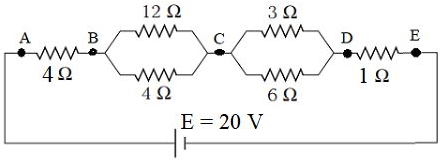
(A) The potential difference across points C and D is
(B) The potential difference across points B and C is
(C) The potential difference across points D and E is
(D) The potential difference across points A and B is
If the potentials , , , are arranged in increasing order, the correct sequence is:
In the circuit diagram shown in the figure, the potential difference E is 20 V.
(A) The potential difference across points C and D is
(B) The potential difference across points B and C is
(C) The potential difference across points D and E is
(D) The potential difference across points A and B is
If the potentials , , , are arranged in increasing order, the correct sequence is:
Solution
✅ Correct Option: 1
The four sections are in series, so the same current flows through each. The two parallel groups first reduce to single resistances.
Using for each section:
, , ,
Increasing order:
(C) = 2 V
(A) = 4 V
(B) = 6 V
(D) = 8 V
Related questions:
2025: 26 May Shift 2
2025: 28 May Shift 1
2026: 31 May Shift 2
2025: 15 May Shift 2
2025: 3 June Shift 2