Q1:
Physics
Electromagnetic Waves
Easy
The wavelength range of X-rays is
Correct Answer
Option 2
Correct Answer

Physics
Electromagnetic Waves
Easy
The wavelength range of X-rays is
Physics
Electromagnetic Induction
Medium
A 200 turn coil of self inductance 20 mH carries a current of 4 mA. The magnetic flux linked with each turn of the coil would be
Physics
Electromagnetic Waves
Easy
Which of the following equations represents the Ampere-Maxwell law?
Physics
Nuclei
Easy
The atomic numbers and mass numbers of the nuclei of hydrogen, deuterium and tritium, respectively are in the ratio
Physics
Electromagnetic Induction
Medium
In a coil, a current of 0.2 A increases at the rate of . If, there is power flow of in the coil, its inductance is
Physics
Moving Charges & Magnetism
Medium
Two wires of equal lengths carrying equal currents bent in the form of two loops, one in square shape and the other in circular shape having one turn only are suspended in same, uniform magnetic field perpendicular to the plane of loops.
Physics
Wave Optics
Easy
In Young's double slit experiment, two slits 0.12 mm apart are illuminated by monochromatic light of wavelength 480 nm. The screen is 1.0 m away from the slits. The distance of the second bright fringe from the central maximum will be
Physics
Alternating Current
Medium
An a.c. voltage source of fixed amplitude and variable angular frequency is connected with an electric bulb of resistance R (inductance zero) and a capacitor of capacitance C in series. On increasing the angular frequency of the source, the total impedance of the circuit
Physics
Dual Nature of Radiation & Matter
Medium
Photoelectric current depends on
(A) the intensity of incident light
(B) the potential difference applied between the two electrodes
(C) the nature of the emitter material
(D) the conductivity of the emitter material
Physics
Ray Optics & Optical Instruments
Easy
The colour of light which is scattered the most by atmospheric molecules is
Physics
Moving Charges & Magnetism
Easy
A charged particle enters a magnetic field with velocity v at an angle with the field and experiences a magnetic force. The kinetic energy of the particle
Physics
Semiconductor Electronics
Easy
Choose the correct statement(s) from the following:
(A) With increasing reverse bias voltage, the barrier potential across the junction of p-n diode decreases.
(B) A p-type semiconductor can be obtained by doping Si or Ge with trivalent atoms.
(C) A rectifier rectifies dc voltages.
(D) Pure semiconductors are called extrinsic semiconductors.
Physics
Moving Charges & Magnetism
Medium
A proton and a deuteron execute circular orbits having same radii of 0.5 m in a plane perpendicular to a uniform magnetic field B. If the kinetic energy of the deuteron is 50 keV, the K.E. of the proton will be
Physics
Semiconductor Electronics
Medium
, and , denote the ionization energy values for Ge, Si and C, respectively. The values correctly arranged in increasing order are as in option
Physics
Electromagnetic Waves
Medium
Accelerated charges radiate electromagnetic waves. Choose the correct key features of electromagnetic waves from the following:
(A) The electric field is always parallel to the magnetic field.
(B) The electric and magnetic fields are always normal to the direction in which the wave is travelling.
(C) The electric and magnetic fields sometimes vary sinusoidally.
(D) The electric and magnetic fields vary with the same frequency.
Physics
Nuclei
Easy
Match List-I with List-II
| List-I | List-II |
|---|---|
| Name of the Particle | Charge and mass |
| (A) Proton | (I) +2e; 4 u |
| (B) Neutron | (II) +e; 1 u |
| (C) Deuteron | (III) 0; 1 u |
| (D) -particle | (IV) +e; 2 u |
Physics
Alternating Current
Easy
The time required for a 50 Hz alternating current to reach the peak value starting from zero
Physics
Electric Charges & Fields
Easy
Which of the following is not a unit of electric field intensity?
Physics
Wave Optics
Easy
When light travels from one medium to another, then its
Physics
Electrostatic Potential & Capacitance
Medium
Which of the following statements are correct?
(A) the mid-point between the two similar and equal point charges located nearby, is called neutral point.
(B) There are maximum number of field lines at the neutral point.
(C) The work done to bring any positive charge from infinity to a point in an electric field is called the electric potential at that point.
(D) The work done to move a charge from one point to another point on the equipotential surface will be zero.
Physics
Atoms
Medium
The electron in a hydrogen atom emits wavelengths , , and in the following transitions (A), (B), (C) and (D), respectively. Arrange the transitions in the increasing order of emitted wavelengths.
(A) n=3 to n=2
(B) n=4 to n=3
(C) n=4 to n=2
(D) n=2 to n=1
Physics
Nuclei
Easy
The ratio of densities of nuclei with mass numbers A and 2A, respectively is
Physics
Ray Optics & Optical Instruments
Medium
A convex lens has 20 cm focal length in air. Its focal length in water would be
(Given : Refractive index of water = 1.33, refractive index for glass = 1.5)
Physics
Dual Nature of Radiation & Matter
Easy
An electron accelerated with potential V has a de-Broglie wavelength associated with it. If the potential is changed to 4 V, the wavelength becomes
Physics
Electric Charges & Fields
Easy
An oil drop of mass m carrying a charge +q is held stationary in air by an electric field E.
The electric field is correctly given by
Physics
Dual Nature of Radiation & Matter
Easy
An electron of mass kg is moving with velocity m/s. Its momentum will be
Physics
Electromagnetic Induction
Easy
The magnetic flux () through the area of cross-section of a current-carrying coil is proportional to the current (i) i.e.,
(A) L is self-inductance of the coil
(B) The self-inductance of the coil does not depend on its geometry
(C) self-inductance is the electromagnetic analogue of mass in mechanics
(D) The self-inductance of the coil depends on the permeability of the medium inside coil
Physics
Wave Optics
Easy
Monochromatic light of wavelength 600 nm is incident from air onto a water surface. The wavelength and speed of light respectively in water will be
(Given: Refractive index of water = 4/3)
Physics
Current Electricity
Easy
The materials and devices do not obey Ohm's law when
(A) The relation between V and I is not unique, i.e., there is more than one value of V for the same current I
(B) The relation between V and I depends on the sign of V
(C) V ceases to be proportional to I
(D) The relation between V and I is linear
Physics
Moving Charges & Magnetism
Easy
Two circular coils of diameter 10 cm and 20 cm, carrying equal currents have the same number of turns. The ratio of magnetic fields produced at the center of coils, respectively will be
Physics
Electric Charges & Fields
Easy
Two parallel large thin metal sheets have equal charge densities of of opposite signs. If the permittivity of free space is equal to , the electric field between these sheets will be
Physics
Magnetism & Matter
Medium
A bar magnet with pole strength m and magnetic dipole moment p is cut into two identical pieces along its length.
Then for each of the two pieces
Physics
Electrostatic Potential & Capacitance
Medium
A slab of material of dielectric constant K has the same area as the plates of a parallel-plate capacitor but has a thickness (1/4)d, where d is the separation of the plates. If the slab is inserted between the plates of the capacitor, the potential difference between the plates will be
(Given: Potential difference across the capacitor without dielectric is )
Physics
Current Electricity
Hard
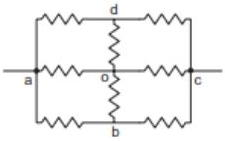
The equivalent resistance between the points a and c of the network shown in the figure, would be
(Here each resistance is equal to r.)
Physics
Ray Optics & Optical Instruments
Easy
A point source of light is placed at a distance twice the focal length of a converging lens. If the focal length of the lens is , the intensity of the image of light source on the other side of the lens will be maximum at
Physics
Wave Optics
Easy
Choose the phenomenon from the following, which shows that light is a transverse wave.
Physics
Electrostatic Potential & Capacitance
Easy
The ratio of equivalent capacitance in series and parallel combinations of two capacitors of capacity 5 F and 20 F will be
Physics
Current Electricity
Easy
A battery of emf 3 V and internal resistance r is connected in series with resistance of through an ammeter of resistance . The ammeter reads the current 50 mA. The internal resistance r of the battery is
Physics
Current Electricity
Medium
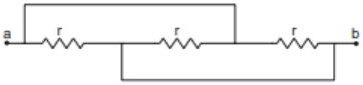
The equivalent resistance of the network shown in figure between the points a and b will be
Physics
Electrostatic Potential & Capacitance
Easy
The electric potential at a point in an electric field is V. The work done to bring a point charge C from infinity to this point in the field is
Physics
Alternating Current
Easy
A 50 Hz alternating current is flowing in a 28 mH coil. The reactance of the coil is
Physics
Current Electricity
Easy
Identify the correct statements from the following for an electrical circuit.
(A) An ammeter of very low resistance is connected in series in the circuit.
(B) A Voltmeter of high resistance is connected in series with a resistance in the circuit.
(C) A current I coming at a point P of a circuit, divides into 4 small currents flowing through different branches and all the currents again combine to give current I at the next point S of the circuit. The branches are in parallel.
(D) The internal resistance of the batteries can always be neglected
Physics
Alternating Current
Easy
During transmission of electrical energy by transformer, near the consumer
Physics
Ray Optics & Optical Instruments
Easy
A thin lens of focal length 20 cm placed in combination with another thin lens acts as a lens of focal length 12.5 cm. The power of is
Physics
Current Electricity
Medium
A total of electrons per second go through a conductor of area of cross-section 2 . The current density will be
Physics
Electrostatic Potential & Capacitance
Easy
E and V, respectively, denote electric field intensity and electrostatic potential at a point. The correct relation between the two is
Physics
Semiconductor Electronics
Easy
In an intrinsic semiconductor, the relation between the numbers of holes () and conduction electrons () will be
Physics
Magnetism & Matter
Medium
A solenoid has a core of a material with relative permeability 400. The windings of the solenoid are insulated from the core and carry a current of 1 A. If the number of turns is 800 per metre, the magnetic field inside solenoid will be
Physics
Magnetism & Matter
Medium
Match List-I with List-II
| List-I | List-II |
|---|---|
| (Physical Quantity) | (Unit) |
| (A) Magnetic flux | (I) |
| (B) Magnetic permeability | (II) |
| (C) Magnetisation | (III) |
| (D) Magnetic moment | (IV) |
Physics
Current Electricity
Easy
The terminal voltage of a cell
Every question from the CUET Physics 2025 21 May Shift 1 paper is here in full, with the correct answer and a step by step solution for each one. It is completely free, there is no login and no paywall, and you can read the whole paper online or download it to revise offline.
You can also attempt it instead of only reading it. Take the paper as a full length mock under exam conditions, or filter it by topic and attempt just that topic as a topic test. Both are free, and you get a breakdown of your accuracy, your timing and your weak areas once you submit.
CUET Physics past year questions (PYQs) are the closest thing to the real exam, so working through them is the quickest way to learn the paper pattern, the marking scheme and the level of difficulty to expect on the day.