
Three charges, each equal to +q, are placed at the corners of an equilateral triangle ABC of side 'a' as shown in the figure. P and R are the mid-points of BC and CA. The work done in taking a charge Q from point P to R is:
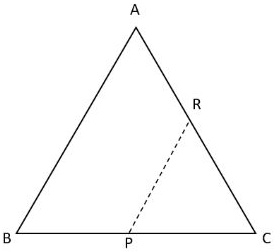
Three charges, each equal to +q, are placed at the corners of an equilateral triangle ABC of side 'a' as shown in the figure. P and R are the mid-points of BC and CA. The work done in taking a charge Q from point P to R is:
Solution
✅ Correct Option: 4
Work done is , so we compare the potentials at P and R.
P is at distance from B and C, and at distance from A (the median length).
R is at distance from C and A, and at distance from B.
Both points have the same set of distances to the three charges, so .
Related questions:
2025: 15 May Shift 2
2026: 20 May Shift 1
2025: 2 June Shift 1