CUET Chemistry: ChemistryElectrochemistry. Free, no login required.

Q1:

2025: 26 May Shift 2

Electrochemistry

Medium

For strong electrolytes, Λm\Lambda_m increases with dilution and is represented by the equation Λm=Λm0−Ac1/2\Lambda_m = \Lambda^0_m - Ac^{1/2}. Here, the value of the constant A depends upon

(A) Nature of solvent.

(B) Temperature.

(C) Charges on cation and anions produced.

(D) Type of electrolyte.

Answer options
Option 3
Correct Answer
Explanation for 2025: 26 May Shift 2 CHE question 1

Q2:

2025: 24 May Shift 2

Electrochemistry

Easy

In the reaction below, identify the species undergoing oxidation and reduction.

H2S(g)+Cl2(g)⟶2HCl(g)+S(s)H_2S(g) + Cl_2(g) \longrightarrow 2HCl(g) + S(s)

Answer options
Option 1
Correct Answer
Explanation for 2025: 24 May Shift 2 CHE question 2

Q3:

2025: 24 May Shift 2

Electrochemistry

Easy

The molar conductivity of KNO3KNO_3, NaClNaCl and KClKCl are 111, 128 and 152 S cm2 mol−1S\ cm^2\ mol^{-1}, respectively. The molar conductivity of NaNO3NaNO_3 will be:

Answer options
Option 4
Correct Answer
Explanation for 2025: 24 May Shift 2 CHE question 3

Q4:

2025: 24 May Shift 2

Electrochemistry

Medium

Consider the following hypothetical redox reaction

A(s)+2B+(aq)→A2+(aq)+2B(s):Ecell0=0.295VA(s) + 2B^+(aq) \rightarrow A^{2+}(aq) + 2B(s) : E^{0}_{cell} = 0.295V

The equilibrium constant of the reaction at 298 K will be :

Answer options
Option 2
Correct Answer
Explanation for 2025: 24 May Shift 2 CHE question 4

Q5:

2025: 24 May Shift 2

Electrochemistry

Easy

Which of the following statements are correct with reference to the following reaction?

Zn(s)+Cu2+(aq)→Zn2+(aq)+Cu(s)Zn(s) + Cu^{2+}(aq) \rightarrow Zn^{2+}(aq) + Cu(s)

(A) The reduction reaction is

Cu2+(aq)+2e−→Cu(s)Cu^{2+}(aq) + 2e^- \rightarrow Cu(s)

(B) The oxidation reaction is

Zn(s)→Zn2+(aq)+2e−Zn(s) \rightarrow Zn^{2+}(aq) + 2e^-

(C) The two half (oxidation and reduction) reactions constitute redox couple.

(D) The given reaction is not a redox reaction.

Answer options
Option 1
Correct Answer
Explanation for 2025: 24 May Shift 2 CHE question 5

Q6:

2025: 24 May Shift 2

Electrochemistry

Easy

The Nernst equation corresponding to the cell reaction given below, is

Ni(s)+2Ag+(aq)→Ni2+(aq)+2Ag(s)Ni(s) + 2Ag^+(aq) \rightarrow Ni^{2+}(aq) + 2Ag(s)

Answer options
Option 1
Correct Answer
Explanation for 2025: 24 May Shift 2 CHE question 6

Q7:

2025: 23 May Shift 2

Electrochemistry

Easy

Electrochemistry is the study involving two types of processes. One type involves the production of electricity from the energy released during a spontaneous chemical reaction. Galvanic cells like Daniel cells are used to produce electricity from the redox reaction. Nernst equation of a galvanic cell gives the relation between the standard cell potential and the concentration of the species involved in the redox reaction. The second type of study involves the cells in which electrical energy is used to bring about the chemical reactions in a non-spontaneous process. The conductance of electrolytic solution depends on many factors including the nature of the electrolyte and the dimensions of the electrolytic cell.

What is the SI unit of conductivity?

Answer options
Option 1
Correct Answer
Explanation for 2025: 23 May Shift 2 CHE question 7

Q8:

2025: 23 May Shift 2

Electrochemistry

Medium

Electrochemistry is the study involving two types of processes. One type involves the production of electricity from the energy released during a spontaneous chemical reaction. Galvanic cells like Daniel cells are used to produce electricity from the redox reaction. Nernst equation of a galvanic cell gives the relation between the standard cell potential and the concentration of the species involved in the redox reaction. The second type of study involves the cells in which electrical energy is used to bring about the chemical reactions in a non-spontaneous process. The conductance of electrolytic solution depends on many factors including the nature of the electrolyte and the dimensions of the electrolytic cell.

The following equation represents the reaction taking place in a Galvanic cell:

Mg(s)+2Ag+(0.001M)→Mg2+(0.01M)+2Ag (s)\text{Mg(s)} + 2\text{Ag}^+ (0.001\text{M}) \rightarrow \text{Mg}^{2+}(0.01\text{M}) + 2\text{Ag (s)}

Calculate its EcellE_{cell} at 298 K if Ecell∘E^\circ_{cell} = 2.91 V

Answer options
Option 1
Correct Answer
Explanation for 2025: 23 May Shift 2 CHE question 8

Q9:

2025: 23 May Shift 2

Electrochemistry

Easy

Electrochemistry is the study involving two types of processes. One type involves the production of electricity from the energy released during a spontaneous chemical reaction. Galvanic cells like Daniel cells are used to produce electricity from the redox reaction. Nernst equation of a galvanic cell gives the relation between the standard cell potential and the concentration of the species involved in the redox reaction. The second type of study involves the cells in which electrical energy is used to bring about the chemical reactions in a non-spontaneous process. The conductance of electrolytic solution depends on many factors including the nature of the electrolyte and the dimensions of the electrolytic cell.

The conductivity of ionic electrolytic solutions does not depend on:

Answer options
Option 4
Correct Answer
Explanation for 2025: 23 May Shift 2 CHE question 9

Q10:

2025: 23 May Shift 2

Electrochemistry

Easy

Electrochemistry is the study involving two types of processes. One type involves the production of electricity from the energy released during a spontaneous chemical reaction. Galvanic cells like Daniel cells are used to produce electricity from the redox reaction. Nernst equation of a galvanic cell gives the relation between the standard cell potential and the concentration of the species involved in the redox reaction. The second type of study involves the cells in which electrical energy is used to bring about the chemical reactions in a non-spontaneous process. The conductance of electrolytic solution depends on many factors including the nature of the electrolyte and the dimensions of the electrolytic cell.

When KCl is dissolved in water, the Potassium ion is;

Answer options

Q11:

2025: 23 May Shift 2

Electrochemistry

Easy

Electrochemistry is the study involving two types of processes. One type involves the production of electricity from the energy released during a spontaneous chemical reaction. Galvanic cells like Daniel cells are used to produce electricity from the redox reaction. Nernst equation of a galvanic cell gives the relation between the standard cell potential and the concentration of the species involved in the redox reaction. The second type of study involves the cells in which electrical energy is used to bring about the chemical reactions in a non-spontaneous process. The conductance of electrolytic solution depends on many factors including the nature of the electrolyte and the dimensions of the electrolytic cell.

Faraday's laws of electrolysis are related to:

Answer options

Q12:

2025: 22 May Shift 1

Electrochemistry

Easy

The resistance (RR) of an object is given by the expression ρlA\rho\frac{l}{A}. The inverse of RR is called conductance and the inverse of ρ\rho is called conductivity or specific conductance represented by κ\kappa. The conductivity depends upon the nature of the material (insulator, semiconductor or conductor) and the temperature of the substance. Similarly, the conductance due to the ions present in the solution (ionic conductance) depends upon the nature of the electrolyte, size of the ions produced, the nature of the solvent and the temperature. Molar conductivity (Λm\Lambda_m) of a solution at a given concentration is the conductance of the volume VV of solution containing one mole of electrolyte kept between two electrodes with area of cross-section AA and the distance of unit length. It is given by the expression, Λm=κV\Lambda_m = \kappa V. Molar conductivity increases with the decrease in concentration and when the concentration approaches zero, it is called limiting molar conductivity. The decrease is linear in the case of a strong electrolyte. However, in the case of a weak electrolyte, the change in molar conductivity is gradual in the higher concentration range and there is a sharp increase in molar conductivity as the concentration approaches zero. From the limiting molar conductivity values of a strong electrolyte, we can find the limiting molar conductivity of a weak electrolyte containing the common ions using the Kohlrausch law of independent migration of ions. From molar conductivity and limiting molar conductivity, we can determine the degree of dissociation (ΛmΛm0\frac{\Lambda_m}{\Lambda_m^0}) and ionization constant of a weak acid.

Select the correct statement.

Answer options

Q13:

2025: 22 May Shift 1

Electrochemistry

Easy

The resistance (RR) of an object is given by the expression ρlA\rho\frac{l}{A}. The inverse of RR is called conductance and the inverse of ρ\rho is called conductivity or specific conductance represented by κ\kappa. The conductivity depends upon the nature of the material (insulator, semiconductor or conductor) and the temperature of the substance. Similarly, the conductance due to the ions present in the solution (ionic conductance) depends upon the nature of the electrolyte, size of the ions produced, the nature of the solvent and the temperature. Molar conductivity (Λm\Lambda_m) of a solution at a given concentration is the conductance of the volume VV of solution containing one mole of electrolyte kept between two electrodes with area of cross-section AA and the distance of unit length. It is given by the expression, Λm=κV\Lambda_m = \kappa V. Molar conductivity increases with the decrease in concentration and when the concentration approaches zero, it is called limiting molar conductivity. The decrease is linear in the case of a strong electrolyte. However, in the case of a weak electrolyte, the change in molar conductivity is gradual in the higher concentration range and there is a sharp increase in molar conductivity as the concentration approaches zero. From the limiting molar conductivity values of a strong electrolyte, we can find the limiting molar conductivity of a weak electrolyte containing the common ions using the Kohlrausch law of independent migration of ions. From molar conductivity and limiting molar conductivity, we can determine the degree of dissociation (ΛmΛm0\frac{\Lambda_m}{\Lambda_m^0}) and ionization constant of a weak acid.

Limiting molar conductivity values for HCl, NaCl and CH3COONaCH_3COONa are 425.9, 126.4 and 91.0 S cm2^2 mol−1^{-1}, respectively. Calculate the limiting molar conductivity value for acetic acid.

Answer options

Q14:

2025: 22 May Shift 1

Electrochemistry

Medium

The resistance (RR) of an object is given by the expression ρlA\rho\frac{l}{A}. The inverse of RR is called conductance and the inverse of ρ\rho is called conductivity or specific conductance represented by κ\kappa. The conductivity depends upon the nature of the material (insulator, semiconductor or conductor) and the temperature of the substance. Similarly, the conductance due to the ions present in the solution (ionic conductance) depends upon the nature of the electrolyte, size of the ions produced, the nature of the solvent and the temperature. Molar conductivity (Λm\Lambda_m) of a solution at a given concentration is the conductance of the volume VV of solution containing one mole of electrolyte kept between two electrodes with area of cross-section AA and the distance of unit length. It is given by the expression, Λm=κV\Lambda_m = \kappa V. Molar conductivity increases with the decrease in concentration and when the concentration approaches zero, it is called limiting molar conductivity. The decrease is linear in the case of a strong electrolyte. However, in the case of a weak electrolyte, the change in molar conductivity is gradual in the higher concentration range and there is a sharp increase in molar conductivity as the concentration approaches zero. From the limiting molar conductivity values of a strong electrolyte, we can find the limiting molar conductivity of a weak electrolyte containing the common ions using the Kohlrausch law of independent migration of ions. From molar conductivity and limiting molar conductivity, we can determine the degree of dissociation (ΛmΛm0\frac{\Lambda_m}{\Lambda_m^0}) and ionization constant of a weak acid.

For a weak acid like Acetic acid, the correct expression for the ionization constant at concentration cc is _______

Answer options

Q15:

2025: 22 May Shift 1

Electrochemistry

Easy

The resistance (RR) of an object is given by the expression ρlA\rho\frac{l}{A}. The inverse of RR is called conductance and the inverse of ρ\rho is called conductivity or specific conductance represented by κ\kappa. The conductivity depends upon the nature of the material (insulator, semiconductor or conductor) and the temperature of the substance. Similarly, the conductance due to the ions present in the solution (ionic conductance) depends upon the nature of the electrolyte, size of the ions produced, the nature of the solvent and the temperature. Molar conductivity (Λm\Lambda_m) of a solution at a given concentration is the conductance of the volume VV of solution containing one mole of electrolyte kept between two electrodes with area of cross-section AA and the distance of unit length. It is given by the expression, Λm=κV\Lambda_m = \kappa V. Molar conductivity increases with the decrease in concentration and when the concentration approaches zero, it is called limiting molar conductivity. The decrease is linear in the case of a strong electrolyte. However, in the case of a weak electrolyte, the change in molar conductivity is gradual in the higher concentration range and there is a sharp increase in molar conductivity as the concentration approaches zero. From the limiting molar conductivity values of a strong electrolyte, we can find the limiting molar conductivity of a weak electrolyte containing the common ions using the Kohlrausch law of independent migration of ions. From molar conductivity and limiting molar conductivity, we can determine the degree of dissociation (ΛmΛm0\frac{\Lambda_m}{\Lambda_m^0}) and ionization constant of a weak acid.

SI units of conductance and conductivity, respectively, are ______

Answer options

Q16:

2025: 22 May Shift 1

Electrochemistry

Easy

The resistance (RR) of an object is given by the expression ρlA\rho\frac{l}{A}. The inverse of RR is called conductance and the inverse of ρ\rho is called conductivity or specific conductance represented by κ\kappa. The conductivity depends upon the nature of the material (insulator, semiconductor or conductor) and the temperature of the substance. Similarly, the conductance due to the ions present in the solution (ionic conductance) depends upon the nature of the electrolyte, size of the ions produced, the nature of the solvent and the temperature. Molar conductivity (Λm\Lambda_m) of a solution at a given concentration is the conductance of the volume VV of solution containing one mole of electrolyte kept between two electrodes with area of cross-section AA and the distance of unit length. It is given by the expression, Λm=κV\Lambda_m = \kappa V. Molar conductivity increases with the decrease in concentration and when the concentration approaches zero, it is called limiting molar conductivity. The decrease is linear in the case of a strong electrolyte. However, in the case of a weak electrolyte, the change in molar conductivity is gradual in the higher concentration range and there is a sharp increase in molar conductivity as the concentration approaches zero. From the limiting molar conductivity values of a strong electrolyte, we can find the limiting molar conductivity of a weak electrolyte containing the common ions using the Kohlrausch law of independent migration of ions. From molar conductivity and limiting molar conductivity, we can determine the degree of dissociation (ΛmΛm0\frac{\Lambda_m}{\Lambda_m^0}) and ionization constant of a weak acid.

Which of the following is an insulator?

Answer options

Q17:

2025: 21 May Shift 2

Electrochemistry

Easy

Which one represents the correct reduction reaction for Cu2+\mathrm{Cu^{2+}}|Cu half-cell?

Answer options

Q18:

2025: 21 May Shift 2

Electrochemistry

Medium

Match List-I with List-II

List-IList-II
MaterialsConductivity (S m−1\mathrm{S\ m^{-1}})
(A) Gold(I) 1.0×10−161.0 \times 10^{-16}
(B) Germanium(II) 1.2×101.2 \times 10
(C) Glass(III) 4.5×1034.5 \times 10^{3}
(D) Graphite(IV) 2.0
Answer options

Q19:

2025: 21 May Shift 2

Electrochemistry

Easy

How much current is needed to pass for 1 sec for depositing a metal with a mass equal to double of its electrochemical equivalent?

Answer options

Q20:

2025: 21 May Shift 2

Electrochemistry

Medium

If the Ecell0E^0_{cell} of the given hypothetical cell reaction is 0.046 V, the value of log KcK_c for this reaction at 298 K would be

A(s)+2B+(aq)→A2+(aq)+2B(s)\mathrm{A(s) + 2B^+(aq) \rightarrow A^{2+}(aq) + 2B(s)}

Answer options

Q21:

2025: 21 May Shift 2

Electrochemistry

Hard

The aqueous solutions of the following salts were electrolyzed for 30 min with a current of 20 amp. Arrange the following in the increasing order of the amount of metal deposited at the cathode.

(A) WCl6\mathrm{WCl_6}

(B) ZnSO4\mathrm{ZnSO_4}

(C) HfCl4\mathrm{HfCl_4}

(D) AgNO3\mathrm{AgNO_3}

(Atomic mass of: W =184 u, Zn = 65 u, Hf = 178 u and Ag = 108u)

Answer options

Q22:

2025: 21 May Shift 1

Electrochemistry

Medium

Choose the correct statement about molar conductivity, Λm\Lambda_m

Answer options

Q23:

2025: 21 May Shift 1

Electrochemistry

Easy

Relation between equilibrium constant and standard potential of the cell under standard conditions is represented by_____

Answer options

Q24:

2025: 21 May Shift 1

Electrochemistry

Medium

What is the correct Nernst equation for the following cell?

Zn(s)∣Zn2+∣∣Ag+∣Ag(s)\mathrm{Zn(s)|Zn^{2+}||Ag^+|Ag(s)}

Answer options

Q25:

2025: 21 May Shift 1

Electrochemistry

Medium

The standard Gibbs energy of the following reaction is -610 kJ mol−1^{-1}

Mg(s)+2Ag+(aq)→Mg2+(aq)+2Ag(s)\mathrm{Mg(s) + 2Ag^+(aq) \rightarrow Mg^{2+}(aq) + 2Ag(s)}

What is the standard EMF for the cell correspondng to the above reaction?

Given: Faraday's constant = 96500 C mol−1^{-1}

Answer options

Q26:

2025: 21 May Shift 1

Electrochemistry

Easy

Fuel cell involves _______

Answer options

Q27:

2025: 19 May Shift 2

Electrochemistry

Easy

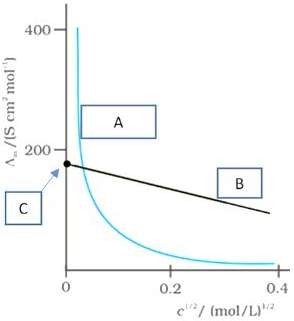
The molar conductivity of a solution at any given concentration is the conductance of the volume of solution containing one mole of electrolyte kept between two platinum electrodes with unit area of cross-section and at a distance of unit length. Both conductivity and molar conductivity change with the concentration of the electrolyte. Kohlrausch examined Λm∘\Lambda^\circ_m values for a number of strong electrolytes and observed certain regularities. He noted that the difference in Λm∘\Lambda^\circ_m of the electrolytes NaX and KX for any X is nearly constant. On the basis of the above observations, he enunciated the Kohlrausch law of independent migration of ions.

Figure

Identify electrolyte A and B in the given image.

Answer options

Q28:

2025: 19 May Shift 2

Electrochemistry

Easy

The molar conductivity of a solution at any given concentration is the conductance of the volume of solution containing one mole of electrolyte kept between two platinum electrodes with unit area of cross-section and at a distance of unit length. Both conductivity and molar conductivity change with the concentration of the electrolyte. Kohlrausch examined Λm∘\Lambda^\circ_m values for a number of strong electrolytes and observed certain regularities. He noted that the difference in Λm∘\Lambda^\circ_m of the electrolytes NaX and KX for any X is nearly constant. On the basis of the above observations, he enunciated the Kohlrausch law of independent migration of ions.

Figure

Point C in the image is called

Answer options

Q29:

2025: 19 May Shift 2

Electrochemistry

Medium

The molar conductivity of a solution at any given concentration is the conductance of the volume of solution containing one mole of electrolyte kept between two platinum electrodes with unit area of cross-section and at a distance of unit length. Both conductivity and molar conductivity change with the concentration of the electrolyte. Kohlrausch examined Λm∘\Lambda^\circ_m values for a number of strong electrolytes and observed certain regularities. He noted that the difference in Λm∘\Lambda^\circ_m of the electrolytes NaX and KX for any X is nearly constant. On the basis of the above observations, he enunciated the Kohlrausch law of independent migration of ions.

Figure

A 0.001 mol L−1^{-1} solution of acetic acid shows conductivity of 5.02×10−55.02 \times 10^{-5} S cm−1^{-1}. If Λm∘\Lambda^\circ_m for acetic acid is 390 cm2^2 mol−1^{-1}, then the degree of dissociation is

Answer options

Q30:

2025: 19 May Shift 2

Electrochemistry

Medium

The molar conductivity of a solution at any given concentration is the conductance of the volume of solution containing one mole of electrolyte kept between two platinum electrodes with unit area of cross-section and at a distance of unit length. Both conductivity and molar conductivity change with the concentration of the electrolyte. Kohlrausch examined Λm∘\Lambda^\circ_m values for a number of strong electrolytes and observed certain regularities. He noted that the difference in Λm∘\Lambda^\circ_m of the electrolytes NaX and KX for any X is nearly constant. On the basis of the above observations, he enunciated the Kohlrausch law of independent migration of ions.

Figure

The decrease in molar conductivity of a weak electrolyte on increasing the concentration for a fixed volume is due to

Answer options