CUET Chemistry: ChemistryElectrochemistry. Free, no login required.

Q1:

2025: 19 May Shift 2

Electrochemistry

Easy

The molar conductivity of a solution at any given concentration is the conductance of the volume of solution containing one mole of electrolyte kept between two platinum electrodes with unit area of cross-section and at a distance of unit length. Both conductivity and molar conductivity change with the concentration of the electrolyte. Kohlrausch examined Λm∘\Lambda^\circ_m values for a number of strong electrolytes and observed certain regularities. He noted that the difference in Λm∘\Lambda^\circ_m of the electrolytes NaX and KX for any X is nearly constant. On the basis of the above observations, he enunciated the Kohlrausch law of independent migration of ions.
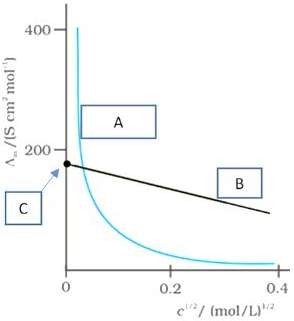
Figure

Units of conductivity and molar conductivity are, respectively

Answer options
Option 1
Correct Answer
Explanation for 2025: 19 May Shift 2 CHE question 1

Q2:

2025: 16 May Shift 1

Electrochemistry

Easy

Molar conductivity (Λm\Lambda_m) of a solution at a given concentration (cc) is the conductance of volume, VV of solution, containing one mole of electrolyte kept between the two electrodes with area of cross-section AA and at a distance of unit length. It increases with the decrease in concentration and when the concentration approaches zero, the molar conductivity is called limiting molar conductivity (Λm0\Lambda_m^0). For a strong electrolyte, Λm\Lambda_m increases linearly with dilution and is given by Λm=Λm0−Ac1/2\Lambda_m = \Lambda_m^0 - Ac^{1/2}. The value of the constant A for a given solvent depends on the type of electrolyte along with temperature. According to Kohlrausch law, the value of Λm0\Lambda_m^0 for an electrolyte is Λm0=v+λ+0+v−λ−0\Lambda_m^0 = v_+\lambda_+^0 + v_-\lambda_-^0, where v+v_+ and v−v_- are the number of cations and anions, respectively, per molecule of the electrolyte and λ+0\lambda_+^0 and λ−0\lambda_-^0 are limiting molar conductivities of cation and anion, respectively. Kohlrausch law finds many applications, like determining the solubility of a sparingly soluble salt, determining the degree of dissociation (Λm/Λm0\Lambda_m/\Lambda_m^0) and the dissociation constant of a weak electrolyte.

The plot between Λm\Lambda_m and c1/2c^{1/2} is a straight line with

Answer options
Option 4
Correct Answer
Explanation for 2025: 16 May Shift 1 CHE question 2

Q3:

2025: 16 May Shift 1

Electrochemistry

Easy

Molar conductivity (Λm\Lambda_m) of a solution at a given concentration (cc) is the conductance of volume, VV of solution, containing one mole of electrolyte kept between the two electrodes with area of cross-section AA and at a distance of unit length. It increases with the decrease in concentration and when the concentration approaches zero, the molar conductivity is called limiting molar conductivity (Λm0\Lambda_m^0). For a strong electrolyte, Λm\Lambda_m increases linearly with dilution and is given by Λm=Λm0−Ac1/2\Lambda_m = \Lambda_m^0 - Ac^{1/2}. The value of the constant A for a given solvent depends on the type of electrolyte along with temperature. According to Kohlrausch law, the value of Λm0\Lambda_m^0 for an electrolyte is Λm0=v+λ+0+v−λ−0\Lambda_m^0 = v_+\lambda_+^0 + v_-\lambda_-^0, where v+v_+ and v−v_- are the number of cations and anions, respectively, per molecule of the electrolyte and λ+0\lambda_+^0 and λ−0\lambda_-^0 are limiting molar conductivities of cation and anion, respectively. Kohlrausch law finds many applications, like determining the solubility of a sparingly soluble salt, determining the degree of dissociation (Λm/Λm0\Lambda_m/\Lambda_m^0) and the dissociation constant of a weak electrolyte.

Which one of the following has a different value of constant A in water?

Answer options
Option 1
Correct Answer
Explanation for 2025: 16 May Shift 1 CHE question 3

Q4:

2025: 16 May Shift 1

Electrochemistry

Medium

Molar conductivity (Λm\Lambda_m) of a solution at a given concentration (cc) is the conductance of volume, VV of solution, containing one mole of electrolyte kept between the two electrodes with area of cross-section AA and at a distance of unit length. It increases with the decrease in concentration and when the concentration approaches zero, the molar conductivity is called limiting molar conductivity (Λm0\Lambda_m^0). For a strong electrolyte, Λm\Lambda_m increases linearly with dilution and is given by Λm=Λm0−Ac1/2\Lambda_m = \Lambda_m^0 - Ac^{1/2}. The value of the constant A for a given solvent depends on the type of electrolyte along with temperature. According to Kohlrausch law, the value of Λm0\Lambda_m^0 for an electrolyte is Λm0=v+λ+0+v−λ−0\Lambda_m^0 = v_+\lambda_+^0 + v_-\lambda_-^0, where v+v_+ and v−v_- are the number of cations and anions, respectively, per molecule of the electrolyte and λ+0\lambda_+^0 and λ−0\lambda_-^0 are limiting molar conductivities of cation and anion, respectively. Kohlrausch law finds many applications, like determining the solubility of a sparingly soluble salt, determining the degree of dissociation (Λm/Λm0\Lambda_m/\Lambda_m^0) and the dissociation constant of a weak electrolyte.

The unit of constant A is:

Answer options
Option 3
Correct Answer
Explanation for 2025: 16 May Shift 1 CHE question 4

Q5:

2025: 16 May Shift 1

Electrochemistry

Medium

Molar conductivity (Λm\Lambda_m) of a solution at a given concentration (cc) is the conductance of volume, VV of solution, containing one mole of electrolyte kept between the two electrodes with area of cross-section AA and at a distance of unit length. It increases with the decrease in concentration and when the concentration approaches zero, the molar conductivity is called limiting molar conductivity (Λm0\Lambda_m^0). For a strong electrolyte, Λm\Lambda_m increases linearly with dilution and is given by Λm=Λm0−Ac1/2\Lambda_m = \Lambda_m^0 - Ac^{1/2}. The value of the constant A for a given solvent depends on the type of electrolyte along with temperature. According to Kohlrausch law, the value of Λm0\Lambda_m^0 for an electrolyte is Λm0=v+λ+0+v−λ−0\Lambda_m^0 = v_+\lambda_+^0 + v_-\lambda_-^0, where v+v_+ and v−v_- are the number of cations and anions, respectively, per molecule of the electrolyte and λ+0\lambda_+^0 and λ−0\lambda_-^0 are limiting molar conductivities of cation and anion, respectively. Kohlrausch law finds many applications, like determining the solubility of a sparingly soluble salt, determining the degree of dissociation (Λm/Λm0\Lambda_m/\Lambda_m^0) and the dissociation constant of a weak electrolyte.

If the molar conductance values of Ca2+^{2+} and Cl−^- at infinite dilution are, respectively, 118.8×10−4118.8 \times 10^{-4} ohm−1^{-1} m2^2 mol−1^{-1} and 77.33×10−477.33 \times 10^{-4} ohm−1^{-1} m2^2 mol−1^{-1}, then the molar conductance of CaCl2_2 at infinite dilution will be:

Answer options
Option 1
Correct Answer
Explanation for 2025: 16 May Shift 1 CHE question 5

Q6:

2025: 16 May Shift 1

Electrochemistry

Medium

Molar conductivity (Λm\Lambda_m) of a solution at a given concentration (cc) is the conductance of volume, VV of solution, containing one mole of electrolyte kept between the two electrodes with area of cross-section AA and at a distance of unit length. It increases with the decrease in concentration and when the concentration approaches zero, the molar conductivity is called limiting molar conductivity (Λm0\Lambda_m^0). For a strong electrolyte, Λm\Lambda_m increases linearly with dilution and is given by Λm=Λm0−Ac1/2\Lambda_m = \Lambda_m^0 - Ac^{1/2}. The value of the constant A for a given solvent depends on the type of electrolyte along with temperature. According to Kohlrausch law, the value of Λm0\Lambda_m^0 for an electrolyte is Λm0=v+λ+0+v−λ−0\Lambda_m^0 = v_+\lambda_+^0 + v_-\lambda_-^0, where v+v_+ and v−v_- are the number of cations and anions, respectively, per molecule of the electrolyte and λ+0\lambda_+^0 and λ−0\lambda_-^0 are limiting molar conductivities of cation and anion, respectively. Kohlrausch law finds many applications, like determining the solubility of a sparingly soluble salt, determining the degree of dissociation (Λm/Λm0\Lambda_m/\Lambda_m^0) and the dissociation constant of a weak electrolyte.

If the equivalent conductivity of 1 M Phthalic acid is 12.8 S cm2^2 eq−1^{-1} and the limiting equivalent conductivities of the hydrogen and Phthalate ions are 42 and 288.42 S cm2^2 eq−1^{-1}, respectively, the degree of dissociation of Phthalic acid will be:

Answer options
Option 4
Correct Answer
Explanation for 2025: 16 May Shift 1 CHE question 6

Q7:

2025: 15 May Shift 2

Electrochemistry

Medium

Which of the statements given below are correct with reference to corrosion:

(A) Corrosion covers the surfaces of metallic objects with oxides or other salts.

(B) In corrosion, a metal is oxidised by the loss of electrons to oxygen and results in the formation of oxides.

(C) Rust is hydrated ferric oxide.

(D) A sacrificial electrode is used to save an object from corrosion.

Answer options
Option 3
Correct Answer
Explanation for 2025: 15 May Shift 2 CHE question 7

Q8:

2025: 15 May Shift 2

Electrochemistry

Medium

Four different electrolyte solutions with the concentrations given below have the same molar conductivity value of 1.29×10⁻⁴ S m2 mol−11.29 \times 10^{-4}\ S\ m^2\ mol^{-1}. Arrange them in increasing order of their conductivity values:

(A) 0.1 M

(B) 0.075 M

(C) 0.15 M

(D) 0.05 M

Answer options
Option 4
Correct Answer
Explanation for 2025: 15 May Shift 2 CHE question 8

Q9:

2025: 15 May Shift 2

Electrochemistry

Medium

For the following reaction, at equilibrium the Nernst equation may be written as:

Zn(s)+Cu2+(aq)→Zn2+(aq)+Cu(s)Zn(s) + Cu^{2+}(aq) \rightarrow Zn^{2+}(aq) + Cu(s)

Answer options
Option 2
Correct Answer
Explanation for 2025: 15 May Shift 2 CHE question 9

Q10:

2025: 15 May Shift 2

Electrochemistry

Easy

The unit for molar conductivity is

Answer options

Q11:

2025: 15 May Shift 2

Electrochemistry

Easy

The conductivity of electrolytic solutions does not depend upon

Answer options

Q12:

2025: 15 May Shift 1

Electrochemistry

Easy

Λmo\Lambda_m^o for NaCl, HCl and CH3_3COONa are 126.4, 425.9 and 91.0 S cm2^2 mol−1^{-1} respectively. Calculate Λmo\Lambda_m^o for CH3_3COOH

Answer options

Q13:

2025: 15 May Shift 1

Electrochemistry

Easy

The limiting molar conductivities for H+^+, Na+^+, Cl−^-, CH3_3COO−^- are 349.6, 50.1, 76.3, 40.9 S cm2^2 mol−1^{-1}, respectively, in water at 298 K.

Match List-I with List-II

List-IList-II
ElectrolyteΛmo\Lambda_m^o
(A) HCl(I) 390.5 S cm2^2 mol−1^{-1}
(B) NaCl(II) 126.4 S cm2^2 mol−1^{-1}
(C) CH3_3COONa(III) 425.9 S cm2^2 mol−1^{-1}
(D) CH3_3COOH(IV) 91.0 S cm2^2 mol−1^{-1}
Answer options

Q14:

2025: 15 May Shift 1

Electrochemistry

Medium

Calculate the emf of the following cell at 298 K if ECello=1.10E^o_{Cell} = 1.10 V:

Ni(s)+2Ag+(0.2M)→Ni2+(0.04M)+2Ag(s)Ni(s) + 2Ag^+(0.2M) \rightarrow Ni^{2+}(0.04M) + 2Ag(s)

Answer options

Q15:

2025: 15 May Shift 1

Electrochemistry

Medium

The resistance of 1N solution of four different electrolytes are given below. Arrange them in increasing order of their equivalent conductance values if the same conductivity cell was used to measure the resistance of all the electrolytic solutions:

(A) 250 ohm

(B) 150 ohm

(C) 50 ohm

(D) 280 ohm

Answer options

Q16:

2025: 15 May Shift 1

Electrochemistry

Medium

The conductivity of 0.001 mol L−1^{-1} solution of a weak monobasic acid is 4.0×10−54.0 \times 10^{-5} S cm−1^{-1}. Calculate its dissociation constant if Λmo\Lambda_m^o for weak acid is 400.0 S cm2^2 mol−1^{-1}.

Answer options

Q17:

2025: 14 May Shift 2

Electrochemistry

Medium

When we consider an inert electrode in a cell; which statement is not suitable for it?

(A) It provides surface either for oxidation or for reduction reaction.

(B) It does not participate in the cell reaction.

(C) It provides surface for redox reaction.

(D) It provides surface for conduction of electrons.

Answer options

Q18:

2025: 14 May Shift 2

Electrochemistry

Medium

If the molar conductivities at infinite dilution for CH3COOKCH_3COOK, K2SO4K_2SO_4 and H2SO4H_2SO_4 are respectively, z, y and x (S cm2 mol−1\text{S cm}^2\ \text{mol}^{-1}), the molar conductivity of CH3COOHCH_3COOH at infinite dilution will be:

Answer options

Q20:

2025: 14 May Shift 2

Electrochemistry

Easy

Which one of the following statements regarding the electrolytic solution is not correct?

Answer options

Q22:

2025: 14 May Shift 1

Electrochemistry

Medium

The aqueous solution of ZnSO4\mathrm{ZnSO_4}, AgNO3\mathrm{AgNO_3}, FeCl3\mathrm{FeCl_3} and WCl6\mathrm{WCl_6} are electrolyzed for 2 hours using a current of 5 amperes. The decreasing order of mass deposited of the following metals at cathode will be ........

(A) Zn

(B) Ag

(C) Fe

(D) W

(atomic mass: Fe =56 g mol−1\mathrm{g\ mol^{-1}}, Zn =65 g mol−1\mathrm{g\ mol^{-1}}, Ag = 108 g mol−1\mathrm{g\ mol^{-1}}, W = 184 g mol−1\mathrm{g\ mol^{-1}})

Answer options

Q23:

2025: 14 May Shift 1

Electrochemistry

Easy

The correct SI unit of molar conductivity is ........

Answer options

Q24:

2025: 14 May Shift 1

Electrochemistry

Easy

From the given standard reduction potentials, arrange the metals in decreasing order of their reducing power.

(A) EZn2+/Zn0=−0.76VE^0_{\mathrm{Zn^{2+}/Zn}} = -0.76V

(B) EMg2+/Mg0=−2.37E^0_{\mathrm{Mg^{2+}/Mg}} = -2.37 V

(C) EAl3+/Al0=−1.67E^0_{\mathrm{Al^{3+}/Al}} = -1.67 V

(D) EAg+/Ag0=+0.80E^0_{\mathrm{Ag^{+}/Ag}} = +0.80 V

Answer options

Q25:

2025: 14 May Shift 1

Electrochemistry

Easy

The half-cell reaction is the one that .......

Answer options

Q26:

2025: 14 May Shift 1

Electrochemistry

Easy

The standard reduction potential of Ag+/Ag\mathrm{Ag^+/Ag} electrode is +0.80 V. Choose the correct statement based on this information.

Answer options

Q27:

2025: 13 May Shift 2

Electrochemistry

Easy

When a metal is placed in a solution of its ions, the metal can lose electron and can go in the solution as ion or the metal ion in the solution can take electron from the electrode and get deposited as metal. Thus, the electrode acquires either positive or negative charge with respect to the solution leading to the development of a potential difference between the metal electrode and the solution. This potential difference is called the electrode potential of the metal. The electrode potential of a metal is a measure of relative tendency to undergo oxidation (loss of electron) or reduction (gain of electron). When the concentration of the ions in the solution is unity, the electrode potential is called standard electrode potential. The magnitude of potential depends upon the nature of electrode, concentration of ions in solution and the temperature. In a galvanic cell, the electrode at which oxidation occurs is known as anodic half-cell and the electrode at which reduction occurs is known as cathodic half cell. The emf of the cell in terms of standard reduction potential is given by Ecello=Ecathodeo−EanodeoE^{o}_{cell} = E^{o}_{cathode} - E^{o}_{anode}. The standard free energy change of the redox reaction taking place in the cell is related to EcelloE^{o}_{cell} by ΔGo=−nFEo\Delta G^{o} = -nFE^{o}. A redox reaction would occur spontaneously if the free energy change is negative. The equilibrium constant of the reaction is related to the standard free energy change by ΔGo=−RTln⁡K\Delta G^{o} = -RT \ln K.

The equilibrium constant of a feasible cell reaction is

Answer options

Q28:

2025: 13 May Shift 2

Electrochemistry

Easy

When a metal is placed in a solution of its ions, the metal can lose electron and can go in the solution as ion or the metal ion in the solution can take electron from the electrode and get deposited as metal. Thus, the electrode acquires either positive or negative charge with respect to the solution leading to the development of a potential difference between the metal electrode and the solution. This potential difference is called the electrode potential of the metal. The electrode potential of a metal is a measure of relative tendency to undergo oxidation (loss of electron) or reduction (gain of electron). When the concentration of the ions in the solution is unity, the electrode potential is called standard electrode potential. The magnitude of potential depends upon the nature of electrode, concentration of ions in solution and the temperature. In a galvanic cell, the electrode at which oxidation occurs is known as anodic half-cell and the electrode at which reduction occurs is known as cathodic half cell. The emf of the cell in terms of standard reduction potential is given by Ecello=Ecathodeo−EanodeoE^{o}_{cell} = E^{o}_{cathode} - E^{o}_{anode}. The standard free energy change of the redox reaction taking place in the cell is related to EcelloE^{o}_{cell} by ΔGo=−nFEo\Delta G^{o} = -nFE^{o}. A redox reaction would occur spontaneously if the free energy change is negative. The equilibrium constant of the reaction is related to the standard free energy change by ΔGo=−RTln⁡K\Delta G^{o} = -RT \ln K.

The standard oxidation potentials E0E^0 for the half cell reactions are

Zn→Zn2++2e−Zn \rightarrow Zn^{2+} + 2e^- : E0E^0 = + 0.76 V

Fe→Fe2++2e−Fe \rightarrow Fe^{2+} + 2e^- : E0E^0 = + 0.41 V

The emf of cell Fe2++Zn→Zn2++FeFe^{2+} + Zn \rightarrow Zn^{2+} + Fe is________

Answer options

Q29:

2025: 13 May Shift 2

Electrochemistry

Medium

When a metal is placed in a solution of its ions, the metal can lose electron and can go in the solution as ion or the metal ion in the solution can take electron from the electrode and get deposited as metal. Thus, the electrode acquires either positive or negative charge with respect to the solution leading to the development of a potential difference between the metal electrode and the solution. This potential difference is called the electrode potential of the metal. The electrode potential of a metal is a measure of relative tendency to undergo oxidation (loss of electron) or reduction (gain of electron). When the concentration of the ions in the solution is unity, the electrode potential is called standard electrode potential. The magnitude of potential depends upon the nature of electrode, concentration of ions in solution and the temperature. In a galvanic cell, the electrode at which oxidation occurs is known as anodic half-cell and the electrode at which reduction occurs is known as cathodic half cell. The emf of the cell in terms of standard reduction potential is given by Ecello=Ecathodeo−EanodeoE^{o}_{cell} = E^{o}_{cathode} - E^{o}_{anode}. The standard free energy change of the redox reaction taking place in the cell is related to EcelloE^{o}_{cell} by ΔGo=−nFEo\Delta G^{o} = -nFE^{o}. A redox reaction would occur spontaneously if the free energy change is negative. The equilibrium constant of the reaction is related to the standard free energy change by ΔGo=−RTln⁡K\Delta G^{o} = -RT \ln K.

The measured potential for

Ag++e−→Ag(s)Ag^+ + e^- \rightarrow Ag(s)

does not change with

Answer options

Q30:

2025: 13 May Shift 2

Electrochemistry

Easy

When a metal is placed in a solution of its ions, the metal can lose electron and can go in the solution as ion or the metal ion in the solution can take electron from the electrode and get deposited as metal. Thus, the electrode acquires either positive or negative charge with respect to the solution leading to the development of a potential difference between the metal electrode and the solution. This potential difference is called the electrode potential of the metal. The electrode potential of a metal is a measure of relative tendency to undergo oxidation (loss of electron) or reduction (gain of electron). When the concentration of the ions in the solution is unity, the electrode potential is called standard electrode potential. The magnitude of potential depends upon the nature of electrode, concentration of ions in solution and the temperature. In a galvanic cell, the electrode at which oxidation occurs is known as anodic half-cell and the electrode at which reduction occurs is known as cathodic half cell. The emf of the cell in terms of standard reduction potential is given by Ecello=Ecathodeo−EanodeoE^{o}_{cell} = E^{o}_{cathode} - E^{o}_{anode}. The standard free energy change of the redox reaction taking place in the cell is related to EcelloE^{o}_{cell} by ΔGo=−nFEo\Delta G^{o} = -nFE^{o}. A redox reaction would occur spontaneously if the free energy change is negative. The equilibrium constant of the reaction is related to the standard free energy change by ΔGo=−RTln⁡K\Delta G^{o} = -RT \ln K.

The standard reduction potential of Zinc is represented by the reaction

Answer options