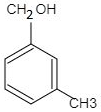
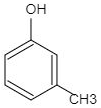
CUET Chemistry: ChemistryAlcohols, Phenols & Ethers. Free, no login required.

Q1:

2025: 15 May Shift 2

Alcohols, Phenols & Ethers

Easy

Alcohols are versatile compounds as they can act as both nucleophile and electrophiles. They undergo reactions based on cleavage of O-H and C-O bonds. The cleavage of O-H bond reflects the acidic character of alcohols. However they are weaker acids than water, phenol and carboxylic acids. Alkoxide ion formed by loss of proton from the OH group of alcohols react with water to form the corresponding conjugate acid - base pair. They act as Bronsted base due to presence of unshared electron pairs on oxygen.Both alcohols and phenol react with carboxylic acids, acid chlorides and anhydrides to form esters. The introduction of acetyl group in alcohols or phenol is known as acetylation. Alcohols react with hydrogen halides to form alkyl halides which form the basis of Lucas test. They also undergo acid catalyzed dehydration to form alkenes. Alcohols can be easily oxidized with variety of oxidizing agents. The nature of the product depends on the type of oxidizing agent and the nature of alcohol.

Oxidation of alcohols involves formation of carbon oxygen double bond with
Answer options
Option 3
Correct Answer
Explanation for 2025: 15 May Shift 2 CHE question 1

Q2:

2025: 15 May Shift 2

Alcohols, Phenols & Ethers

Medium

Alcohols are versatile compounds as they can act as both nucleophile and electrophiles. They undergo reactions based on cleavage of O-H and C-O bonds. The cleavage of O-H bond reflects the acidic character of alcohols. However they are weaker acids than water, phenol and carboxylic acids. Alkoxide ion formed by loss of proton from the OH group of alcohols react with water to form the corresponding conjugate acid - base pair. They act as Bronsted base due to presence of unshared electron pairs on oxygen.Both alcohols and phenol react with carboxylic acids, acid chlorides and anhydrides to form esters. The introduction of acetyl group in alcohols or phenol is known as acetylation. Alcohols react with hydrogen halides to form alkyl halides which form the basis of Lucas test. They also undergo acid catalyzed dehydration to form alkenes. Alcohols can be easily oxidized with variety of oxidizing agents. The nature of the product depends on the type of oxidizing agent and the nature of alcohol.

Identify the most acidic alcohol among the following:

Answer options
Option 1
Correct Answer
Explanation for 2025: 15 May Shift 2 CHE question 2

Q3:

2025: 15 May Shift 2

Alcohols, Phenols & Ethers

Easy

Alcohols are versatile compounds as they can act as both nucleophile and electrophiles. They undergo reactions based on cleavage of O-H and C-O bonds. The cleavage of O-H bond reflects the acidic character of alcohols. However they are weaker acids than water, phenol and carboxylic acids. Alkoxide ion formed by loss of proton from the OH group of alcohols react with water to form the corresponding conjugate acid - base pair. They act as Bronsted base due to presence of unshared electron pairs on oxygen.Both alcohols and phenol react with carboxylic acids, acid chlorides and anhydrides to form esters. The introduction of acetyl group in alcohols or phenol is known as acetylation. Alcohols react with hydrogen halides to form alkyl halides which form the basis of Lucas test. They also undergo acid catalyzed dehydration to form alkenes. Alcohols can be easily oxidized with variety of oxidizing agents. The nature of the product depends on the type of oxidizing agent and the nature of alcohol.

Lucas reagent is

Answer options
Option 1
Correct Answer
Explanation for 2025: 15 May Shift 2 CHE question 3

Q4:

2025: 15 May Shift 1

Alcohols, Phenols & Ethers

Easy

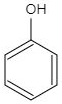
Pick the correct structure for carbolic acid among the following compounds:

Answer options
Option 4
Correct Answer
Explanation for 2025: 15 May Shift 1 CHE question 4

Q5:

2025: 15 May Shift 1

Alcohols, Phenols & Ethers

Medium

Arrange the following compounds in increasing order of their acidic character.

(A) mm-nitrophenol

(B) pp-nitrophenol

(C) Phenol

(D) pp-methoxyphenol

Answer options
Option 4
Correct Answer
Explanation for 2025: 15 May Shift 1 CHE question 5

Q6:

2025: 15 May Shift 1

Alcohols, Phenols & Ethers

Medium

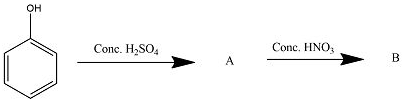
Consider the following reaction and identify A and B.

Figure

Answer options
Option 1
Correct Answer
Explanation for 2025: 15 May Shift 1 CHE question 6

Q7:

2025: 15 May Shift 1

Alcohols, Phenols & Ethers

Easy

Match List-I with List-II

List-IList-II
(Name reaction.)(Reaction)
(A) Williamson ether synthesis(I) Figure
(B) Hydroboration oxidation(II) Figure
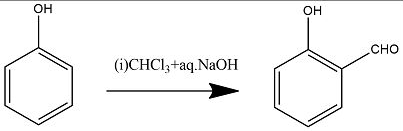
(C) Reimer-Tiemann reaction(III) Figure
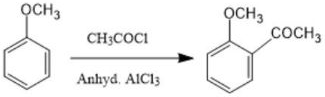
(D) Friedel Craft Acylation reaction(IV) Figure
Answer options
Option 3
Correct Answer
Explanation for 2025: 15 May Shift 1 CHE question 7

Q8:

2025: 14 May Shift 2

Alcohols, Phenols & Ethers

Easy

What is the first step in acid catalyzed dehydration of alcohol?

Answer options
Option 4
Correct Answer
Explanation for 2025: 14 May Shift 2 CHE question 8

Q9:

2025: 14 May Shift 2

Alcohols, Phenols & Ethers

Easy

The reaction of phenol with chloroform in the presence of sodium hydroxide gives

Answer options
Option 3
Correct Answer
Explanation for 2025: 14 May Shift 2 CHE question 9

Q10:

2025: 14 May Shift 2

Alcohols, Phenols & Ethers

Medium

The composition of Lucas reagent is

Answer options

Q11:

2025: 14 May Shift 2

Alcohols, Phenols & Ethers

Easy

Match List-I with List-II

List-IList-II
(A) Kolbe's reaction(I) Preparation of symmetrical and unsymmetrical ethers
(B) Williamson synthesis(II) Preparation of Salicylic acid
(C) Lucas test(III) Organo-Magnesium halide
(D) Grignard's reagent(IV) Distinction between different types of alcohols
Answer options

Q12:

2025: 14 May Shift 1

Alcohols, Phenols & Ethers

Easy

The C-O-H bond angle in alcohols is slightly less than tetrahedral angle 109°28' due to

Answer options

Q13:

2025: 14 May Shift 1

Alcohols, Phenols & Ethers

Medium

The reagents used for dehydration of alcohols

(A) Conc. H2SO4\mathrm{H_2SO_4}

(B) Phosphoric acid

(C) Alumina

(D) Anhydrous ZnCl2\mathrm{ZnCl_2}

Answer options

Q14:

2025: 13 May Shift 2

Alcohols, Phenols & Ethers

Medium

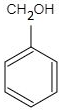
Which of the following compounds are aromatic alcohols?

(A). Figure

(B). Figure

(C). Figure

(D). Figure

Answer options

Q15:

2025: 13 May Shift 2

Alcohols, Phenols & Ethers

Easy

Anisole on heating with concentrated HI gives

Answer options

Q17:

2025: 13 May Shift 2

Alcohols, Phenols & Ethers

Medium

What is the product formed when tertiary alcohol is treated with alkaline KMnO4KMnO_4 at elevated temperature?

Answer options

Q18:

2025: 13 May Shift 1

Alcohols, Phenols & Ethers

Medium

Arrange the following compounds in increasing order of their acidic strength:

(A) 3-nitrophenol

(B) 3,5-Dinitrophenol

(C) 2,4,6 -Trinitrophenol

(D) Phenol

Answer options

Q19:

2025: 13 May Shift 1

Alcohols, Phenols & Ethers

Medium

The reagent(s) used in hydroboration oxidation of propene are

(A) B2_2H6_6

(B) H2_2O

(C) H2_2O2_2

(D) OH−^{-}

Answer options

Q20:

2025: 13 May Shift 1

Alcohols, Phenols & Ethers

Easy

What happens when C6_6H5_5-O-R is treated with HX?

Answer options

Q21:

2025: 13 May Shift 1

Alcohols, Phenols & Ethers

Easy

Replacement of a hydrogen atom in a hydrocarbon by an alkoxy or carboxyl group yields a class of compounds known as ethers. Ethers are classified as symmetrical or unsymmetrical on the basis of groups attached to the oxygen atoms. Diethyl ether, a symmetrical ether, has been widely used as an inhalation anesthetic. Ethers can be prepared by acid catalyzed intermolecular dehydration of alcohols and Williamson's synthesis. Acid catalyzed dehydration of alcohols is not generally preferred as it gives a mixture of elimination and substitution products. In Williamson's synthesis, an alkyl halide is allowed to react with sodium alkoxide. Ethers containing substituted Alkyl groups may also be prepared by this method. The C-O bond in ether is weakly polar and is cleaved under drastic conditions with excess of hydrogen halides. In electrophilic substitution, the alkoxy group deactivates the aromatic ring and directs the incoming group to ortho and para positions.

When ethanol is dehydrated in the presence of H2_2SO4_4, at 443K and 413 K respectively the products formed are

Answer options

Q22:

2025: 13 May Shift 1

Alcohols, Phenols & Ethers

Medium

Replacement of a hydrogen atom in a hydrocarbon by an alkoxy or carboxyl group yields a class of compounds known as ethers. Ethers are classified as symmetrical or unsymmetrical on the basis of groups attached to the oxygen atoms. Diethyl ether, a symmetrical ether, has been widely used as an inhalation anesthetic. Ethers can be prepared by acid catalyzed intermolecular dehydration of alcohols and Williamson's synthesis. Acid catalyzed dehydration of alcohols is not generally preferred as it gives a mixture of elimination and substitution products. In Williamson's synthesis, an alkyl halide is allowed to react with sodium alkoxide. Ethers containing substituted Alkyl groups may also be prepared by this method. The C-O bond in ether is weakly polar and is cleaved under drastic conditions with excess of hydrogen halides. In electrophilic substitution, the alkoxy group deactivates the aromatic ring and directs the incoming group to ortho and para positions.

The major product in the reaction of anisole with bromine in ethanoic acid, is:

Answer options

Q23:

2025: 13 May Shift 1

Alcohols, Phenols & Ethers

Easy

Replacement of a hydrogen atom in a hydrocarbon by an alkoxy or carboxyl group yields a class of compounds known as ethers. Ethers are classified as symmetrical or unsymmetrical on the basis of groups attached to the oxygen atoms. Diethyl ether, a symmetrical ether, has been widely used as an inhalation anesthetic. Ethers can be prepared by acid catalyzed intermolecular dehydration of alcohols and Williamson's synthesis. Acid catalyzed dehydration of alcohols is not generally preferred as it gives a mixture of elimination and substitution products. In Williamson's synthesis, an alkyl halide is allowed to react with sodium alkoxide. Ethers containing substituted Alkyl groups may also be prepared by this method. The C-O bond in ether is weakly polar and is cleaved under drastic conditions with excess of hydrogen halides. In electrophilic substitution, the alkoxy group deactivates the aromatic ring and directs the incoming group to ortho and para positions.

In Williamson synthesis, the alkoxide ion attacks the alkyl halide via which pathway?

Answer options

Q24:

2025: 13 May Shift 1

Alcohols, Phenols & Ethers

Easy

Replacement of a hydrogen atom in a hydrocarbon by an alkoxy or carboxyl group yields a class of compounds known as ethers. Ethers are classified as symmetrical or unsymmetrical on the basis of groups attached to the oxygen atoms. Diethyl ether, a symmetrical ether, has been widely used as an inhalation anesthetic. Ethers can be prepared by acid catalyzed intermolecular dehydration of alcohols and Williamson's synthesis. Acid catalyzed dehydration of alcohols is not generally preferred as it gives a mixture of elimination and substitution products. In Williamson's synthesis, an alkyl halide is allowed to react with sodium alkoxide. Ethers containing substituted Alkyl groups may also be prepared by this method. The C-O bond in ether is weakly polar and is cleaved under drastic conditions with excess of hydrogen halides. In electrophilic substitution, the alkoxy group deactivates the aromatic ring and directs the incoming group to ortho and para positions.

Which is most reactive hydrogen halide for cleavage of ethers?

Answer options

Q25:

2025: 13 May Shift 1

Alcohols, Phenols & Ethers

Easy

Replacement of a hydrogen atom in a hydrocarbon by an alkoxy or carboxyl group yields a class of compounds known as ethers. Ethers are classified as symmetrical or unsymmetrical on the basis of groups attached to the oxygen atoms. Diethyl ether, a symmetrical ether, has been widely used as an inhalation anesthetic. Ethers can be prepared by acid catalyzed intermolecular dehydration of alcohols and Williamson's synthesis. Acid catalyzed dehydration of alcohols is not generally preferred as it gives a mixture of elimination and substitution products. In Williamson's synthesis, an alkyl halide is allowed to react with sodium alkoxide. Ethers containing substituted Alkyl groups may also be prepared by this method. The C-O bond in ether is weakly polar and is cleaved under drastic conditions with excess of hydrogen halides. In electrophilic substitution, the alkoxy group deactivates the aromatic ring and directs the incoming group to ortho and para positions.

Which type of ether is anisole ?

Answer options