
A copper rod of length 20 cm and cross-sectional area 2 mm is joined with an identical aluminium rod as shown in the figure. The resistance of the combination between the two ends (A and B) is approximately
(Given: Resistivity of Cu = m and resistivity of Al = m) 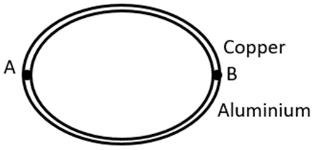
A copper rod of length 20 cm and cross-sectional area 2 mm is joined with an identical aluminium rod as shown in the figure. The resistance of the combination between the two ends (A and B) is approximately
(Given: Resistivity of Cu = m and resistivity of Al = m)
Solution
✅ Correct Option: 2
The figure shows the two rods joined at both ends A and B, so they are in parallel between A and B.
Resistance of each rod: , with m and m.
For parallel resistances:
Option 1: 4.3 would be the series sum in m, and here it is also written in , which is off by a factor of 1000.
Related questions:
2025: 14 May Shift 2
2025: 3 June Shift 1
2026: 25 May Shift 1