
The diagram shows four energy levels of an electron in Bohr's model of hydrogen atom. Identify the transition in which the emitted photon will have shortest wavelength. 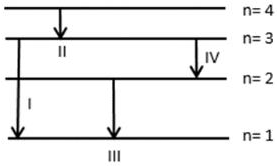
The diagram shows four energy levels of an electron in Bohr's model of hydrogen atom. Identify the transition in which the emitted photon will have shortest wavelength.
Solution
✅ Correct Option: 1
Wavelength is shortest when the photon energy is largest, since . So we need the transition with the largest energy gap, using eV.
In the diagram, I is , II is , III is and IV is .
| Transition | Levels | (eV) |
|---|---|---|
| I | ||
| II | ||
| III | ||
| IV |
The largest gap is for I, so it gives the shortest wavelength:
Option 3: III also ends at , but it starts from , so its gap (10.2 eV) is smaller than that of .
Related questions:
2025: 13 May Shift 2
2026: 19 May Shift 2
2026: 20 May Shift 2