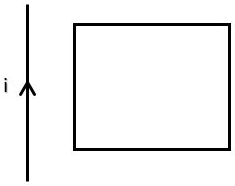
A long hollow metallic cylinder is held vertically. A small bar magnet is dropped along its axis. Finally it will fall with (Given: g is acceleration due to gravity)
A long hollow metallic cylinder is held vertically. A small bar magnet is dropped along its axis. Finally it will fall with (Given: g is acceleration due to gravity)
Solution
As the magnet falls, the flux through each ring of the metallic cylinder changes, so eddy currents are induced. By Lenz's law, these currents produce a magnetic force on the magnet that opposes its motion. This force grows with the speed of the magnet.
The magnet speeds up until the opposing force equals its weight, . At that point the net force is zero, so and the magnet falls with a constant terminal velocity.
Option 2: the acceleration is less than only in the initial stage. Finally, it drops to zero.
Option 3: would hold only for a non-conducting tube, where no eddy currents are induced.
Related questions:
2026: 18 May Shift 2
2026: 18 May Shift 2
2025: 2 June Shift 2