
Two identical short bar magnets are kept as shown, 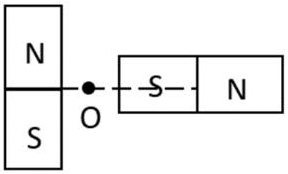
The direction of net magnetic field at point O is correctly represented by:
Two identical short bar magnets are kept as shown,
The direction of net magnetic field at point O is correctly represented by:
Solution
O lies on the equatorial line of the vertical magnet and on the axial line of the horizontal magnet. Take the distance from O to each magnet's centre as and the magnetic moment as (the two magnets are identical).
| Magnet | Position of O | Field at O | Direction |
|---|---|---|---|
| Vertical (N up, S down) | Equatorial | Opposite to its moment, so downward | |
| Horizontal (S left, N right) | Axial | Along its moment, so to the right |
The net field has a horizontal component to the right and a vertical component downward.
The net field points to the right and downward, at an angle below the horizontal. This is the down-right arrow.
Option 1: this would be the field of the horizontal magnet alone. It ignores the downward field of the vertical magnet.
Option 2: the vertical component would point up, but on the equatorial line the field is opposite to the moment, so it points down.
Option 4: this would need the horizontal magnet's field to be zero, but O is on its axis where the field is strongest.
Related questions:
2026: 21 May Shift 2
2025: 23 May Shift 2
2026: 26 May Shift 2
2025: 13 May Shift 1