
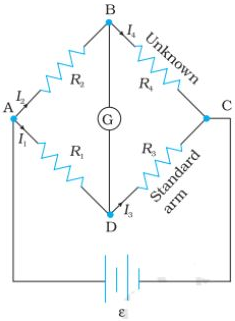
The following statements are given related to Wheatstone Bridge:
(A) when Wheatstone Bridge is balanced, no current flows through the galvanometer arm.
(B) Wheatstone Bridge works on the principle of Kirchhoff's law.
(C) Being a null method based experiment, the result is free from the effect of extra resistances ( cell resistance) of the circuit
(D) Wheatstone Bridge is most sensitive when all the four resistances are nearly of the same magnitude.
Solution
All four statements are correct.
(A) At balance, the galvanometer terminals are at the same potential, so no current flows through that arm.
(B) The bridge is analysed with Kirchhoff's laws, and the balance condition follows from them.
(C) The bridge is a null-deflection method. Only the condition of zero galvanometer current matters, so the result does not depend on the cell's internal resistance or the galvanometer's resistance.
(D) Sensitivity is greatest when all four resistances are of the same order of magnitude.
Option 1 leaves out (C): students often think the cell resistance affects the result, but a null method removes that effect.
Option 4 leaves out (A), which is the basic balance condition.
Related questions:
2025: 3 June Shift 1
2025: 13 May Shift 1
2025: 26 May Shift 2
2025: 20 May Shift 2