
The Wheatstone bridge is an arrangement of four resistances: , , , as shown in the figure given below. The null-point condition is not given by
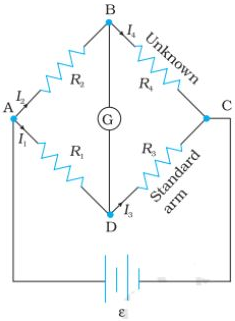
The Wheatstone bridge is an arrangement of four resistances: , , , as shown in the figure given below. The null-point condition is not given by
Solution
✅ Correct Option: 4
At the null point no current flows through the galvanometer, so also passes through and also passes through , and B and D are at the same potential.
Dividing the first equation by the second gives , so
Options 1, 2 and 3 are all rearrangements of this same condition. The relation in Option 4 does not follow from it, so it is the one that does not give the null point.
Related questions:
2025: 20 May Shift 2
2025: 30 May Shift 2
2026: 25 May Shift 1