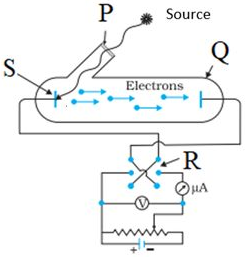
In the context of the Photoelectric effect, identify the statements which support quantum nature of light.
(A) The electric charge of photoelectrons is quantized
(B) The maximum kinetic energy of photoelectrons depends on the frequency of the incident light, but is independent of its intensity
(C) The photoelectric emission is an instantaneous process without any apparent time lag, even when the incident radiation is made exceedingly dim
(D) There is a minimum frequency of light below which no photoelectrons are emitted
Solution
The quantum (photon) picture explains (B), (C) and (D), and the wave picture cannot.
(B) Each photon gives energy to one electron, so . This depends on frequency only, and intensity changes just the number of photons, not the energy of each.
(C) Each electron absorbs a whole photon at once, so emission is instantaneous even for very dim light. A wave theory would predict a delay while the electron builds up enough energy.
(D) Emission needs , which gives a threshold frequency . Below it, no single photon has enough energy, however intense the light.
(A): quantization of charge is a property of electrons and matter, not of light, and it says nothing about how light behaves. It is true but irrelevant to the photoelectric effect's evidence for photons.
Related questions:
2025: 30 May Shift 2
2025: 28 May Shift 2
2025: 16 May Shift 1