CUET Chemistry: ChemistryHaloalkanes & Haloarenes. Free, no login required.

Q1:

2025: 29 May Shift 2

Haloalkanes & Haloarenes

Easy

Which species is involved in chlorination of benzene using Cl2\text{Cl}_2 in presence of AlCl3\text{AlCl}_3 ?

Answer options
Option 1
Correct Answer
Explanation for 2025: 29 May Shift 2 CHE question 1

Q2:

2025: 29 May Shift 2

Haloalkanes & Haloarenes

Easy

Arrange the following alkyl halides in increasing order of boiling points

(A) 1-Iodobutane

(B) 1 -Bromobutane

(C) 1- Chlorobutane

(D) Butane

Answer options
Option 1
Correct Answer
Explanation for 2025: 29 May Shift 2 CHE question 2

Q3:

2025: 29 May Shift 1

Haloalkanes & Haloarenes

Easy

Which of the following is an example of vic-dihalide?

Answer options
Option 2
Correct Answer
Explanation for 2025: 29 May Shift 1 CHE question 3

Q4:

2025: 29 May Shift 1

Haloalkanes & Haloarenes

Medium

Arrange the following in order of increasing boiling points.

(A) Bromomethane

(B) Bromoform

(C) Chloromethane

(D) Dibromomethane

Answer options
Option 1
Correct Answer
Explanation for 2025: 29 May Shift 1 CHE question 4

Q5:

2025: 29 May Shift 1

Haloalkanes & Haloarenes

Easy

Match List-I with List-II

List-IList-II
(A) SN1\text{S}_\text{N}1 Reaction(I) vic-dibromides
(B) Bromination of alkenes(II) gem-dihalides
(C) Alkylidene halides(III) racemisation
(D) Elimination of HX from alkylhalide(IV) Saytzeff rule
Answer options
Option 1
Correct Answer
Explanation for 2025: 29 May Shift 1 CHE question 5

Q6:

2025: 29 May Shift 1

Haloalkanes & Haloarenes

Medium

Identify the correct statements for Ethylene dichloride and Ethylidene chloride

(A) They represent structural isomers.

(B) Both are formed by reaction of ethene with chlorine in presence of CCl4\text{CCl}_4

(C) Both the compounds belong to a class of dihalocompounds

(D) Both the compounds are optically inactive.

Answer options
Option 1
Correct Answer
Explanation for 2025: 29 May Shift 1 CHE question 6

Q7:

2025: 29 May Shift 1

Haloalkanes & Haloarenes

Easy

Complete the following analogy:

SN2\text{S}_\text{N}2: Inversion of configuration; SN1\text{S}_\text{N}1:______________

Answer options
Option 1
Correct Answer
Explanation for 2025: 29 May Shift 1 CHE question 7

Q8:

2025: 28 May Shift 2

Haloalkanes & Haloarenes

Easy

Haloalkanes undergo nucelophilic substitution reactions owing to the polarity of C-X bond. The nucleophile reacts with the haloalkane on the carbon possessing a partial positive charge holding the halogen atom. The halogen atom X is replaced by a nucleophile. Depending on the kinetics and mode of bond breaking, the mechanism can be either SN1S_N1 or SN2S_N2 reaction. The rate of SN1S_N1 reaction is governed by the stability of carbocation and in SN2S_N2 reaction, the rate of reaction is governed by steric factor. Chirality is the main factor in both SN1S_N1and SN2S_N2. In SN1S_N1 reaction, the chirality of alkyl halide is accompanied by racemization of the product, while in SN2S_N2 reaction , the product is characterized by inversion of configuration. The structure of alkyl halide and the nature of the solvent also governs the mechanism of the substitution.

What is chiral carbon ?

Answer options
Option 2
Correct Answer
Explanation for 2025: 28 May Shift 2 CHE question 8

Q9:

2025: 28 May Shift 2

Haloalkanes & Haloarenes

Easy

Haloalkanes undergo nucelophilic substitution reactions owing to the polarity of C-X bond. The nucleophile reacts with the haloalkane on the carbon possessing a partial positive charge holding the halogen atom. The halogen atom X is replaced by a nucleophile. Depending on the kinetics and mode of bond breaking, the mechanism can be either SN1S_N1 or SN2S_N2 reaction. The rate of SN1S_N1 reaction is governed by the stability of carbocation and in SN2S_N2 reaction, the rate of reaction is governed by steric factor. Chirality is the main factor in both SN1S_N1and SN2S_N2. In SN1S_N1 reaction, the chirality of alkyl halide is accompanied by racemization of the product, while in SN2S_N2 reaction , the product is characterized by inversion of configuration. The structure of alkyl halide and the nature of the solvent also governs the mechanism of the substitution.

Which of the following compound will undergo SN1S_N1 reaction readily? .

Answer options
Option 4
Correct Answer
Explanation for 2025: 28 May Shift 2 CHE question 9

Q10:

2025: 28 May Shift 2

Haloalkanes & Haloarenes

Easy

Haloalkanes undergo nucelophilic substitution reactions owing to the polarity of C-X bond. The nucleophile reacts with the haloalkane on the carbon possessing a partial positive charge holding the halogen atom. The halogen atom X is replaced by a nucleophile. Depending on the kinetics and mode of bond breaking, the mechanism can be either SN1S_N1 or SN2S_N2 reaction. The rate of SN1S_N1 reaction is governed by the stability of carbocation and in SN2S_N2 reaction, the rate of reaction is governed by steric factor. Chirality is the main factor in both SN1S_N1and SN2S_N2. In SN1S_N1 reaction, the chirality of alkyl halide is accompanied by racemization of the product, while in SN2S_N2 reaction , the product is characterized by inversion of configuration. The structure of alkyl halide and the nature of the solvent also governs the mechanism of the substitution.

What is meant by the term racemic mixture?

Answer options

Q11:

2025: 28 May Shift 2

Haloalkanes & Haloarenes

Medium

Haloalkanes undergo nucelophilic substitution reactions owing to the polarity of C-X bond. The nucleophile reacts with the haloalkane on the carbon possessing a partial positive charge holding the halogen atom. The halogen atom X is replaced by a nucleophile. Depending on the kinetics and mode of bond breaking, the mechanism can be either SN1S_N1 or SN2S_N2 reaction. The rate of SN1S_N1 reaction is governed by the stability of carbocation and in SN2S_N2 reaction, the rate of reaction is governed by steric factor. Chirality is the main factor in both SN1S_N1and SN2S_N2. In SN1S_N1 reaction, the chirality of alkyl halide is accompanied by racemization of the product, while in SN2S_N2 reaction , the product is characterized by inversion of configuration. The structure of alkyl halide and the nature of the solvent also governs the mechanism of the substitution.

Which of the following bromo isomer of butane will react at a faster rate towards SN2S_N2 reaction?

Answer options

Q12:

2025: 28 May Shift 2

Haloalkanes & Haloarenes

Medium

Haloalkanes undergo nucelophilic substitution reactions owing to the polarity of C-X bond. The nucleophile reacts with the haloalkane on the carbon possessing a partial positive charge holding the halogen atom. The halogen atom X is replaced by a nucleophile. Depending on the kinetics and mode of bond breaking, the mechanism can be either SN1S_N1 or SN2S_N2 reaction. The rate of SN1S_N1 reaction is governed by the stability of carbocation and in SN2S_N2 reaction, the rate of reaction is governed by steric factor. Chirality is the main factor in both SN1S_N1and SN2S_N2. In SN1S_N1 reaction, the chirality of alkyl halide is accompanied by racemization of the product, while in SN2S_N2 reaction , the product is characterized by inversion of configuration. The structure of alkyl halide and the nature of the solvent also governs the mechanism of the substitution.

Hydrolysis of 2-Chlorobutane will result in formation of

Answer options

Q13:

2025: 28 May Shift 1

Haloalkanes & Haloarenes

Hard

Primary Alkyl halide C4H9BrC_4H_9Br (X) reacts with alcoholic KOH to give the compound (Y). Compound (Y) is reacted with HBr to give (Z) which is an isomer of (X). When (X) is reacted with Na/dry ether, it gives a compound (T), C8H18C_8H_{18}, which is different from the compound formed when n-butyl bromide is reacted with Na/dry ether. The correct IUPAC name of (T) is:

Answer options

Q14:

2025: 28 May Shift 1

Haloalkanes & Haloarenes

Easy

The correct IUPAC name of Freon 12 is

Answer options

Q15:

2025: 28 May Shift 1

Haloalkanes & Haloarenes

Medium

Which of the following methyl halide will have the highest value of dipole moment?

Answer options

Q16:

2025: 28 May Shift 1

Haloalkanes & Haloarenes

Medium

Identify A, B, and C in the following reaction:
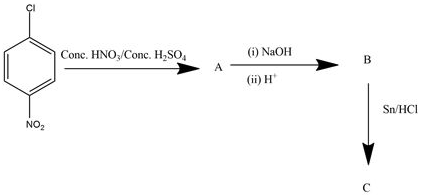
Figure

Answer options

Q17:

2025: 28 May Shift 1

Haloalkanes & Haloarenes

Medium

Which of the following is a characteristic of SN2S_N2 reaction?

(A). Concentration of both reactants determines the reaction rate.

(B). Proceeds with inversion of configuration.

(C). The transition state involves central carbon bonded to five species.

(D). Occurs in polar protic solvent

Answer options

Q18:

2025: 27 May Shift 2

Haloalkanes & Haloarenes

Easy

IUPAC name of the following compound is:
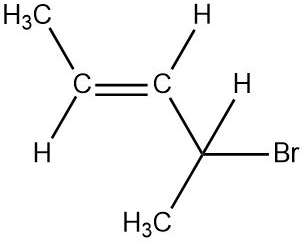
Figure

Answer options

Q19:

2025: 27 May Shift 2

Haloalkanes & Haloarenes

Easy

Match List-I with List-II

List-IList-II
(A) SN2\mathrm{S_N}^2(I) Racemization
(B) Iodoform(II) Ozone depletion
(C) SN1\mathrm{S_N}^1(III) Antiseptic
(D) Carbon tetrachloride(IV) Inversion
Answer options

Q20:

2025: 27 May Shift 2

Haloalkanes & Haloarenes

Easy

Chlorobenzene reacts with acetyl chloride in anhydrous AlCl3\mathrm{AlCl_3} to give major product as

Answer options

Q21:

2025: 27 May Shift 2

Haloalkanes & Haloarenes

Medium

Arrange the following alkyl halides in increasing order of reactivity towards SN2\mathrm{S_N2} reaction:

(A) 1-Bromobutane

(B) 1-Bromo-2,2-dimethylpropane

(C) 1-Bromo-2-methylbutane

(D) 1-Bromo-3-methylbutane

Answer options

Q22:

2025: 27 May Shift 2

Haloalkanes & Haloarenes

Easy

The major product in the following reaction is

C6H5CH=CH2+HI→?\mathrm{C_6H_5CH{=}CH_2 + HI \rightarrow ?}

Answer options

Q23:

2025: 26 May Shift 2

Haloalkanes & Haloarenes

Easy

The reaction of two molecules of 1-chlorobenzene with sodium metal in the presence of dry ether to form diphenyl is known as

Answer options

Q24:

2025: 26 May Shift 2

Haloalkanes & Haloarenes

Easy

Match List-I with List-II

List-IList-II
(A) Freons(I) Paint remover
(B) DDT(II) Refrigeration
(C) Dichloromethane(III) Fire extinguisher
(D) Tetrachloromethane(IV) Insecticide
Answer options

Q25:

2025: 26 May Shift 2

Haloalkanes & Haloarenes

Easy

The nitration of chlorobenzene gives the major product as:

Answer options

Q27:

2025: 26 May Shift 2

Haloalkanes & Haloarenes

Medium

Identify the chiral molecule from the following,
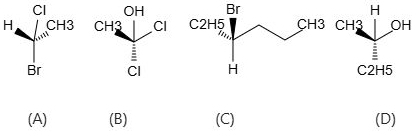
Figure

Answer options

Q28:

2025: 24 May Shift 2

Haloalkanes & Haloarenes

Easy

Many halogen containing organic compounds are present in nature and some of them are clinically useful. These classes of organic compounds find a wide range of applications in our daily life as well as in industries. Many of the polyhalogen compounds are useful too in agriculture. However, some of these compounds cannot be easily decomposed are thus considered to be environmental hazards. These halo compounds are prepared via different synthetic routes where a variety of organic compounds can be used as substrates such as amines, hydrocarbons etc. They are used as solvents for relatively non-polar compounds. These compounds exhibit substitution and elimination reactions, in addition to their reactions with different metals, which leads to the formation of a versatile starting material for others organic compounds.

Chloroform when slowly oxidized by air in the presence of light releases

Answer options

Q29:

2025: 24 May Shift 2

Haloalkanes & Haloarenes

Medium

Many halogen containing organic compounds are present in nature and some of them are clinically useful. These classes of organic compounds find a wide range of applications in our daily life as well as in industries. Many of the polyhalogen compounds are useful too in agriculture. However, some of these compounds cannot be easily decomposed are thus considered to be environmental hazards. These halo compounds are prepared via different synthetic routes where a variety of organic compounds can be used as substrates such as amines, hydrocarbons etc. They are used as solvents for relatively non-polar compounds. These compounds exhibit substitution and elimination reactions, in addition to their reactions with different metals, which leads to the formation of a versatile starting material for others organic compounds.

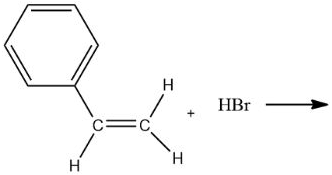
Write the product in the following reaction.
Figure

Answer options

Q30:

2025: 24 May Shift 2

Haloalkanes & Haloarenes

Easy

Many halogen containing organic compounds are present in nature and some of them are clinically useful. These classes of organic compounds find a wide range of applications in our daily life as well as in industries. Many of the polyhalogen compounds are useful too in agriculture. However, some of these compounds cannot be easily decomposed are thus considered to be environmental hazards. These halo compounds are prepared via different synthetic routes where a variety of organic compounds can be used as substrates such as amines, hydrocarbons etc. They are used as solvents for relatively non-polar compounds. These compounds exhibit substitution and elimination reactions, in addition to their reactions with different metals, which leads to the formation of a versatile starting material for others organic compounds.

Which halocompound is used for the treatment of malaria ?

Answer options