CUET Chemistry: ChemistryHaloalkanes & Haloarenes. Free, no login required.

Q1:

2026: 22 May Shift 2

Haloalkanes & Haloarenes

Medium

Identify the two reagents used to convert ethanol to butane.

Answer options
Option 2
Correct Answer
Explanation for 2026: 22 May Shift 2 CHE question 1

Q2:

2026: 22 May Shift 2

Haloalkanes & Haloarenes

Easy

Propene reacts with HI to form major product as 2-bromopropane. Suggest the rule applied / effect used for predicting the major product .

Answer options
Option 4
Correct Answer
Explanation for 2026: 22 May Shift 2 CHE question 2

Q3:

2026: 22 May Shift 2

Haloalkanes & Haloarenes

Easy

Freon-12 from tetrachloromethane is synthesized by

Answer options
Option 3
Correct Answer
Explanation for 2026: 22 May Shift 2 CHE question 3

Q4:

2026: 22 May Shift 2

Haloalkanes & Haloarenes

Medium

Consider the following statements. Choose the correct statements

(A) p-dichlorobenzene has zero dipole moment.

(B) Amongst the polychlorocompounds of methane, chloroform has the lowest dipole moment.

(C) Alkyl halides are highly soluble in water.

(D) p-dichlorobenzene has a higher melting point than ortho and meta isomers.

Answer options
Option 4
Correct Answer
Explanation for 2026: 22 May Shift 2 CHE question 4

Q5:

2026: 22 May Shift 2

Haloalkanes & Haloarenes

Medium

Arrange the following in the increasing order of their reactivity towards SN1S_N1 mechanism:

(A) (CH3)2CHCH2Br\mathrm{(CH_3)_2CHCH_2Br}

(B) (CH3)3CBr\mathrm{(CH_3)_3CBr}

(C) CH3CH2CH2CH2Br\mathrm{CH_3CH_2CH_2CH_2Br}

(D) CH3CH2CH(Br)CH3\mathrm{CH_3CH_2CH(Br)CH_3}

Answer options
Option 4
Correct Answer
Explanation for 2026: 22 May Shift 2 CHE question 5

Q6:

2026: 22 May Shift 1

Haloalkanes & Haloarenes

Easy

Arrange the following compounds in order of increasing boiling points.

(A) Bromomethane

(B) Bromoform

(C) Chloromethane

(D) Dibromomethane

Answer options
Option 2
Correct Answer
Explanation for 2026: 22 May Shift 1 CHE question 6

Q7:

2026: 22 May Shift 1

Haloalkanes & Haloarenes

Easy

Which haloform was used as a general anaesthetic in surgery earlier but now has been replaced by less toxic substances?

Answer options
Option 2
Correct Answer
Explanation for 2026: 22 May Shift 1 CHE question 7

Q8:

2026: 22 May Shift 1

Haloalkanes & Haloarenes

Easy

Among the following halogen compounds, which would undergo an SN2S_N2 reaction faster?

Answer options
Option 1
Correct Answer
Explanation for 2026: 22 May Shift 1 CHE question 8

Q9:

2026: 22 May Shift 1

Haloalkanes & Haloarenes

Easy

Haloalkanes react with KCN to form alkyl cyanides as main product because

Answer options
Option 1
Correct Answer
Explanation for 2026: 22 May Shift 1 CHE question 9

Q10:

2026: 21 May Shift 2

Haloalkanes & Haloarenes

Hard

The major product formed by dehydrohalogenation of 2,2,3-trimethyl-3-bromopentane is

Answer options

Q11:

2026: 21 May Shift 2

Haloalkanes & Haloarenes

Easy

Alkyl chlorides are converted to alkyl iodides by treating with NaI in the presence of dry acetone. The name of the reaction involved is

Answer options

Q13:

2026: 21 May Shift 2

Haloalkanes & Haloarenes

Easy

Chloroform is stored in closed dark coloured bottle completely filled so that

Answer options

Q14:

2026: 21 May Shift 2

Haloalkanes & Haloarenes

Medium

Arrange the following compounds in increasing order of reactivity by SN2S_N2 mechanism.

A. CH3CH2CH2CH2Br\mathrm{CH_3CH_2CH_2CH_2Br}

B. (CH3)2CHCH2Br\mathrm{(CH_3)_2CHCH_2Br}

C. CH3CH2CH2CH2I\mathrm{CH_3CH_2CH_2CH_2I}

D. (CH3)3CBr\mathrm{(CH_3)_3CBr}

Answer options

Q15:

2026: 21 May Shift 1

Haloalkanes & Haloarenes

Easy

Which of the following combination of reagents can directly convert chlorobenzene into toluene in a single step?

Answer options

Q16:

2026: 21 May Shift 1

Haloalkanes & Haloarenes

Easy

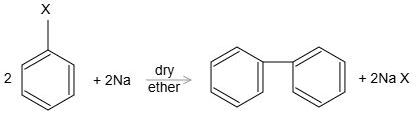
The reaction between aryl halides and sodium metal in the presence of dry ether is
Figure

Answer options

Q17:

2026: 21 May Shift 1

Haloalkanes & Haloarenes

Medium

Read the following statements. Choose the correct statements

(A) During the electrophilic substitution reaction of haloarenes , meta substituted derivative is the major product.

(B) Enantiomers are the optical isomers which exists as a pair of non-superimposable mirror images.

(C) The conversion of an alkyl halide into an alcohol by aqueous NaOH is a substitution reaction.

(D) C-Cl bond length in CH3−Cl\mathrm{CH_3{-}Cl} is shorter than C-Cl bond length in chlorobenzene.

Answer options

Q18:

2026: 21 May Shift 1

Haloalkanes & Haloarenes

Medium

Consider the following statements and choose the correct statements

(A) Ethyl chloride reacts with KCN to form ethyl cyanide as main product.

(B) AgCN is mainly ionic in nature.

(C) Ethyl chloride reacts with AgCN to form isocyanide as the main product.

(D) KCN is predominantly covalent in nature.

Answer options

Q20:

2026: 20 May Shift 2

Haloalkanes & Haloarenes

Easy

Method of preparation of haloalkanes

The hydroxyl group of an alcohol is replaced by halogen on reaction with concentrated halogen acids, phosphorus halides, or thionyl chloride. Thionyl chloride is preferred because in this reaction alkyl halide is formed along with gases SO2SO_2 and HCl. The two gaseous products are escapable, hence, the reaction gives pure alkyl halides. The reactions of primary and secondary alcohols with HCl require the presence of a catalyst, ZnCl2ZnCl_2 . With tertiary alcohols, the reaction is conducted by simply shaking the alcohol with concentrated HCl at room temperature. Constant boiling with HBr (48%) is used for preparing alkyl bromide. Good yields of R-I may be obtained by heating alcohols with sodium or potassium iodide in 95% orthophosphoric acid.

An alkene is converted to corresponding alkyl halide by reaction with hydrogen chloride, hydrogen bromide. Further, addition of bromine in CCl4CCl_4 to an alkene resulting in discharge of reddish brown colour of bromine constitutes, an important method for the detection of double bond in a molecule.

Alkyl iodides are often prepared by the reaction of alkyl chlorides/ bromides with NaI in dry acetone.

The alkyl fluorides are best prepared by heating an alkyl chlorides/bromides in the presence of a metallic fluoride.

The primary aromatic amine, dissolved or suspended in cold aqueous mineral acid, is treated with sodium nitrite, a diazonium salt is formed. Mixing the solution of freshly prepared diazonium salt with cuprous chloride or cuprous bromide results in the replacement of the diazonium group by -Cl or -Br .

The reactions of haloalkanes may be divided into the following categories: 1. Nucleophilic substitution 2. Elimination reactions 3. Reaction with metals.

In the given reactions, identify A & B :

3ROH+PBr3→3RBr+A3ROH + PBr_3 \rightarrow 3RBr + A

ROH+PCl5→RCl+POCl3+BROH + PCl_5 \rightarrow RCl + POCl_3 + B

Answer options

Q21:

2026: 20 May Shift 2

Haloalkanes & Haloarenes

Easy

Method of preparation of haloalkanes

The hydroxyl group of an alcohol is replaced by halogen on reaction with concentrated halogen acids, phosphorus halides, or thionyl chloride. Thionyl chloride is preferred because in this reaction alkyl halide is formed along with gases SO2SO_2 and HCl. The two gaseous products are escapable, hence, the reaction gives pure alkyl halides. The reactions of primary and secondary alcohols with HCl require the presence of a catalyst, ZnCl2ZnCl_2 . With tertiary alcohols, the reaction is conducted by simply shaking the alcohol with concentrated HCl at room temperature. Constant boiling with HBr (48%) is used for preparing alkyl bromide. Good yields of R-I may be obtained by heating alcohols with sodium or potassium iodide in 95% orthophosphoric acid.

An alkene is converted to corresponding alkyl halide by reaction with hydrogen chloride, hydrogen bromide. Further, addition of bromine in CCl4CCl_4 to an alkene resulting in discharge of reddish brown colour of bromine constitutes, an important method for the detection of double bond in a molecule.

Alkyl iodides are often prepared by the reaction of alkyl chlorides/ bromides with NaI in dry acetone.

The alkyl fluorides are best prepared by heating an alkyl chlorides/bromides in the presence of a metallic fluoride.

The primary aromatic amine, dissolved or suspended in cold aqueous mineral acid, is treated with sodium nitrite, a diazonium salt is formed. Mixing the solution of freshly prepared diazonium salt with cuprous chloride or cuprous bromide results in the replacement of the diazonium group by -Cl or -Br .

The reactions of haloalkanes may be divided into the following categories: 1. Nucleophilic substitution 2. Elimination reactions 3. Reaction with metals.

The reaction of alkyl chlorides/ bromides with NaI in dry acetone is known as

Answer options

Q22:

2026: 20 May Shift 2

Haloalkanes & Haloarenes

Medium

Method of preparation of haloalkanes

The hydroxyl group of an alcohol is replaced by halogen on reaction with concentrated halogen acids, phosphorus halides, or thionyl chloride. Thionyl chloride is preferred because in this reaction alkyl halide is formed along with gases SO2SO_2 and HCl. The two gaseous products are escapable, hence, the reaction gives pure alkyl halides. The reactions of primary and secondary alcohols with HCl require the presence of a catalyst, ZnCl2ZnCl_2 . With tertiary alcohols, the reaction is conducted by simply shaking the alcohol with concentrated HCl at room temperature. Constant boiling with HBr (48%) is used for preparing alkyl bromide. Good yields of R-I may be obtained by heating alcohols with sodium or potassium iodide in 95% orthophosphoric acid.

An alkene is converted to corresponding alkyl halide by reaction with hydrogen chloride, hydrogen bromide. Further, addition of bromine in CCl4CCl_4 to an alkene resulting in discharge of reddish brown colour of bromine constitutes, an important method for the detection of double bond in a molecule.

Alkyl iodides are often prepared by the reaction of alkyl chlorides/ bromides with NaI in dry acetone.

The alkyl fluorides are best prepared by heating an alkyl chlorides/bromides in the presence of a metallic fluoride.

The primary aromatic amine, dissolved or suspended in cold aqueous mineral acid, is treated with sodium nitrite, a diazonium salt is formed. Mixing the solution of freshly prepared diazonium salt with cuprous chloride or cuprous bromide results in the replacement of the diazonium group by -Cl or -Br .

The reactions of haloalkanes may be divided into the following categories: 1. Nucleophilic substitution 2. Elimination reactions 3. Reaction with metals.

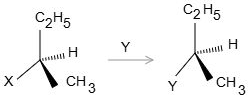
In the following reaction, major product A is

Figure

Answer options

Q23:

2026: 20 May Shift 2

Haloalkanes & Haloarenes

Hard

Method of preparation of haloalkanes

The hydroxyl group of an alcohol is replaced by halogen on reaction with concentrated halogen acids, phosphorus halides, or thionyl chloride. Thionyl chloride is preferred because in this reaction alkyl halide is formed along with gases SO2SO_2 and HCl. The two gaseous products are escapable, hence, the reaction gives pure alkyl halides. The reactions of primary and secondary alcohols with HCl require the presence of a catalyst, ZnCl2ZnCl_2 . With tertiary alcohols, the reaction is conducted by simply shaking the alcohol with concentrated HCl at room temperature. Constant boiling with HBr (48%) is used for preparing alkyl bromide. Good yields of R-I may be obtained by heating alcohols with sodium or potassium iodide in 95% orthophosphoric acid.

An alkene is converted to corresponding alkyl halide by reaction with hydrogen chloride, hydrogen bromide. Further, addition of bromine in CCl4CCl_4 to an alkene resulting in discharge of reddish brown colour of bromine constitutes, an important method for the detection of double bond in a molecule.

Alkyl iodides are often prepared by the reaction of alkyl chlorides/ bromides with NaI in dry acetone.

The alkyl fluorides are best prepared by heating an alkyl chlorides/bromides in the presence of a metallic fluoride.

The primary aromatic amine, dissolved or suspended in cold aqueous mineral acid, is treated with sodium nitrite, a diazonium salt is formed. Mixing the solution of freshly prepared diazonium salt with cuprous chloride or cuprous bromide results in the replacement of the diazonium group by -Cl or -Br .

The reactions of haloalkanes may be divided into the following categories: 1. Nucleophilic substitution 2. Elimination reactions 3. Reaction with metals.

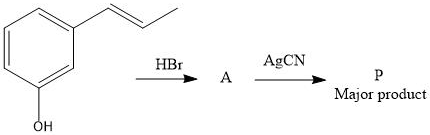
In the following reaction, identify the major product P.
Figure

Answer options

Q24:

2026: 20 May Shift 2

Haloalkanes & Haloarenes

Medium

Method of preparation of haloalkanes

The hydroxyl group of an alcohol is replaced by halogen on reaction with concentrated halogen acids, phosphorus halides, or thionyl chloride. Thionyl chloride is preferred because in this reaction alkyl halide is formed along with gases SO2SO_2 and HCl. The two gaseous products are escapable, hence, the reaction gives pure alkyl halides. The reactions of primary and secondary alcohols with HCl require the presence of a catalyst, ZnCl2ZnCl_2 . With tertiary alcohols, the reaction is conducted by simply shaking the alcohol with concentrated HCl at room temperature. Constant boiling with HBr (48%) is used for preparing alkyl bromide. Good yields of R-I may be obtained by heating alcohols with sodium or potassium iodide in 95% orthophosphoric acid.

An alkene is converted to corresponding alkyl halide by reaction with hydrogen chloride, hydrogen bromide. Further, addition of bromine in CCl4CCl_4 to an alkene resulting in discharge of reddish brown colour of bromine constitutes, an important method for the detection of double bond in a molecule.

Alkyl iodides are often prepared by the reaction of alkyl chlorides/ bromides with NaI in dry acetone.

The alkyl fluorides are best prepared by heating an alkyl chlorides/bromides in the presence of a metallic fluoride.

The primary aromatic amine, dissolved or suspended in cold aqueous mineral acid, is treated with sodium nitrite, a diazonium salt is formed. Mixing the solution of freshly prepared diazonium salt with cuprous chloride or cuprous bromide results in the replacement of the diazonium group by -Cl or -Br .

The reactions of haloalkanes may be divided into the following categories: 1. Nucleophilic substitution 2. Elimination reactions 3. Reaction with metals.

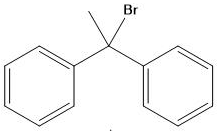
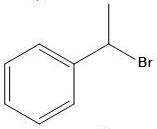
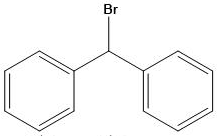
Which of the following compounds undergoes SN2S_N2 reaction most rapidly?

A. Figure

B. Figure

C. Figure

D. Figure

Answer options

Q25:

2026: 19 May Shift 2

Haloalkanes & Haloarenes

Medium

Haloalkanes

The alkyl halides (haloalkanes) are formed by replacement of hydrogen atom(s) in an aliphatic hydrocarbon by halogen atom(s). The homologous series of haloalkanes is represented by CnH2n+1XC_nH_{2n+1}X. They are further classified as primary, secondary or tertiary according to the nature of carbon to which halogen is attached. If halogen is attached to a primary carbon atom in an alkyl halide, the alkyl halide is called primary alkyl halide or 1° alkyl halide. Similarly, if halogen is attached to secondary or tertiary carbon atom, the alkyl halide is called secondary alkyl halide (2°) and tertiary (3°) alkyl halide, respectively. These are very slightly soluble in water but soluble in organic solvents. The photochemical bromination of alkanes gives a complex mixture of isomeric haloalkanes. The free radical monobromination of compound "A" (C5H12C_5H_{12}) gives some chiral and achiral 1°, 2° and 3° structural isomers. The boiling points of isomeric haloalkanes decrease with increase in branching. Most common reactions of alkyl halides are nucleophilic substitution reactions (SN1S_N1 and SN2S_N2), elimination and reactions with metals. When a chiral bromoalkane isomer of "A" is treated with magnesium metal in dry ether gives an organometallic compound which further reacts with water to give the hydrocarbon "B", but if this isomer is heated with sodium metal in dry ether yields a different hydrocarbon "C". The SN1S_N1 reaction occurs in two steps. In step I, the polarised C—Br bond undergoes slow cleavage to produce a carbocation and a bromide ion followed by attack of nucleophile (like hydroxide ion) in step-2. The haloalkane which gives more stable carbocation undergoes SN1S_N1 reaction with faster rate. In elimination reaction, the formation of an alkene as major and minor products by dehydrohalogenation of an alkyl halide is governed by Saytzeff rule which state that "the preferred product is that alkene which has the greater number of alkyl groups attached to the doubly bonded carbon atoms."

The number of possible monobromo structural isomers expected to be formed (excluding stereoisomers) on free radical monobromination of alkane "A" [(CH3)2CHCH2CH3(CH_3)_2CHCH_2CH_3] are

Answer options

Q26:

2026: 19 May Shift 2

Haloalkanes & Haloarenes

Medium

Haloalkanes

The alkyl halides (haloalkanes) are formed by replacement of hydrogen atom(s) in an aliphatic hydrocarbon by halogen atom(s). The homologous series of haloalkanes is represented by CnH2n+1XC_nH_{2n+1}X. They are further classified as primary, secondary or tertiary according to the nature of carbon to which halogen is attached. If halogen is attached to a primary carbon atom in an alkyl halide, the alkyl halide is called primary alkyl halide or 1° alkyl halide. Similarly, if halogen is attached to secondary or tertiary carbon atom, the alkyl halide is called secondary alkyl halide (2°) and tertiary (3°) alkyl halide, respectively. These are very slightly soluble in water but soluble in organic solvents. The photochemical bromination of alkanes gives a complex mixture of isomeric haloalkanes. The free radical monobromination of compound "A" (C5H12C_5H_{12}) gives some chiral and achiral 1°, 2° and 3° structural isomers. The boiling points of isomeric haloalkanes decrease with increase in branching. Most common reactions of alkyl halides are nucleophilic substitution reactions (SN1S_N1 and SN2S_N2), elimination and reactions with metals. When a chiral bromoalkane isomer of "A" is treated with magnesium metal in dry ether gives an organometallic compound which further reacts with water to give the hydrocarbon "B", but if this isomer is heated with sodium metal in dry ether yields a different hydrocarbon "C". The SN1S_N1 reaction occurs in two steps. In step I, the polarised C—Br bond undergoes slow cleavage to produce a carbocation and a bromide ion followed by attack of nucleophile (like hydroxide ion) in step-2. The haloalkane which gives more stable carbocation undergoes SN1S_N1 reaction with faster rate. In elimination reaction, the formation of an alkene as major and minor products by dehydrohalogenation of an alkyl halide is governed by Saytzeff rule which state that "the preferred product is that alkene which has the greater number of alkyl groups attached to the doubly bonded carbon atoms."

The number of chiral structural isomers obtained from monobromination of (CH3)2CHCH2CH3(CH_3)_2CHCH_2CH_3 is

Answer options

Q27:

2026: 19 May Shift 2

Haloalkanes & Haloarenes

Easy

Haloalkanes

The alkyl halides (haloalkanes) are formed by replacement of hydrogen atom(s) in an aliphatic hydrocarbon by halogen atom(s). The homologous series of haloalkanes is represented by CnH2n+1XC_nH_{2n+1}X. They are further classified as primary, secondary or tertiary according to the nature of carbon to which halogen is attached. If halogen is attached to a primary carbon atom in an alkyl halide, the alkyl halide is called primary alkyl halide or 1° alkyl halide. Similarly, if halogen is attached to secondary or tertiary carbon atom, the alkyl halide is called secondary alkyl halide (2°) and tertiary (3°) alkyl halide, respectively. These are very slightly soluble in water but soluble in organic solvents. The photochemical bromination of alkanes gives a complex mixture of isomeric haloalkanes. The free radical monobromination of compound "A" (C5H12C_5H_{12}) gives some chiral and achiral 1°, 2° and 3° structural isomers. The boiling points of isomeric haloalkanes decrease with increase in branching. Most common reactions of alkyl halides are nucleophilic substitution reactions (SN1S_N1 and SN2S_N2), elimination and reactions with metals. When a chiral bromoalkane isomer of "A" is treated with magnesium metal in dry ether gives an organometallic compound which further reacts with water to give the hydrocarbon "B", but if this isomer is heated with sodium metal in dry ether yields a different hydrocarbon "C". The SN1S_N1 reaction occurs in two steps. In step I, the polarised C—Br bond undergoes slow cleavage to produce a carbocation and a bromide ion followed by attack of nucleophile (like hydroxide ion) in step-2. The haloalkane which gives more stable carbocation undergoes SN1S_N1 reaction with faster rate. In elimination reaction, the formation of an alkene as major and minor products by dehydrohalogenation of an alkyl halide is governed by Saytzeff rule which state that "the preferred product is that alkene which has the greater number of alkyl groups attached to the doubly bonded carbon atoms."

Which of the following haloalkane undergoes fastest SN1S_N1 reaction?

Answer options

Q28:

2026: 19 May Shift 2

Haloalkanes & Haloarenes

Easy

Haloalkanes

The alkyl halides (haloalkanes) are formed by replacement of hydrogen atom(s) in an aliphatic hydrocarbon by halogen atom(s). The homologous series of haloalkanes is represented by CnH2n+1XC_nH_{2n+1}X. They are further classified as primary, secondary or tertiary according to the nature of carbon to which halogen is attached. If halogen is attached to a primary carbon atom in an alkyl halide, the alkyl halide is called primary alkyl halide or 1° alkyl halide. Similarly, if halogen is attached to secondary or tertiary carbon atom, the alkyl halide is called secondary alkyl halide (2°) and tertiary (3°) alkyl halide, respectively. These are very slightly soluble in water but soluble in organic solvents. The photochemical bromination of alkanes gives a complex mixture of isomeric haloalkanes. The free radical monobromination of compound "A" (C5H12C_5H_{12}) gives some chiral and achiral 1°, 2° and 3° structural isomers. The boiling points of isomeric haloalkanes decrease with increase in branching. Most common reactions of alkyl halides are nucleophilic substitution reactions (SN1S_N1 and SN2S_N2), elimination and reactions with metals. When a chiral bromoalkane isomer of "A" is treated with magnesium metal in dry ether gives an organometallic compound which further reacts with water to give the hydrocarbon "B", but if this isomer is heated with sodium metal in dry ether yields a different hydrocarbon "C". The SN1S_N1 reaction occurs in two steps. In step I, the polarised C—Br bond undergoes slow cleavage to produce a carbocation and a bromide ion followed by attack of nucleophile (like hydroxide ion) in step-2. The haloalkane which gives more stable carbocation undergoes SN1S_N1 reaction with faster rate. In elimination reaction, the formation of an alkene as major and minor products by dehydrohalogenation of an alkyl halide is governed by Saytzeff rule which state that "the preferred product is that alkene which has the greater number of alkyl groups attached to the doubly bonded carbon atoms."

Identify the compound which is chiral ?

Answer options

Q29:

2026: 19 May Shift 2

Haloalkanes & Haloarenes

Easy

Haloalkanes

The alkyl halides (haloalkanes) are formed by replacement of hydrogen atom(s) in an aliphatic hydrocarbon by halogen atom(s). The homologous series of haloalkanes is represented by CnH2n+1XC_nH_{2n+1}X. They are further classified as primary, secondary or tertiary according to the nature of carbon to which halogen is attached. If halogen is attached to a primary carbon atom in an alkyl halide, the alkyl halide is called primary alkyl halide or 1° alkyl halide. Similarly, if halogen is attached to secondary or tertiary carbon atom, the alkyl halide is called secondary alkyl halide (2°) and tertiary (3°) alkyl halide, respectively. These are very slightly soluble in water but soluble in organic solvents. The photochemical bromination of alkanes gives a complex mixture of isomeric haloalkanes. The free radical monobromination of compound "A" (C5H12C_5H_{12}) gives some chiral and achiral 1°, 2° and 3° structural isomers. The boiling points of isomeric haloalkanes decrease with increase in branching. Most common reactions of alkyl halides are nucleophilic substitution reactions (SN1S_N1 and SN2S_N2), elimination and reactions with metals. When a chiral bromoalkane isomer of "A" is treated with magnesium metal in dry ether gives an organometallic compound which further reacts with water to give the hydrocarbon "B", but if this isomer is heated with sodium metal in dry ether yields a different hydrocarbon "C". The SN1S_N1 reaction occurs in two steps. In step I, the polarised C—Br bond undergoes slow cleavage to produce a carbocation and a bromide ion followed by attack of nucleophile (like hydroxide ion) in step-2. The haloalkane which gives more stable carbocation undergoes SN1S_N1 reaction with faster rate. In elimination reaction, the formation of an alkene as major and minor products by dehydrohalogenation of an alkyl halide is governed by Saytzeff rule which state that "the preferred product is that alkene which has the greater number of alkyl groups attached to the doubly bonded carbon atoms."

Which of the following isomeric haloalkane gives 2-methylbut-2-ene as major product on dehydrohalogenation reaction?

Answer options

Q30:

2026: 19 May Shift 1

Haloalkanes & Haloarenes

Medium

Match List-I with List-II

List-IList-II
ChemicalsApplications
(A) Methylene chloride(I) Antiseptic
(B) Triiodomethane(II) Paint remover
(C) Trichloromethane(III) Fire extinguisher
(D) Tetrachloromethane(IV) Freon refrigerant
Answer options