Q1:
2026: 29 May Shift 2
Chemistry
Chemical Kinetics
Easy
The unit of rate constant for a zero order reaction is
Correct Answer
Option 1
Correct Answer

2026: 29 May Shift 2
Chemistry
Chemical Kinetics
Easy
The unit of rate constant for a zero order reaction is
2026: 29 May Shift 1
Chemistry
Chemical Kinetics
Easy
Match List-I with List-II
| List-I | List-II |
|---|---|
| Reaction/ Constant | Unit |
| (A) Zero order reaction | (I) mol L s |
| (B) First order reaction | (II) cal K mol |
| (C) R (Gas constant) | (III) mol L s |
| (D) Second Order reaction | (IV) s |
2026: 29 May Shift 1
Chemistry
Chemical Kinetics
Medium
The value of rate constant (k) for the above reaction was determined at several temperatures. A plot of ln k versus 1/T gave a straight line with slope K. The activation energy of the reaction will be
2026: 29 May Shift 1
Chemistry
Chemical Kinetics
Medium
Which of the following are not true for order of a chemical reaction ?
(A) It is the sum of powers of the concentration terms in the rate law expression.
(B) It is the sum of stoichiometric coefficients of a chemical reaction.
(C) It is an experimentally determined value.
(D) It is always a whole number.
(E) It can not have zero value.
2026: 29 May Shift 1
Chemistry
Chemical Kinetics
Easy
Which factors affect the rate of a chemical reaction?
(A) Temperature
(B) Pressure
(C) Product concentration.
(D) Reactant Concentration
(E) Shape of container
(F) Catalyst
2026: 29 May Shift 1
Chemistry
Chemical Kinetics
Easy
For a reaction, the rate = k[A][B], when the initial concentration of A is doubled, the initial rate will
2026: 26 May Shift 2
Chemistry
Chemical Kinetics
Easy
Select the correct option(s) from the following statements:
A. A catalyst lowers the activation energy of a chemical reaction.
B. A catalyst does not alter the Gibbs energy () of a chemical reaction.
C. A catalyst can catalyze a non-spontaneous reaction.
D. A catalyst changes the equilibrium constant (K), by helping the attainment of equilibrium faster.
2026: 26 May Shift 2
Chemistry
Chemical Kinetics
Easy
Match the LIST-I with LIST-II.
| LIST-I Units | LIST-II Order of reaction | ||
|---|---|---|---|
| A. | I. | Zero | |
| B. | II. | First | |
| C. | III. | Third | |
| D. | IV. | Second |
2026: 26 May Shift 2
Chemistry
Chemical Kinetics
Easy
Select the correct option in regard to the hydrolysis of the cane sugar.
2026: 26 May Shift 2
Chemistry
Chemical Kinetics
Medium
A first order reaction started with mol L of NO at 313 K. The concentration of NO is found to be mol L after 23 minutes. The rate constant of the reaction at this temperature is
(Given: log 2 = 0.3010)
2026: 26 May Shift 2
Chemistry
Chemical Kinetics
Medium
Select the incorrect statement with reference to Arrhenius theory.
2026: 26 May Shift 1
Chemistry
Chemical Kinetics
Easy
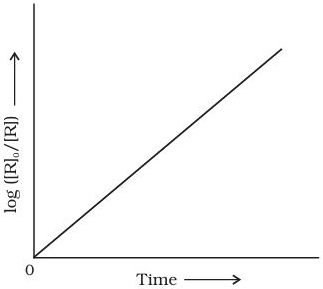
The figure given below represents the graph between vs time, for a first order reaction. The slope of the graph is:
2026: 26 May Shift 1
Chemistry
Chemical Kinetics
Medium
For the reaction, , the initial rate of the reaction at different concentrations of A and B is given in the table below. Which of the following statements are correct about the given data?
| Experiment | Initial [A]/ mol L | Initial [B]/ mol L | Initial rate of formation of [C] /mol Ls |
|---|---|---|---|
| 1 | 0.30 | 0.30 | 0.096 |
| 2 | 0.60 | 0.30 | 0.384 |
| 3 | 0.30 | 0.60 | 0.192 |
(A) The order with respect to A is one.
(B) The order with respect to B is one.
(C) The overall order of the reaction is three.
(D) The molecularity of the reaction is two.
2026: 26 May Shift 1
Chemistry
Chemical Kinetics
Easy
For the reaction, , the rate of reaction can be represented as:
2026: 26 May Shift 1
Chemistry
Chemical Kinetics
Medium
For the first order reaction, the time required for the completion of 90% and 50% reaction are and , respectively. Which of the following relationships between the two is correct?
2026: 26 May Shift 1
Chemistry
Chemical Kinetics
Medium
Match List-I with List-II
| List-I | List-II |
|---|---|
| Concepts in chemical kinetics | Detail |
| (A) Order applies | (I) Zero order reaction |
| (B) Molecularity applies | (II) First order reaction |
| (C) (1130 K, Pt Catalyst) | (III) To elementary as well as complex reactions |
| (D) | (IV) Only for elementary reactions. |
2026: 25 May Shift 2
Chemistry
Chemical Kinetics
Easy
2026: 25 May Shift 2
Chemistry
Chemical Kinetics
Easy
2026: 25 May Shift 2
Chemistry
Chemical Kinetics
Easy
2026: 25 May Shift 2
Chemistry
Chemical Kinetics
Medium
2026: 25 May Shift 2
Chemistry
Chemical Kinetics
Easy
2026: 25 May Shift 1
Chemistry
Chemical Kinetics
Easy
The activation energy of a reaction can be determined from the slope of which of the following graphs?
2026: 25 May Shift 1
Chemistry
Chemical Kinetics
Easy
What is the order of the reaction?
2026: 25 May Shift 1
Chemistry
Chemical Kinetics
Easy
Arrange the reactions, having rate expressions as given below, in the increasing arrangement of the order of reactions:
A. Rate =
B. Rate=
C. Rate=
D. Rate=
2026: 25 May Shift 1
Chemistry
Chemical Kinetics
Medium
Consider and interpret the Arrhenius equation given below and mark the correct option(s):
A. Rate constant increases with increase in activation energy and with decrease in temperature.
B. Rate constant decreases with decrease in activation energy and with decrease in temperature.
C. Rate constant increases with decrease in activation energy and with decrease in temperature.
D. Rate constant increases with decrease in activation energy and with increase in temperature.
2026: 25 May Shift 1
Chemistry
Chemical Kinetics
Easy
Rate constant of a first order reaction is . Its half life will be
2026: 24 May Shift 1
Chemistry
Chemical Kinetics
Easy
Hydrogenation of ethene represented by ,
is an example of
2026: 24 May Shift 1
Chemistry
Chemical Kinetics
Medium
Among the following, which are examples of first-order reactions?
(A)
(B)
(C)
(D)
2026: 24 May Shift 1
Chemistry
Chemical Kinetics
Medium
Arrange the following rate expressions (of hypothetical reactions) in the increasing arrangement of their order of reaction:
Assume the concentrations of A and B in all the rate expressions is same.
(A) Rate =
(B) Rate =
(C) Rate =
(D) Rate =
2026: 24 May Shift 1
Chemistry
Chemical Kinetics
Easy
Species that are formed in one step of reaction mechanism and used up in another step are called