CUET Chemistry: ChemistryAldehydes, Ketones & Carboxylic Acids. Free, no login required.

Q1:

2025: 19 May Shift 2

Aldehydes, Ketones & Carboxylic Acids

Medium

Out of the following given statements, the incorrect statements are;

(A) 2, 2, 6-Trimethylcyclohexanone forms a cyanohydrin in good yield, but the cyclohexanone doesn't.

(B) There are two amino groups in semicarbazide and both can be involved in the formation of semicarbazones.

(C) Mononitration of benzaldehyde will form m-nitrobenzaldehyde.

(D) Mononitration of acetophenone will form m-nitroacetophenone.

Answer options
Option 4
Correct Answer
Explanation for 2025: 19 May Shift 2 CHE question 1

Q2:

2025: 19 May Shift 2

Aldehydes, Ketones & Carboxylic Acids

Easy

Which of the following compounds will show the least reactivity towards nucleophilic addition reaction?

Answer options
Option 2
Correct Answer
Explanation for 2025: 19 May Shift 2 CHE question 2

Q3:

2025: 19 May Shift 2

Aldehydes, Ketones & Carboxylic Acids

Easy

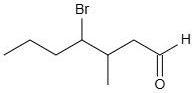
The correct IUPAC name of the following organic compound is

Figure

Answer options
Option 3
Correct Answer
Explanation for 2025: 19 May Shift 2 CHE question 3

Q5:

2025: 19 May Shift 2

Aldehydes, Ketones & Carboxylic Acids

Medium

Arrange the following compounds in the increasing order of their boiling points:

(A) Pentan-1-ol

(B) n-Butane

(C) Pentan-1-al

(D) Ethoxyethane

Answer options
Option 3
Correct Answer
Explanation for 2025: 19 May Shift 2 CHE question 5

Q6:

2025: 19 May Shift 2

Aldehydes, Ketones & Carboxylic Acids

Medium

Which of the following is the best reducing agent to convert RCOOH into RCH2_2OH ?

Answer options
Option 2
Correct Answer
Explanation for 2025: 19 May Shift 2 CHE question 6

Q7:

2025: 16 May Shift 1

Aldehydes, Ketones & Carboxylic Acids

Easy

Name the reaction when a mixture of acetaldehyde and propanal is treated with aqueoous alkali solution.

Answer options
Option 1
Correct Answer
Explanation for 2025: 16 May Shift 1 CHE question 7

Q8:

2025: 16 May Shift 1

Aldehydes, Ketones & Carboxylic Acids

Hard

Aldehydes, carboxylic acids and ketones are widespread in the animal and plant kingdoms. They play a pivotal role in various biochemical processes of life. Their presence in nature adds fragrance and flavor. These compounds are widely used in food products, pharmaceuticals, paints, resins and other important product industries. These compounds are prepared by various laboratory methods, which mainly include oxidation, formylation, acylation and reduction. Due to the polar nature of the carbonyl group in aldehydes and ketones, they can exhibit different reactions like nucleophilic addition. They do exhibit redox and various condensation reactions which lead to the formation of various important compounds. On the other hand, the carboxylic acids are mainly prepared by oxidation and hydrolysis of different compounds. The carboxylic acid consists of a carbonyl group and the hydroxy group (attached to the carbonyl carbon atom). This makes it possible for the carboxylic acid to participate in various chemical reactions which involve cleavage of the C-OH bond and the O-H bond along with the reactions involving the complete -COOH group.

Arrange the following in the increasing order of their pKa_a values:

(A) CF3_3-COOH

(B) O2_2N-CH2_2-COOH

(C) NC-CH2_2-COOH

(D) H-COOH

Answer options
Option 1
Correct Answer
Explanation for 2025: 16 May Shift 1 CHE question 8

Q9:

2025: 16 May Shift 1

Aldehydes, Ketones & Carboxylic Acids

Easy

Aldehydes, carboxylic acids and ketones are widespread in the animal and plant kingdoms. They play a pivotal role in various biochemical processes of life. Their presence in nature adds fragrance and flavor. These compounds are widely used in food products, pharmaceuticals, paints, resins and other important product industries. These compounds are prepared by various laboratory methods, which mainly include oxidation, formylation, acylation and reduction. Due to the polar nature of the carbonyl group in aldehydes and ketones, they can exhibit different reactions like nucleophilic addition. They do exhibit redox and various condensation reactions which lead to the formation of various important compounds. On the other hand, the carboxylic acids are mainly prepared by oxidation and hydrolysis of different compounds. The carboxylic acid consists of a carbonyl group and the hydroxy group (attached to the carbonyl carbon atom). This makes it possible for the carboxylic acid to participate in various chemical reactions which involve cleavage of the C-OH bond and the O-H bond along with the reactions involving the complete -COOH group.

Propyne on hydration in presence of mercury ions produce

Answer options
Option 1
Correct Answer
Explanation for 2025: 16 May Shift 1 CHE question 9

Q10:

2025: 16 May Shift 1

Aldehydes, Ketones & Carboxylic Acids

Medium

Aldehydes, carboxylic acids and ketones are widespread in the animal and plant kingdoms. They play a pivotal role in various biochemical processes of life. Their presence in nature adds fragrance and flavor. These compounds are widely used in food products, pharmaceuticals, paints, resins and other important product industries. These compounds are prepared by various laboratory methods, which mainly include oxidation, formylation, acylation and reduction. Due to the polar nature of the carbonyl group in aldehydes and ketones, they can exhibit different reactions like nucleophilic addition. They do exhibit redox and various condensation reactions which lead to the formation of various important compounds. On the other hand, the carboxylic acids are mainly prepared by oxidation and hydrolysis of different compounds. The carboxylic acid consists of a carbonyl group and the hydroxy group (attached to the carbonyl carbon atom). This makes it possible for the carboxylic acid to participate in various chemical reactions which involve cleavage of the C-OH bond and the O-H bond along with the reactions involving the complete -COOH group.

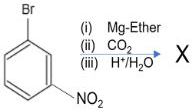
Identify the final product (X) of the chemical reaction obtained from the following transformation:

Figure

Answer options

Q11:

2025: 16 May Shift 1

Aldehydes, Ketones & Carboxylic Acids

Easy

Aldehydes, carboxylic acids and ketones are widespread in the animal and plant kingdoms. They play a pivotal role in various biochemical processes of life. Their presence in nature adds fragrance and flavor. These compounds are widely used in food products, pharmaceuticals, paints, resins and other important product industries. These compounds are prepared by various laboratory methods, which mainly include oxidation, formylation, acylation and reduction. Due to the polar nature of the carbonyl group in aldehydes and ketones, they can exhibit different reactions like nucleophilic addition. They do exhibit redox and various condensation reactions which lead to the formation of various important compounds. On the other hand, the carboxylic acids are mainly prepared by oxidation and hydrolysis of different compounds. The carboxylic acid consists of a carbonyl group and the hydroxy group (attached to the carbonyl carbon atom). This makes it possible for the carboxylic acid to participate in various chemical reactions which involve cleavage of the C-OH bond and the O-H bond along with the reactions involving the complete -COOH group.

The IUPAC name of following compound is

OHC-C6_6H4_4-CHO-pp

Answer options

Q12:

2025: 16 May Shift 1

Aldehydes, Ketones & Carboxylic Acids

Medium

Aldehydes, carboxylic acids and ketones are widespread in the animal and plant kingdoms. They play a pivotal role in various biochemical processes of life. Their presence in nature adds fragrance and flavor. These compounds are widely used in food products, pharmaceuticals, paints, resins and other important product industries. These compounds are prepared by various laboratory methods, which mainly include oxidation, formylation, acylation and reduction. Due to the polar nature of the carbonyl group in aldehydes and ketones, they can exhibit different reactions like nucleophilic addition. They do exhibit redox and various condensation reactions which lead to the formation of various important compounds. On the other hand, the carboxylic acids are mainly prepared by oxidation and hydrolysis of different compounds. The carboxylic acid consists of a carbonyl group and the hydroxy group (attached to the carbonyl carbon atom). This makes it possible for the carboxylic acid to participate in various chemical reactions which involve cleavage of the C-OH bond and the O-H bond along with the reactions involving the complete -COOH group.

The products formed when 2,2-Dimethylpropan-1-al is heated with concentrated KOH are:

Answer options

Q13:

2025: 15 May Shift 2

Aldehydes, Ketones & Carboxylic Acids

Easy

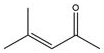
Identify the correct IUPAC name of the given compound:

Figure

Answer options

Q14:

2025: 15 May Shift 2

Aldehydes, Ketones & Carboxylic Acids

Medium

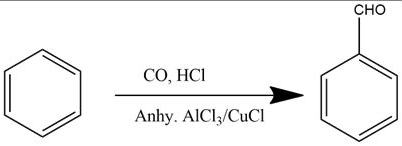
Match List-I with List-II

List-IList-II
(Reaction Name)(Reaction)
(A) Rosenmund Reaction(I) C6H5CN+SnCl2→(ii) H3O+(I) HClC6H5CHOC_6H_5CN + SnCl_2 \xrightarrow[(ii)\ H_3O^+]{(I)\ HCl} C_6H_5CHO
(B) Stephen Reaction(II) Figure
(C) Gattermann Koch Reaction(III) Figure
(D) Etard Reaction(IV) Figure
Answer options

Q15:

2025: 15 May Shift 2

Aldehydes, Ketones & Carboxylic Acids

Medium

Identify A and B in the following reaction.

Figure

Answer options

Q16:

2025: 15 May Shift 2

Aldehydes, Ketones & Carboxylic Acids

Easy

The reagent involved in the Clemmensen reduction of a carbonyl compound is

Answer options

Q17:

2025: 15 May Shift 2

Aldehydes, Ketones & Carboxylic Acids

Medium

Which of the following will not respond to Fehling's Test?

(A) Benzaldehyde

(B) Acetone

(C) Acetaldehyde

(D) Acetophenone

Answer options

Q18:

2025: 15 May Shift 1

Aldehydes, Ketones & Carboxylic Acids

Medium

An organic compound(A), C9_9H10_{10}O, gives a 2,4-DNP reaction, negative Tollens' test and iodoform test. On drastic oxidation with chromic acid, it forms B, having molecular formulae, C7_7H6_6O2_2. Identify A and B.

Answer options

Q19:

2025: 15 May Shift 1

Aldehydes, Ketones & Carboxylic Acids

Easy

Carbonyl carbon in acetone is sp2^2 hybridized. The C-O-C bond angle and the geometry of acetone is.......

Answer options

Q20:

2025: 15 May Shift 1

Aldehydes, Ketones & Carboxylic Acids

Easy

Match List-I with List-II

List-IList-II
(Reaction)(Name)
(A) CH3_3CHO + Dil NaOH ⟶\longrightarrow CH3_3CHOHCH2_2CHO(I) Aldol Reaction
(B) CH3_3CH2_2CH2_2COOH + Br2_2 →(ii) H2O(i)Red P\xrightarrow[\text{(ii) H}_2\text{O}]{\text{(i)Red P}} CH2_2CH2_2CHBrCOOH(II) Cannizzaro Reaction
(C) C6_6H5_5CHO + Conc. KOH ⟶\longrightarrow C6_6H5_5COONa + C6_6H5_5CH2_2OH(III) Haloform Reaction
(D) CH3_3COCH3_3 →NaOCl\xrightarrow{\text{NaOCl}} CH3_3COONa + CHCl3_3(IV) Hell Volhard Zelinski Reaction
Answer options

Q21:

2025: 15 May Shift 1

Aldehydes, Ketones & Carboxylic Acids

Easy

Which of the following will not give iodoform reaction?

Answer options

Q23:

2025: 15 May Shift 1

Aldehydes, Ketones & Carboxylic Acids

Easy

Match List-I with List-II

List-IList-II
ReagentCharacteristic of Compound
(A) Tollen's Reagent(I) Aliphatic aldehyde
(B) Iodoform test(II) Tertiary alcohol
(C) Lucas Reagent(III) Methyl ketone
(D) Fehling's Reagent(IV) Aliphatic and aromatic aldehydes
Answer options

Q24:

2025: 15 May Shift 1

Aldehydes, Ketones & Carboxylic Acids

Medium

Arrange the following compounds in the decreasing order of their boiling points:

(A) Butyraldehyde

(B) n-Butyl alcohol

(C) Sec-butyl alcohol

(D) n-butane

Answer options

Q25:

2025: 14 May Shift 2

Aldehydes, Ketones & Carboxylic Acids

Medium

Reaction of benzaldehyde with acetophenone in the presence of methanolic NaOH yields a major stable product as

Answer options

Q26:

2025: 14 May Shift 2

Aldehydes, Ketones & Carboxylic Acids

Easy

Aldehydes and ketones undergo

Answer options

Q27:

2025: 14 May Shift 2

Aldehydes, Ketones & Carboxylic Acids

Easy

Fehling solution gives red precipitate with.....

Answer options

Q28:

2025: 14 May Shift 2

Aldehydes, Ketones & Carboxylic Acids

Easy

Match List-I with List-II

List-IList-II
Common NameIUPAC Name
(A) Diisopropyl ketone(I) 2-Methylpropanal
(B) Isobutyraldehyde(II) Prop-2-enal
(C) Phthaldehyde(III). 2,4-Dimethylpentan-3-one
(D) Acrolein(IV) Benzene-1,2-dicarbaldehyde
Answer options

Q29:

2025: 14 May Shift 1

Aldehydes, Ketones & Carboxylic Acids

Medium

Arrange the following compounds in increasing order of their acidity.

(A) Phenol

(B) Ethanol

(C) Benzoic acid

(D) p-Nitrobenzoic acid

Answer options

Q30:

2025: 14 May Shift 1

Aldehydes, Ketones & Carboxylic Acids

Easy

Arrange the following compounds in decreasing order of their acidity.

(A) Acetic acid

(B) Chloroacetic acid

(C) Dichloroacetic acid

(D) Trichloroacetic acid

Answer options