CUET Chemistry: ChemistryAldehydes, Ketones & Carboxylic Acids. Free, no login required.

Q1:

2025: 30 May Shift 1

Aldehydes, Ketones & Carboxylic Acids

Medium

Arrange the following compounds in increasing order towards Nucleophilic addition reactions:

(A) Propanal

(B) Benzaldehyde

(C) Acetone

(D) Di-tert-butyl ketone

Answer options
Option 1
Correct Answer
Explanation for 2025: 30 May Shift 1 CHE question 1

Q2:

2025: 30 May Shift 1

Aldehydes, Ketones & Carboxylic Acids

Easy

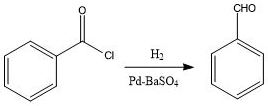
The following reaction is known as

Figure

Answer options
Option 2
Correct Answer
Explanation for 2025: 30 May Shift 1 CHE question 2

Q3:

2025: 30 May Shift 1

Aldehydes, Ketones & Carboxylic Acids

Medium

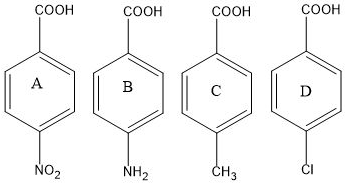
Arrange the following compounds in increasing order of their acidic strength ?

Figure

Answer options
Option 1
Correct Answer
Explanation for 2025: 30 May Shift 1 CHE question 3

Q4:

2025: 30 May Shift 1

Aldehydes, Ketones & Carboxylic Acids

Medium

Match List-I (reagent ) with List-II (Transformation)

List-IList-II
Reducing AgentTransformation
(A) Sodium Borohydride(I) Aldehyde to alkane
(B) SnCl2\mathrm{SnCl_2} and HCl(II) Primary alcohols to aldehydes
(C) Zn-Hg and conc. HCl(III) Nitriles to Imine
(D) DIBAL-H(IV) Ester to aldehyde
Answer options
Option 1
Correct Answer
Explanation for 2025: 30 May Shift 1 CHE question 4

Q5:

2025: 29 May Shift 2

Aldehydes, Ketones & Carboxylic Acids

Easy

Carboxylic acids are the earliest organic compounds isolated from nature. These are also known as organic acids but are weaker acids as compared to mineral acids. However, they are more acidic than alcohols and phenols because of greater resonance stabilization of the parent acid and its conjugate base. The acidic strength is determined by the Ka, which is called the acidity constant. The greater the value of Ka, the greater the tendency of the acid to ionize and hence the stronger the acid. The acidic strength of the saturated aliphatic carboxylic acid depends upon the inductive effect and its position with respect to - COOH groups. Electron -donating substituents tend to decrease whereas electron -withdrawing substituents tend to increase the acidic strength. The acidic strength of the aromatic carboxylic acid, on the other hand depends upon both the inductive effect and the resonance effect of the substituents.

How can we express the (acidity constant) 'KaK_a' of RCOOH ?

Answer options
Option 2
Correct Answer
Explanation for 2025: 29 May Shift 2 CHE question 5

Q6:

2025: 29 May Shift 2

Aldehydes, Ketones & Carboxylic Acids

Easy

Carboxylic acids are the earliest organic compounds isolated from nature. These are also known as organic acids but are weaker acids as compared to mineral acids. However, they are more acidic than alcohols and phenols because of greater resonance stabilization of the parent acid and its conjugate base. The acidic strength is determined by the Ka, which is called the acidity constant. The greater the value of Ka, the greater the tendency of the acid to ionize and hence the stronger the acid. The acidic strength of the saturated aliphatic carboxylic acid depends upon the inductive effect and its position with respect to - COOH groups. Electron -donating substituents tend to decrease whereas electron -withdrawing substituents tend to increase the acidic strength. The acidic strength of the aromatic carboxylic acid, on the other hand depends upon both the inductive effect and the resonance effect of the substituents.

pka_a of chloroacetic acid is lower than acetic acid because of

Answer options
Option 3
Correct Answer
Explanation for 2025: 29 May Shift 2 CHE question 6

Q7:

2025: 29 May Shift 2

Aldehydes, Ketones & Carboxylic Acids

Medium

Carboxylic acids are the earliest organic compounds isolated from nature. These are also known as organic acids but are weaker acids as compared to mineral acids. However, they are more acidic than alcohols and phenols because of greater resonance stabilization of the parent acid and its conjugate base. The acidic strength is determined by the Ka, which is called the acidity constant. The greater the value of Ka, the greater the tendency of the acid to ionize and hence the stronger the acid. The acidic strength of the saturated aliphatic carboxylic acid depends upon the inductive effect and its position with respect to - COOH groups. Electron -donating substituents tend to decrease whereas electron -withdrawing substituents tend to increase the acidic strength. The acidic strength of the aromatic carboxylic acid, on the other hand depends upon both the inductive effect and the resonance effect of the substituents.

Arrange the following acids in decreasing order of acidity

(A) CH3CH2OH\text{CH}_3\text{CH}_2\text{OH}

(B) CH3COOH\text{CH}_3\text{COOH}

(C) BrCH2COOH\text{BrCH}_2\text{COOH}

(D) C6H5CH2COOH\text{C}_6\text{H}_5\text{CH}_2\text{COOH}

Answer options
Option 2
Correct Answer
Explanation for 2025: 29 May Shift 2 CHE question 7

Q8:

2025: 29 May Shift 2

Aldehydes, Ketones & Carboxylic Acids

Easy

Carboxylic acids are the earliest organic compounds isolated from nature. These are also known as organic acids but are weaker acids as compared to mineral acids. However, they are more acidic than alcohols and phenols because of greater resonance stabilization of the parent acid and its conjugate base. The acidic strength is determined by the Ka, which is called the acidity constant. The greater the value of Ka, the greater the tendency of the acid to ionize and hence the stronger the acid. The acidic strength of the saturated aliphatic carboxylic acid depends upon the inductive effect and its position with respect to - COOH groups. Electron -donating substituents tend to decrease whereas electron -withdrawing substituents tend to increase the acidic strength. The acidic strength of the aromatic carboxylic acid, on the other hand depends upon both the inductive effect and the resonance effect of the substituents.

p-Nitrobenzoic acid is a stronger acid than benzoic acid because of

Answer options
Option 1
Correct Answer
Explanation for 2025: 29 May Shift 2 CHE question 8

Q9:

2025: 29 May Shift 2

Aldehydes, Ketones & Carboxylic Acids

Easy

Carboxylic acids are the earliest organic compounds isolated from nature. These are also known as organic acids but are weaker acids as compared to mineral acids. However, they are more acidic than alcohols and phenols because of greater resonance stabilization of the parent acid and its conjugate base. The acidic strength is determined by the Ka, which is called the acidity constant. The greater the value of Ka, the greater the tendency of the acid to ionize and hence the stronger the acid. The acidic strength of the saturated aliphatic carboxylic acid depends upon the inductive effect and its position with respect to - COOH groups. Electron -donating substituents tend to decrease whereas electron -withdrawing substituents tend to increase the acidic strength. The acidic strength of the aromatic carboxylic acid, on the other hand depends upon both the inductive effect and the resonance effect of the substituents.

Which of the following groups when attached directly does not increase the acidity of the carboxylic acid ?

Answer options
Option 3
Correct Answer
Explanation for 2025: 29 May Shift 2 CHE question 9

Q10:

2025: 29 May Shift 1

Aldehydes, Ketones & Carboxylic Acids

Easy

What is the IUPAC name of Oxalic acid?

Answer options

Q11:

2025: 29 May Shift 1

Aldehydes, Ketones & Carboxylic Acids

Medium

Which of the following compounds will give Fehling's solution test ?

(A) CH3CHO\text{CH}_3\text{CHO}

(B) C6H5CHO\text{C}_6\text{H}_5\text{CHO}

(C) CH3CH2CHO\text{CH}_3\text{CH}_2\text{CHO}

(D) HCHO

Answer options

Q12:

2025: 29 May Shift 1

Aldehydes, Ketones & Carboxylic Acids

Easy

What is the chemical composition of Tollen's reagent?

Answer options

Q13:

2025: 29 May Shift 1

Aldehydes, Ketones & Carboxylic Acids

Easy

What is the product of nitration of Benzoic acid?

Answer options

Q14:

2025: 29 May Shift 1

Aldehydes, Ketones & Carboxylic Acids

Easy

What is the reagent used in Clemmensen reduction?

Answer options

Q15:

2025: 28 May Shift 2

Aldehydes, Ketones & Carboxylic Acids

Medium

The ammonia derivatives of carbonyl compounds obtained as colorless precipitate are

(A) Oxime

(B) Hydrazone

(C) Phenyl hydrazone

(D) Semicarbazone

Answer options

Q16:

2025: 28 May Shift 2

Aldehydes, Ketones & Carboxylic Acids

Easy

Match List-I with List-II

List-IList-II
Name ReactionReagent
(A) Rosemund Reaction(I) CO/HCl, anhyd.AlCl3AlCl_3, CuCl
(B) Stephen Reaction(II) CrO2Cl2CrO_2Cl_2
(C) Etard Reaction(III) SnCl2SnCl_2 and HCl
(D) Gatterman Koch Reaction(IV) H2H_2 , Pd-BaSO4BaSO_4
Answer options

Q17:

2025: 28 May Shift 2

Aldehydes, Ketones & Carboxylic Acids

Easy

Which of the following classes of compounds on hydrolysis yields carboxylic acids ?

(A) RCN

(B) RCONH2RCONH_2

(C) RCOCl

(D) RCOOR'

Answer options

Q18:

2025: 28 May Shift 2

Aldehydes, Ketones & Carboxylic Acids

Easy

Which reagent can be employed to distinguish Benzaldehyde and Propanal ?

Answer options

Q20:

2025: 28 May Shift 1

Aldehydes, Ketones & Carboxylic Acids

Easy

Match List-I (compound) with List-II (reagent or chemical test)

List-IList-II
CompoundReagent or Chemical test
(A) Phenols(I) Tollen's test
(B) Amines(II) Neutral FeCl3FeCl_3 aq. solution
(C) Aldehydes(III) Iodoform Test
(D) Methyl Ketones(IV) Hinsberg's Test
Answer options

Q21:

2025: 28 May Shift 1

Aldehydes, Ketones & Carboxylic Acids

Easy

Aldehydes and ketones are important organic compounds prepared mainly by oxidation of alcohols. Primary alcohols give aldehyde and secondary alcohols yield ketones. Aldehydes can also be formed by partial reduction of acid chlorides, reduction of esters or by Gattermann-Koch reaction. Ketones are prepared via Friedel-Craft's acylation, hydration of alkyne and reaction of Grignard's reagent with nitriles. Chemically, aldehydes and ketones are reactive in nature due to the carbonyl group and undergo nucleophilic addition reactions. Aldehydes are more reactive than ketones and can be oxidized to carboxylic acids, while both can be reduced to alcohols or hydrocarbons and exhibit condensation reaction.

Hydration of propyne in the presence of H2SO4H_2SO_4 and HgSO4HgSO_4 gives

Answer options

Q22:

2025: 28 May Shift 1

Aldehydes, Ketones & Carboxylic Acids

Medium

Aldehydes and ketones are important organic compounds prepared mainly by oxidation of alcohols. Primary alcohols give aldehyde and secondary alcohols yield ketones. Aldehydes can also be formed by partial reduction of acid chlorides, reduction of esters or by Gattermann-Koch reaction. Ketones are prepared via Friedel-Craft's acylation, hydration of alkyne and reaction of Grignard's reagent with nitriles. Chemically, aldehydes and ketones are reactive in nature due to the carbonyl group and undergo nucleophilic addition reactions. Aldehydes are more reactive than ketones and can be oxidized to carboxylic acids, while both can be reduced to alcohols or hydrocarbons and exhibit condensation reaction.

The correct IUPAC name of Vanillin is

Answer options

Q23:

2025: 28 May Shift 1

Aldehydes, Ketones & Carboxylic Acids

Medium

Aldehydes and ketones are important organic compounds prepared mainly by oxidation of alcohols. Primary alcohols give aldehyde and secondary alcohols yield ketones. Aldehydes can also be formed by partial reduction of acid chlorides, reduction of esters or by Gattermann-Koch reaction. Ketones are prepared via Friedel-Craft's acylation, hydration of alkyne and reaction of Grignard's reagent with nitriles. Chemically, aldehydes and ketones are reactive in nature due to the carbonyl group and undergo nucleophilic addition reactions. Aldehydes are more reactive than ketones and can be oxidized to carboxylic acids, while both can be reduced to alcohols or hydrocarbons and exhibit condensation reaction.

The correct structure of the product in the following reaction is;

C2H5−C≡N+C6H5−MgBr→(ii)H3O+(i)EtherAC_2H_5 - C \equiv N + C_6H_5 - MgBr \xrightarrow[(ii) H_3O^+]{(i) Ether} A

Answer options

Q24:

2025: 28 May Shift 1

Aldehydes, Ketones & Carboxylic Acids

Easy

Aldehydes and ketones are important organic compounds prepared mainly by oxidation of alcohols. Primary alcohols give aldehyde and secondary alcohols yield ketones. Aldehydes can also be formed by partial reduction of acid chlorides, reduction of esters or by Gattermann-Koch reaction. Ketones are prepared via Friedel-Craft's acylation, hydration of alkyne and reaction of Grignard's reagent with nitriles. Chemically, aldehydes and ketones are reactive in nature due to the carbonyl group and undergo nucleophilic addition reactions. Aldehydes are more reactive than ketones and can be oxidized to carboxylic acids, while both can be reduced to alcohols or hydrocarbons and exhibit condensation reaction.

When two moles of benzaldehyde are heated with concentrated NaOH solution, the product/s obtained is/are;

Answer options

Q25:

2025: 28 May Shift 1

Aldehydes, Ketones & Carboxylic Acids

Hard

Aldehydes and ketones are important organic compounds prepared mainly by oxidation of alcohols. Primary alcohols give aldehyde and secondary alcohols yield ketones. Aldehydes can also be formed by partial reduction of acid chlorides, reduction of esters or by Gattermann-Koch reaction. Ketones are prepared via Friedel-Craft's acylation, hydration of alkyne and reaction of Grignard's reagent with nitriles. Chemically, aldehydes and ketones are reactive in nature due to the carbonyl group and undergo nucleophilic addition reactions. Aldehydes are more reactive than ketones and can be oxidized to carboxylic acids, while both can be reduced to alcohols or hydrocarbons and exhibit condensation reaction.

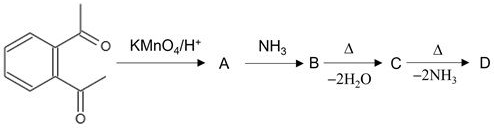
Predict the end product (D) of the following reaction sequence;

Figure

Answer options

Q26:

2025: 27 May Shift 2

Aldehydes, Ketones & Carboxylic Acids

Easy

Carboxylic acids are the organic compounds which comprise of carboxyl functional group, -COOH. These are generally found in nature, some higher members are known as fatty acids as they occur in natural fats as esters of glycerol. They can be prepared from oxidation of alcohols and aldehydes, hydrolysis of nitriles and amides and Grignard reagents. They are stronger acids than simple phenols and alcohols. but weaker than mineral acids. Substituents affect the acidity of aliphatic and aromatic carboxylic acids. They undergo reactions involving cleavage of -OH and C-OH bond. Carboxylic acids having an alpha hydrogen get halogenated in the presence of red phosphorus to form alpha halo carboxylic acids. The reaction is known as Hell Volhard Zelinsky reaction. Besides these aromatic carboxylic acids undergo electrophilic substitution reactions. They are versatile and are employed in the manufacture of various useful compounds. For example, methanoic acid is used in rubber, textile, dyeing, leather and electroplating industries. Higher fatty acids are used in the manufacture of soaps and detergents. Esters of Benzoic acid are used in perfumery.

Which carboxylic acid will not undergo HVZ reaction?

Answer options

Q27:

2025: 27 May Shift 2

Aldehydes, Ketones & Carboxylic Acids

Medium

Carboxylic acids are the organic compounds which comprise of carboxyl functional group, -COOH. These are generally found in nature, some higher members are known as fatty acids as they occur in natural fats as esters of glycerol. They can be prepared from oxidation of alcohols and aldehydes, hydrolysis of nitriles and amides and Grignard reagents. They are stronger acids than simple phenols and alcohols. but weaker than mineral acids. Substituents affect the acidity of aliphatic and aromatic carboxylic acids. They undergo reactions involving cleavage of -OH and C-OH bond. Carboxylic acids having an alpha hydrogen get halogenated in the presence of red phosphorus to form alpha halo carboxylic acids. The reaction is known as Hell Volhard Zelinsky reaction. Besides these aromatic carboxylic acids undergo electrophilic substitution reactions. They are versatile and are employed in the manufacture of various useful compounds. For example, methanoic acid is used in rubber, textile, dyeing, leather and electroplating industries. Higher fatty acids are used in the manufacture of soaps and detergents. Esters of Benzoic acid are used in perfumery.

Identify the strongest acid

Answer options

Q28:

2025: 27 May Shift 2

Aldehydes, Ketones & Carboxylic Acids

Easy

Carboxylic acids are the organic compounds which comprise of carboxyl functional group, -COOH. These are generally found in nature, some higher members are known as fatty acids as they occur in natural fats as esters of glycerol. They can be prepared from oxidation of alcohols and aldehydes, hydrolysis of nitriles and amides and Grignard reagents. They are stronger acids than simple phenols and alcohols. but weaker than mineral acids. Substituents affect the acidity of aliphatic and aromatic carboxylic acids. They undergo reactions involving cleavage of -OH and C-OH bond. Carboxylic acids having an alpha hydrogen get halogenated in the presence of red phosphorus to form alpha halo carboxylic acids. The reaction is known as Hell Volhard Zelinsky reaction. Besides these aromatic carboxylic acids undergo electrophilic substitution reactions. They are versatile and are employed in the manufacture of various useful compounds. For example, methanoic acid is used in rubber, textile, dyeing, leather and electroplating industries. Higher fatty acids are used in the manufacture of soaps and detergents. Esters of Benzoic acid are used in perfumery.

The reagents needed for the preparation of Benzoic acid from ethyl benzene is

Answer options

Q29:

2025: 27 May Shift 2

Aldehydes, Ketones & Carboxylic Acids

Easy

Carboxylic acids are the organic compounds which comprise of carboxyl functional group, -COOH. These are generally found in nature, some higher members are known as fatty acids as they occur in natural fats as esters of glycerol. They can be prepared from oxidation of alcohols and aldehydes, hydrolysis of nitriles and amides and Grignard reagents. They are stronger acids than simple phenols and alcohols. but weaker than mineral acids. Substituents affect the acidity of aliphatic and aromatic carboxylic acids. They undergo reactions involving cleavage of -OH and C-OH bond. Carboxylic acids having an alpha hydrogen get halogenated in the presence of red phosphorus to form alpha halo carboxylic acids. The reaction is known as Hell Volhard Zelinsky reaction. Besides these aromatic carboxylic acids undergo electrophilic substitution reactions. They are versatile and are employed in the manufacture of various useful compounds. For example, methanoic acid is used in rubber, textile, dyeing, leather and electroplating industries. Higher fatty acids are used in the manufacture of soaps and detergents. Esters of Benzoic acid are used in perfumery.

Benzoic acid in the presence of conc. HNO3\mathrm{HNO_3} and conc. H2SO4\mathrm{H_2SO_4} give major product as

Answer options

Q30:

2025: 27 May Shift 2

Aldehydes, Ketones & Carboxylic Acids

Easy

Carboxylic acids are the organic compounds which comprise of carboxyl functional group, -COOH. These are generally found in nature, some higher members are known as fatty acids as they occur in natural fats as esters of glycerol. They can be prepared from oxidation of alcohols and aldehydes, hydrolysis of nitriles and amides and Grignard reagents. They are stronger acids than simple phenols and alcohols. but weaker than mineral acids. Substituents affect the acidity of aliphatic and aromatic carboxylic acids. They undergo reactions involving cleavage of -OH and C-OH bond. Carboxylic acids having an alpha hydrogen get halogenated in the presence of red phosphorus to form alpha halo carboxylic acids. The reaction is known as Hell Volhard Zelinsky reaction. Besides these aromatic carboxylic acids undergo electrophilic substitution reactions. They are versatile and are employed in the manufacture of various useful compounds. For example, methanoic acid is used in rubber, textile, dyeing, leather and electroplating industries. Higher fatty acids are used in the manufacture of soaps and detergents. Esters of Benzoic acid are used in perfumery.

Esterification of carboxylic acid with alcohols or phenols is which type of reaction ?

Answer options