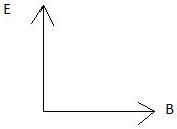
Which of the following is true about electric field () and magnetic field () of electromagnetic waves?
A. and are perpendicular to each other.
B. and differ in phase by .
C. The energy density associated with and energy density associated with are same.
D. and are parallel
Which of the following is true about electric field () and magnetic field () of electromagnetic waves?
A. and are perpendicular to each other.
B. and differ in phase by .
C. The energy density associated with and energy density associated with are same.
D. and are parallel
Solution
In an electromagnetic wave, and are perpendicular to each other and also perpendicular to the direction of propagation (A is true). They oscillate in phase, reaching maxima and zeros together.
The energy density of the electric field is and that of the magnetic field is . Using and :
So the two energy densities are equal (C is true).
Option B: the fields are in phase (phase difference ), not . Students confuse this with the fact that they are at in space, not in time.
Option D: the fields are perpendicular, never parallel.
Related questions:
2026: 19 May Shift 1
2025: 29 May Shift 1
2025: 3 June Shift 2
2025: 2 June Shift 2