
Two infinitely long straight uniformly charged wires of linear charge density and ( ) are placed parallel to each other, r distance apart in air as shown in the figure. The electric field at point P at distance from the first wire will be
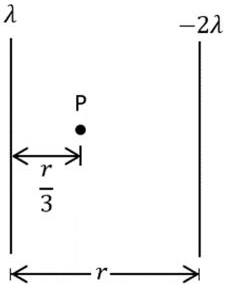
Two infinitely long straight uniformly charged wires of linear charge density and ( ) are placed parallel to each other, r distance apart in air as shown in the figure. The electric field at point P at distance from the first wire will be
Solution
✅ Correct Option: 4
Field of an infinite line charge: , directed away from a positive wire and towards a negative wire. Take pointing from the first wire towards the second.
Wire 1 () is at distance from P, and its field points away from it, so along :
Wire 2 () is at distance from P, and its field points towards it, so also along :
Both fields point the same way, so they add:
Related questions:
2025: 30 May Shift 1