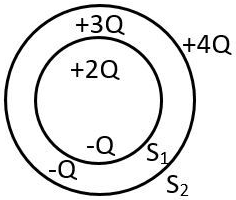
An uniform electric field is given by N/C for and N/C for . A right circular cylinder of length 20 cm and area of cross-section 10 cm has its centre at the origin and its axis along the x–axis so that one face is at x= +10 cm and the other is at x = –10 cm as shown in the figure. The fluxes through the flat faces at x = –10 cm and x= +10 cm , respectively, are_______________ (in SI-units ).
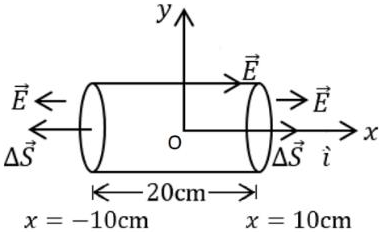
An uniform electric field is given by N/C for and N/C for . A right circular cylinder of length 20 cm and area of cross-section 10 cm has its centre at the origin and its axis along the x–axis so that one face is at x= +10 cm and the other is at x = –10 cm as shown in the figure. The fluxes through the flat faces at x = –10 cm and x= +10 cm , respectively, are_______________ (in SI-units ).
Solution
✅ Correct Option: 4
Flux through a flat face is , where points outward from the closed surface. The area is .
At cm, the field is and the outward area vector is :
At cm, the field is and the outward area vector is :
Related questions:
2025: 2 June Shift 1