
Three point charges (-q), (+q) and (-q) are placed at three corners of an equilateral triangle ABC as shown in the figure below. The net electrostatic force at point A will act:
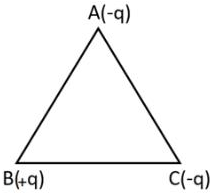
Three point charges (-q), (+q) and (-q) are placed at three corners of an equilateral triangle ABC as shown in the figure below. The net electrostatic force at point A will act:
Solution
✅ Correct Option: 2
Let each side be , so the force magnitude between any two charges is . Take the x-axis along BC (positive to the right) and the y-axis upward.
The force on A from B is attractive (opposite charges), so it points from A towards B. The force on A from C is repulsive (like charges), so it points directly away from C.
| Force on A | Direction | x-component | y-component |
|---|---|---|---|
| From B (attraction) | towards B, below the negative x-axis | ||
| From C (repulsion) | away from C, above the negative x-axis |
The y-components cancel and the x-components add:
The net force has magnitude and acts along the negative x-axis, parallel to BC and pointing from C towards B.
Related questions:
2025: 21 May Shift 2
2025: 13 May Shift 1
2026: 6 June Shift 1
2025: 22 May Shift 1