
In the context of photoelectric effect , three curves (labelled 1, 2 and 3) as shown in figure, represent the variation of photocurrent (I) and collector plate potential (V) for two different materials using different intensities of a monochromatic light. Which of the following curves represent the same material?
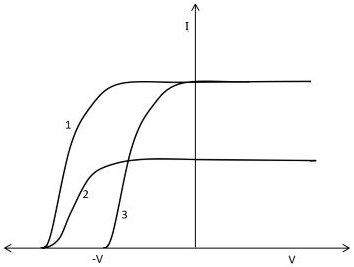
In the context of photoelectric effect , three curves (labelled 1, 2 and 3) as shown in figure, represent the variation of photocurrent (I) and collector plate potential (V) for two different materials using different intensities of a monochromatic light. Which of the following curves represent the same material?
Solution
Stopping potential depends only on the frequency of the light and the work function of the material, not on the intensity. Saturation current depends on intensity.
Curves 1 and 2 cut the voltage axis at the same negative potential, so they have the same stopping potential and therefore the same material. Their saturation currents differ, so they were drawn for different intensities of the same monochromatic light.
Curve 3 has a different stopping potential, , so it belongs to a different material.
Option 1: curves 1 and 3 have the same saturation current (same intensity), but different stopping potentials, so they are different materials.
Option 4: curves 2 and 3 differ in both saturation current and stopping potential, so they are different materials.
Related questions:
2026: 6 June Shift 1
2026: 19 May Shift 2
2026: 15 May Shift 1